The Research Paper I Need Isn’t in English: How to Read It
 Equalang
In brief
A practical workflow for researchers to read academic papers written in Chinese, Japanese, or German without breaking PDF layouts, formulas, or tables.
Keywords: academic paper translation; non-English research papers; PDF layout translation; scientific paper reading; research workflow
In academic research, breakthrough methods and foundational data are not always published in English. You might track a critical citation in robotics or materials science back to a Japanese paper, discover essential experimental results in a German chemistry monograph, or find a recent machine learning architecture documented in a Chinese technical report. When the only available source is a non-English PDF, reading it carefully becomes a major bottleneck.
The Common Pitfalls of Copy-Pasting and Generic Translators
When faced with a foreign-language paper, the instinctive reaction is often to copy paragraphs into a general translation box. In academic PDFs, that immediately falls apart. Copying text from multi-column layouts scrambles sentences across column breaks, drops inline mathematical symbols, and creates fragmented paragraphs that distort technical meaning.
Uploading the entire PDF to a basic file converter or standard document tool is rarely better. Most generic tools strip out embedded vector graphics, corrupt complex tables with merged cells, and drop mathematical notations. When formulas turn into scrambled symbols and data plots are detached from the text explaining them, verifying the author's claims becomes nearly impossible.
Translating Academic PDFs While Preserving Structure
Below is how this works in Equalang Document Translation. While local open-source extractors and browser tools can handle plain text passages, an academic paper requires preserving the structural relationship between text, figures, formulas, and tables.
When you upload an academic PDF, the document translation engine automatically detects the source language. Document translation currently covers Chinese, English, Japanese, Korean, Spanish, French, German, and other languages, allowing researchers to translate non-English source papers directly into English.
Equalang reconstructs multi-column layouts, paragraph hierarchies, footers, headers, and figure captions. Sentences broken by page boundaries are stitched back together before translation to prevent chopped, disjointed phrasing. For technical content, table structures—including merged cells and multi-row headers—are rebuilt rather than flattened, and both display and inline equations are protected from garbling. If an inline formula contains complex formatting, formula optimization can be enabled to keep symbols intact.
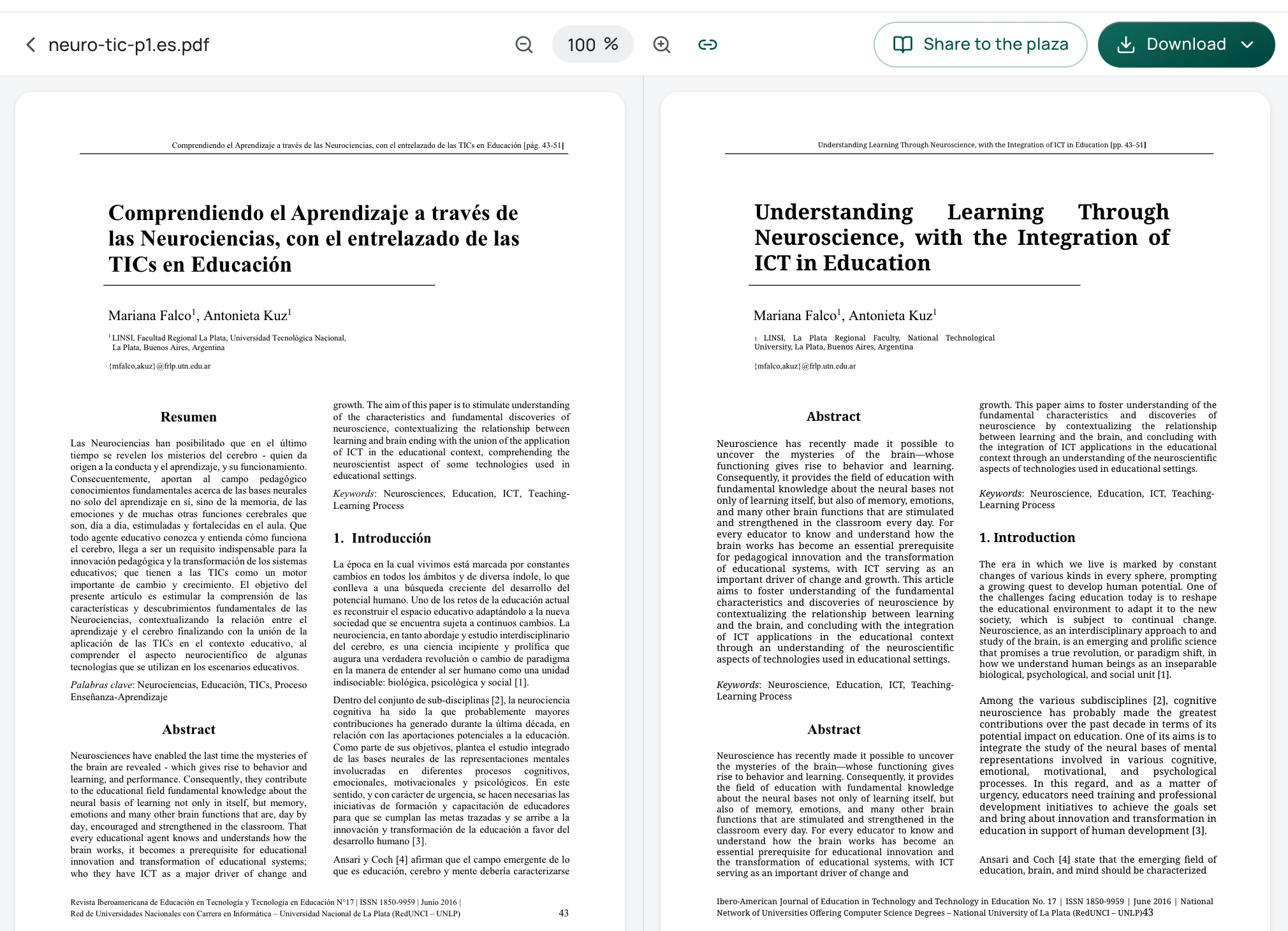
Translation preserves document structure and reading flow, but it does not produce a pixel-identical replica. Because translated text naturally expands or contracts depending on the language, font sizes and line breaks adjust dynamically to accommodate the new wording.
A Rigorous Workflow for Reading Translated Papers
Having a translated PDF is only the starting point. Academic rigor requires an active reading workflow:
-
Skim the translated structure first: Begin by reading the abstract, section headers, and conclusions. Because the diagrams and charts remain in their original positions, you can interpret figures alongside the translated discussions immediately. For broader strategies on reviewing academic literature with modern tools, see our guide on how to read academic papers with translation tools.
-
Verify specialized terminology against the original: Technical fields develop distinct vocabulary across languages. A German engineering term, Japanese chemical designation, or Chinese algorithmic concept may carry nuances that automated systems generalize. In the Equalang translation workspace, you can view the original and translated files side by side with synchronized scrolling. Whenever a key term or methodological step seems critical or ambiguous, check the corresponding phrase in the original column. For more on handling complex disciplinary papers, explore our notes on translating academic paper PDFs.
-
Audit quantitative data in tables and equations: Never rely on translated prose alone for critical constants, benchmarks, or statistical results. Cross-reference every quantitative claim against the numbers in the original tables and charts. Mathematical equations should also be checked against the original notation, especially in algorithm-heavy papers (see our specific overview on translating AI papers and formulas).
-
Cite the primary source correctly: When referencing findings in your own thesis, paper, or literature review, always cite the original publication in its source language with its official DOI, author list, and publication venue. A translation tool assists your understanding, but academic attribution belongs entirely to the original authors and their published work.