Frustrated by Broken Formulas in arXiv Papers? Practical Tools for Reading Academic Literature
 Equalang
In brief
Struggling with broken LaTeX math and split sentences in two-column academic papers? Here is a breakdown of academic translation hurdles and a workflow for preserving layouts with side-by-side reading.
Keywords: arXiv paper translation, academic translation tools, two-column PDF layout preservation, LaTeX formula translation, side-by-side paper reading

Whether tracking the latest arXiv preprints or reviewing accepted papers before a major conference, graduate students and researchers often hit an invisible wall: copying text paragraph by paragraph from a two-column academic PDF into a generic translation box. In an instant, rigorous LaTeX mathematical formulas, superscripts, subscripts, and summation symbols shatter into garbled characters. Hyphenated words split across columns or page breaks get forcibly truncated, resulting in incoherent machine translations. And even when a page is finally translated, figure and table labels drift out of place and mathematical derivations fall apart, draining your mental energy as you constantly switch between windows to verify original coordinates.
The true bottleneck in reading cutting-edge literature is rarely a lack of English vocabulary. Instead, it is the constant disruption to your analytical flow caused by garbled formulas, fractured two-column layouts, and the inability to align translations with the original text.
In this article, we outline key criteria for selecting academic translation tools, compare the strengths and limitations of open-source and mainstream solutions, and demonstrate an efficient workflow that preserves LaTeX formulas and two-column layouts for deep paper reading.
1. Why Academic Papers Are a Tough Challenge for Machine Translation
Standard translation tools—such as browser extension popups or plain text boxes—excel at everyday conversational prose, but they quickly stumble when faced with academic PDFs. This stems from three technical challenges unique to scientific literature:
- Interwoven LaTeX Formulas and Mathematical Notations: Research papers are filled with inline variables (e.g., $\theta_i, \mathbf{W}_Q$), superscripts, subscripts, complex fractions, and standalone tensor equations. Generic machine translation models lack awareness of typesetting syntax trees. They frequently treat mathematical variables as plain English words, translating symbols into random text or tearing apart expressions like the denominator $\sqrt{d_k}$, which completely breaks the mathematical derivation.
- Two-Column Layouts and Physical Page Breaks: At its core, the PDF format consists of static drawing instructions designed for printing; it contains no inherent concept of logical paragraph flow. Two-column layouts cause naive extractors to read horizontally across columns, while long sentences cut off at the bottom of a page get split into isolated halves, leading to severe mistranslations.
- Lost Figure/Table Numbering and Cross-References: Model architecture diagrams (Figures), ablation study tables (Tables), and in-text references to specific equations (such as Equation 3) easily get misplaced or omitted during text extraction, disrupting the author's logical argumentation.
Consequently, a dependable academic translation tool must provide three core capabilities: structured PDF layout parsing, in-place LaTeX formula preservation, and synchronized side-by-side bilingual alignment.
2. Comparing Common Academic Paper Translation Approaches
In daily research, common paper translation methods generally fall into three categories, each with distinct trade-offs:
For scenarios that require formula fidelity, neat formatting, and zero-configuration ease of use out of the box, we will demonstrate the end-to-end workflow below using our own tool, Equalang.
3. A Three-Step Workflow for Side-by-Side Two-Column Paper Reading
To read research literature smoothly, you can compare the original and the generated translation side by side for focused, immersive reading.
Step 1: Parse the Full Document with Formula Protection
Upload the original PDF downloaded from arXiv to the Document Translation page on the Equalang web platform. For papers in computer science, mathematics, or physics that are dense with math notation, the parser automatically identifies and protects inline symbols and standalone equations.
Sentences split across physical page breaks are reassembled into coherent paragraphs at the logical parsing stage before translation, preventing disjointed sentences between consecutive pages.
Step 2: Verify Complex Formulas and Symbolic Notation
Once translation is complete, the generated document retains the original paper's two-column width, section hierarchy, diagrams, and caption alignments.
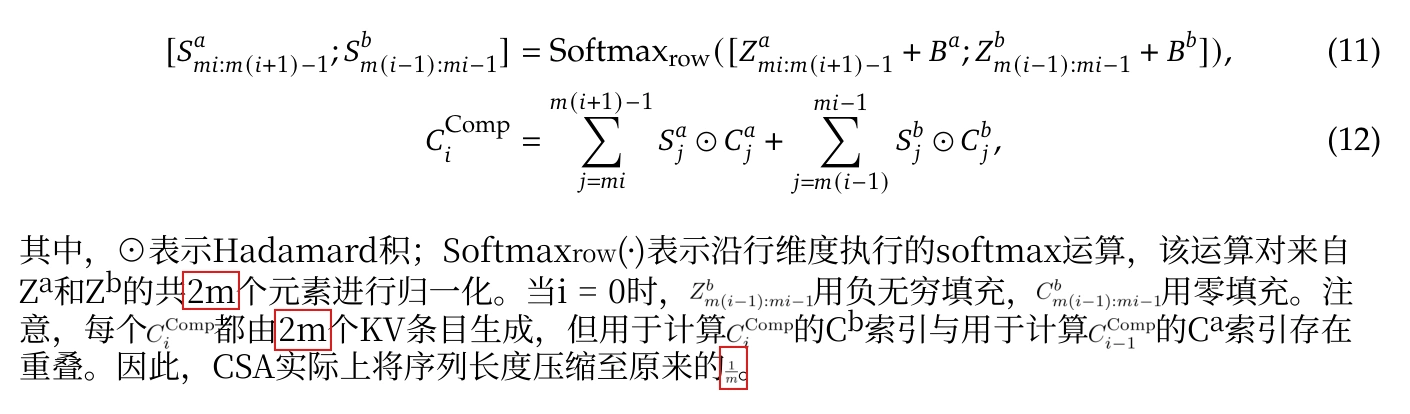
When working through rigorous derivations—such as in the DeepSeek-V4 paper—the image above illustrates the results of formula and translation layout:
- Inline symbols not translated into text: Inline symbols such as 2m and Z^a are not translated into text, although the font size of some inline formulas is noticeably reduced.
- Standalone equations align with equation numbers: CSA formulas (11) and (12) are centered, while equation index numbers on the right margin are clearly preserved, keeping the narrative logic and derivations seamlessly connected.
Step 3: Compare the Original and Translated Documents Side by Side in Two Windows
Open the original English document and the downloaded Chinese translation separately in macOS Preview, Acrobat, PDF Expert, or the Edge browser, and arrange the two windows side by side:
- Open the original English document in the window on the left side of the screen.
- Open the corresponding Chinese translation in the window on the right side of the screen, and navigate to the same page number.
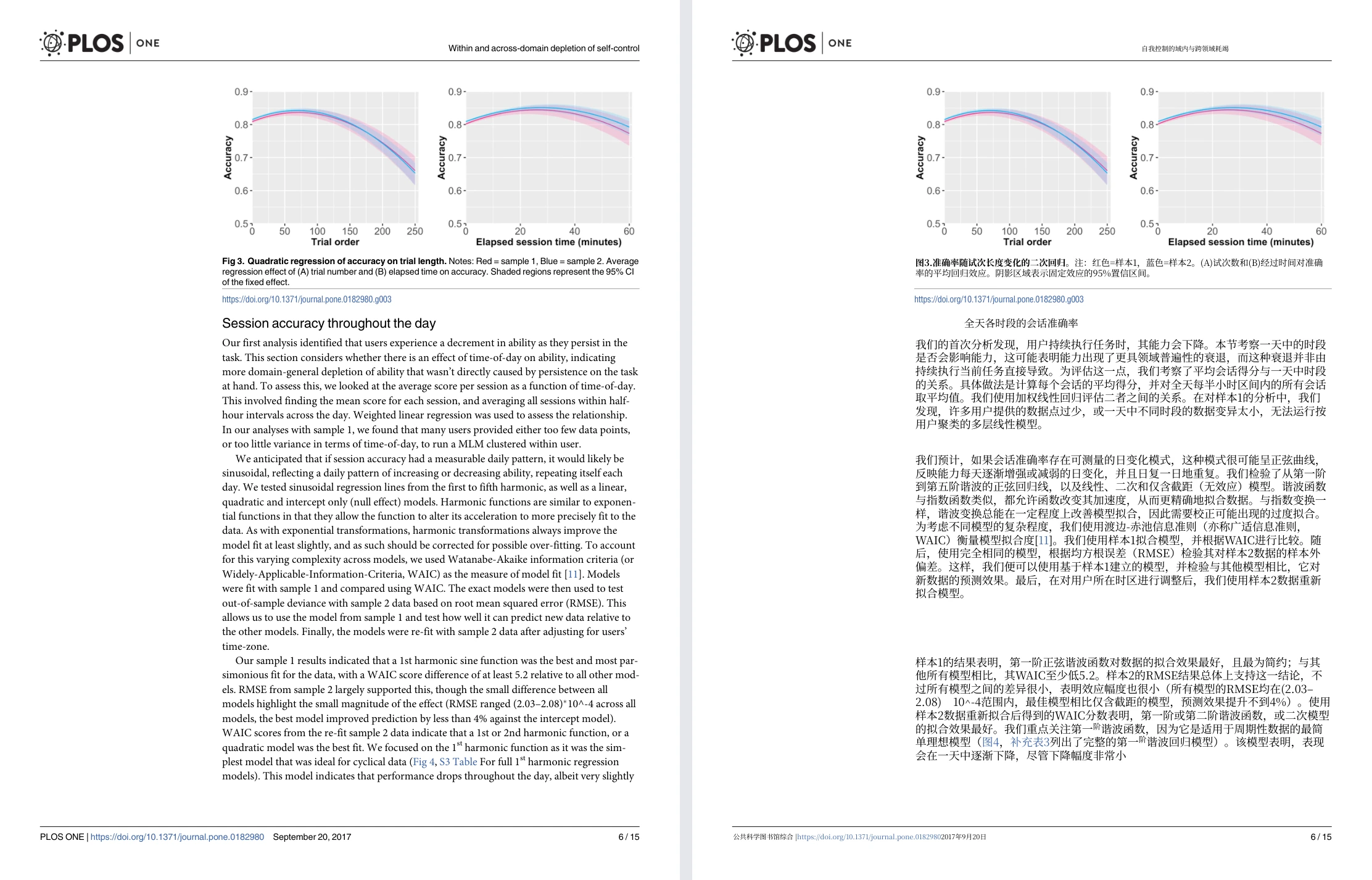
Once configured, the screen presents page $N$ of the original English publication on the left, directly facing page $N$ of the translated document on the right:
- Synchronized reading flow: Readers can skim the translated page on the right to absorb the research questions, empirical findings, and methodological rationale quickly, while effortlessly referencing the original English text on the left to verify formal mathematical formulations or raw statistical figures.
4. Practical Tips and Pitfalls to Avoid in Bilingual Paper Reading
When using automated tools to read academic literature, keeping a few practical guidelines in mind helps ensure both speed and precision:
- Always verify critical claims against the original definition: While translation significantly lowers the barrier to understanding, always refer to the original English text when citing papers, verifying formal proofs, or writing code to reproduce results.
- Distinguish between scanned documents and vector PDFs: Older scanned papers that lack clean OCR may experience degraded layout fidelity. Whenever possible, obtain vector-based original PDFs directly from arXiv, IEEE Xplore, or the ACM Digital Library.
- Keep pseudocode and identifiers in their original form: Function names, variable identifiers, and framework-specific terms (such as PyTorch or TensorFlow primitives) in algorithm blocks are better left in English to avoid confusion during implementation.
Sources & Attribution
- Equalang Document Translation
- arXiv.org Open Access Preprint Repository
- Keshav, S. (2007). How to Read a Paper. ACM SIGCOMM Computer Communication Review, 37(3), 83-84.
- Vaswani, A., et al. (2017). Attention Is All You Need. Advances in Neural Information Processing Systems (NeurIPS 2017), arXiv:1706.03762.
- PDFMathTranslate Open-Source Academic Paper Translation Repository