Is Bilingual Reading Effective for Learning a Language?
 Equalang
In brief
Discover when parallel bilingual reading accelerates language acquisition, when it becomes a crutch, and a practical 4-step routine to read real content.
Keywords: bilingual reading; parallel reading; language learning methods; reading in foreign languages; comprehensible input
You sit down to read an article in a foreign language. Alongside the original text, a full translation in your native language sits line-by-line or paragraph-by-paragraph. At first, the experience feels smooth, almost effortless. You finish three pages in ten minutes without once reaching for a dictionary.
Then a familiar doubt creeps in: did you actually read the foreign language, or did your eyes simply drift to the translation the moment a sentence looked slightly complicated? It is easy to finish a whole article feeling like you understood everything, only to realize you cannot recall a single new phrase or grammatical pattern.
Learners often find themselves trapped between two frustrating extremes. Simplified graded readers offer safety, but their sanitized plots and repetitive sentence structures quickly grow tedious. Authentic news, novels, and industry blogs, on the other hand, often present a wall of unfamiliar vocabulary that turns every paragraph into an exhausting stop-and-go chore. Parallel or bilingual reading looks like the ideal bridge between the two. But is it genuinely effective for language acquisition, or does it just create an illusion of competence?
When Bilingual Reading Works (and When It Fails)
Bilingual reading is neither an automatic shortcut nor a useless crutch. Its effectiveness depends entirely on how the translation is used and the difficulty of the underlying material.
Parallel reading genuinely helps in two scenarios:
- Bridging the vocabulary gap without breaking momentum. When you encounter a passage where you know roughly 70% to 80% of the words, an adjacent translation keeps you moving. You grasp the narrative flow and deduce context without interrupting your train of thought every ten seconds.
- Validating sentence structure. When a foreign sentence has complicated syntax—such as split clauses, inverted word order, or unfamiliar idioms—glancing at a translation helps you check whether your mental breakdown of the sentence was accurate.
However, bilingual reading actively works against you when:
- The text is far beyond your current level. If nine out of ten words in a sentence are unfamiliar, your brain naturally takes the path of least cognitive resistance. Instead of deciphering the target language, you read your native tongue and scan the original as background decoration. That is not reading practice; it is reading a translation with foreign subtitles.
- You read the translation first. Looking at the translation before attempting to parse the foreign sentence eliminates all cognitive effort. Without the effort of attempting to decode meaning, your brain does not form durable memory traces.
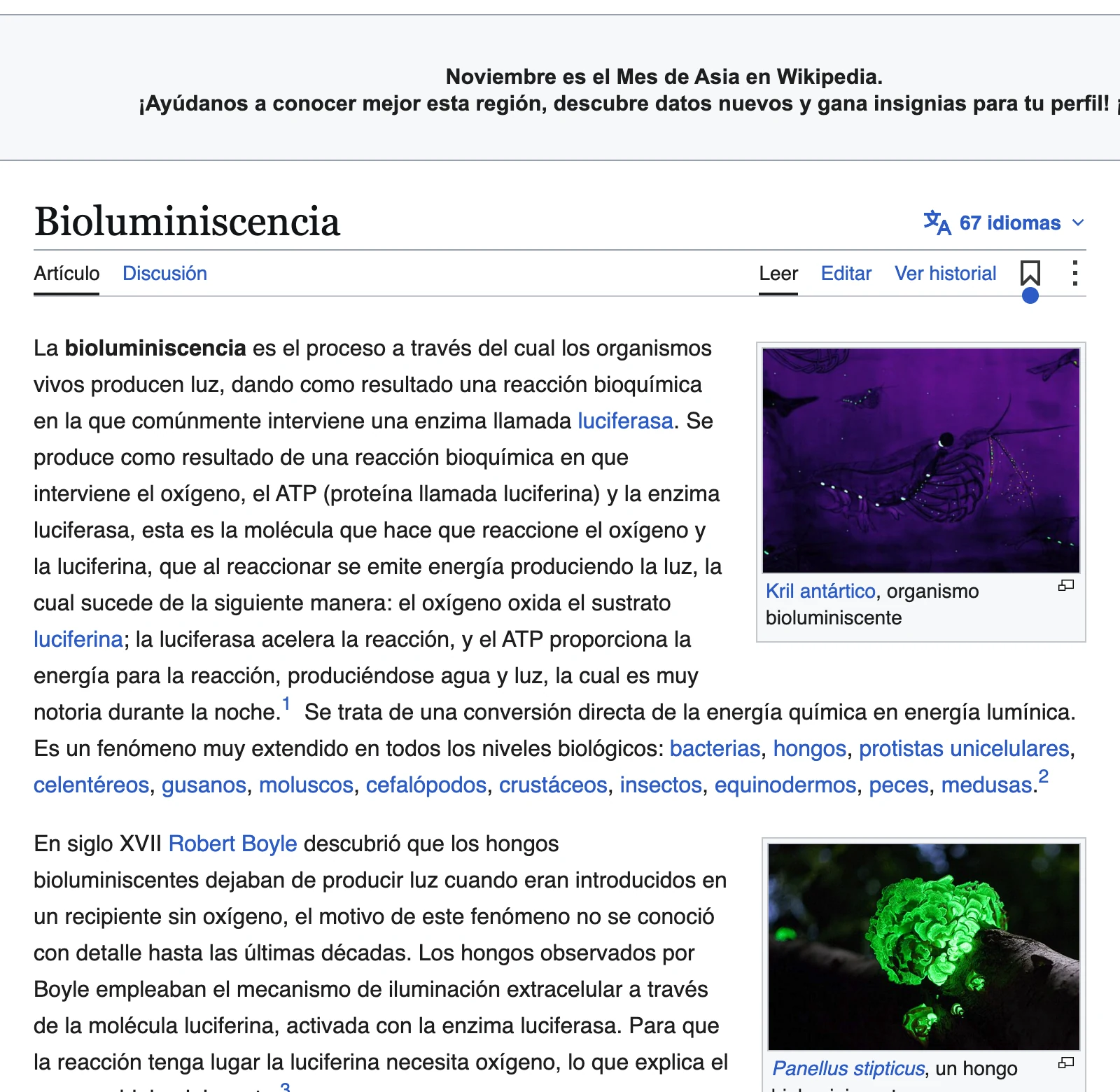
If tackling an authentic page like the Spanish article above feels daunting on its own, the solution is not to surrender to a passive translated read, but to establish a deliberate reading rhythm.
A Practical 4-Step Routine to Avoid Self-Deception
To turn bilingual reading into an active learning tool rather than a passive crutch, you need a disciplined sequence. Instead of letting your eyes wander freely back and forth, follow this four-step routine on each paragraph:
- Read the original paragraph first. Keep your attention strictly on the target language. Read the entire paragraph from start to finish without looking at any translation. Try to piece together the core idea, even if several terms are unfamiliar.
- Check the translation to verify your comprehension. Once you have made an honest attempt, look at the translation. Did you grasp the main point? Did you misinterpret who did what, or did a conjunction twist the meaning in a way you missed? The translation serves here as an answer key, not a substitute.
- Inspect the exact words that blocked you. If a specific term prevented you from understanding the sentence, examine that individual word in its sentence context. Figure out its function and meaning before moving on.
- Reread the original paragraph with clean eyes. Look back at the original text one more time. Now that the meaning is clear, read the foreign sentences smoothly from beginning to end. This final step is where acquisition actually happens: your mind connects the target-language words directly to their concepts without mental translation.
Putting the Method into Practice
You can implement this routine using traditional print materials—such as facing-page bilingual books where you cover the translated page with an index card—or by opening two browser windows side by side.
For everyday digital reading, the Equalang extension supports this exact workflow directly on the web pages you read.
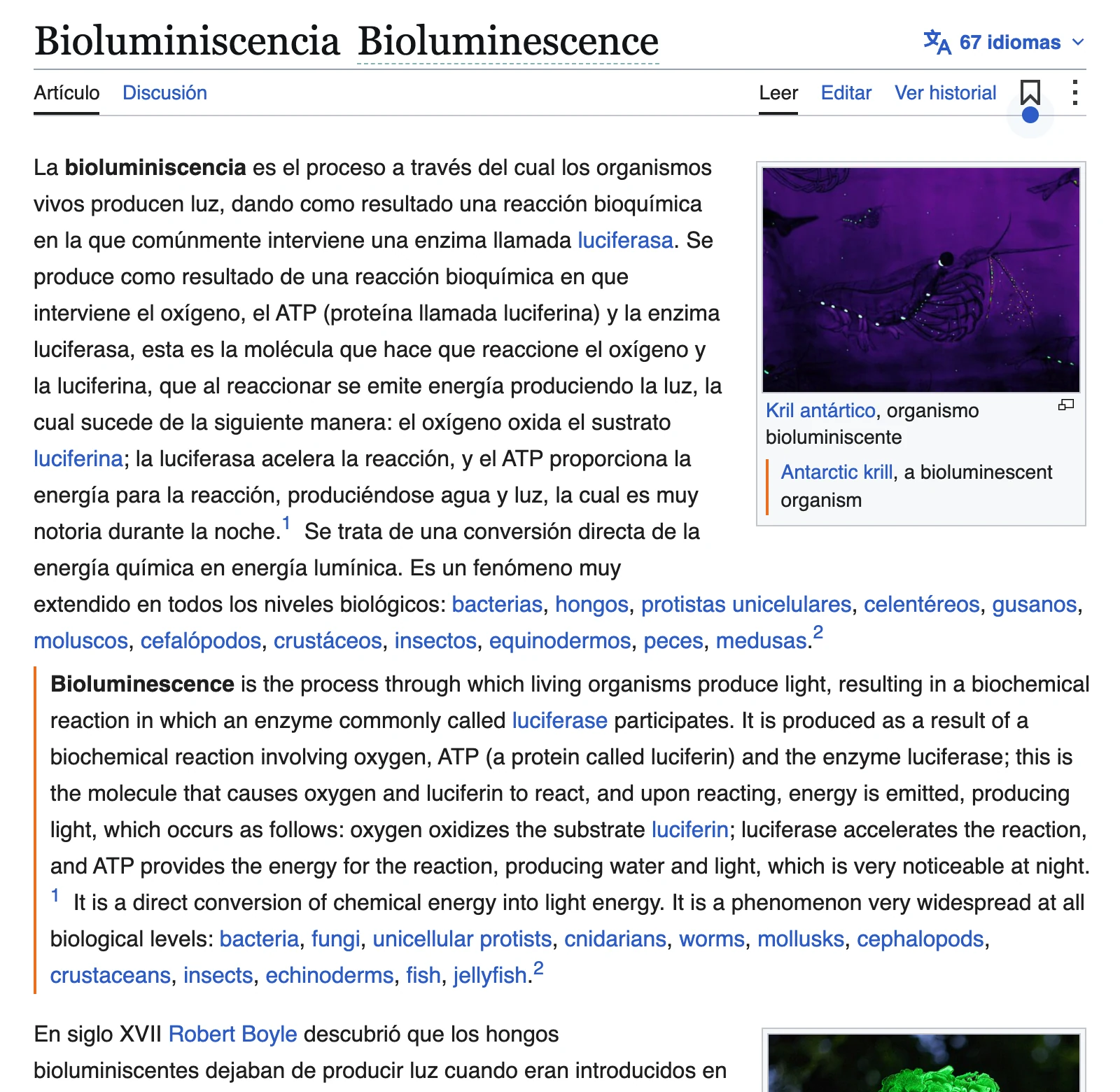
When activated, Equalang displays a paragraph-by-paragraph translation directly underneath the corresponding original text, preserving original hyperlinks. This format allows you to read the original paragraph at the top, glance down to verify your interpretation, and continue scrolling smoothly.
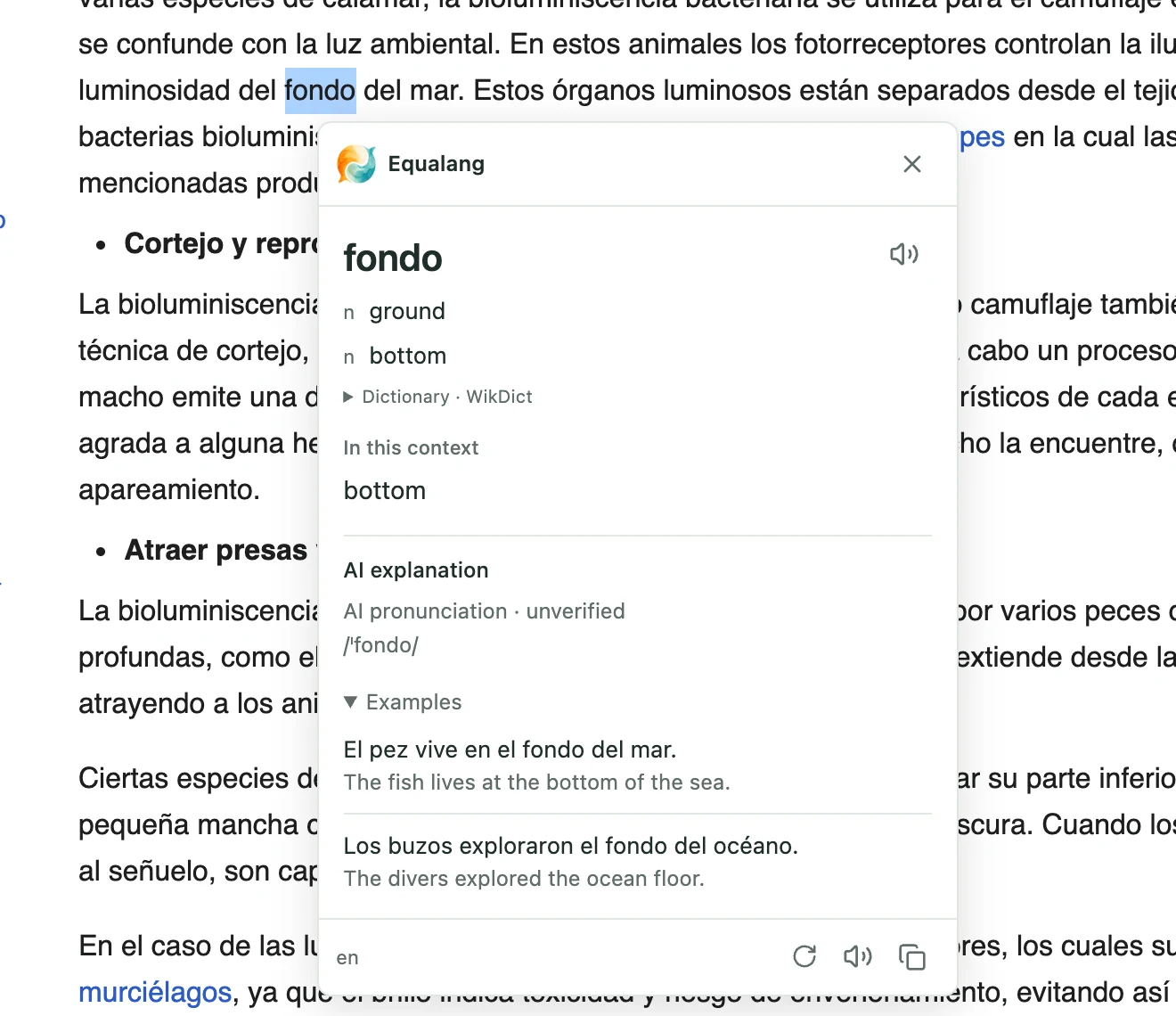
For the third step of the routine—inspecting specific stumbling blocks—you can enable selection translation within the extension. Highlighting an unfamiliar term, such as fondo in the Spanish example above, and clicking the translation icon opens a compact pop-up with dictionary definitions, contextual translation, pronunciation, bilingual example sentences, retry, and copy controls. This allows you to resolve the specific blocker without losing your place on the page.
If you are exploring different types of content, you can apply this approach whether you read foreign websites bilingually, practice with bilingual immersion in literature, or follow international industry updates with bilingual tech news.
An Honest Assessment of Limits
Bilingual reading is a powerful transitional tool, but it is important to be clear about what it cannot do.
It cannot replace foundational grammar study. If you do not understand how relative clauses or past tenses work in your target language, seeing a translation will tell you what the sentence means, but not why it is constructed that way. Furthermore, parallel reading does not automatically build an active vocabulary for speaking or writing. Seeing a word translated and recognized in context is passive recognition; transferring it into your active recall requires deliberate practice and output over time.
Used passively, parallel text is little more than a comfort blanket. But when used as a structured verification tool—reading the original first, verifying with the translation, resolving specific words, and rereading clean—bilingual reading provides the exact scaffold needed to transition from textbook exercises to real-world fluency.