Ready to Give Up After Two Pages? Read Original Books with Paragraph-by-Paragraph Bilingual Immersion
 Equalang
In brief
Struggling with dense vocabulary and broken narrative flow in original books? Move past tedious dictionary lookups and flat machine translations with paragraph-by-paragraph bilingual reading.
Keywords: bilingual reading, paragraph-by-paragraph translation, EPUB bilingual reader, immersive language learning, reading original books, browser bilingual extension

Most avid readers have saved a few long-coveted original books on their phone or e-reader—perhaps an acclaimed business bestseller, an in-depth tech monograph, or a beautifully written literary classic.
Yet for anyone tackling a book in a second language, the experience often hits the same frustrating roadblock: you breeze through the preface, open Chapter 1, and are immediately hit with a wall of unfamiliar adjectives, colloquial idioms, and intricate relative clauses. Stopping three times in a single sentence to look up words in a dictionary shatters your reading flow and emotional immersion. Within ten minutes, cognitive fatigue sets in. On the other hand, turning to a flat machine translation or a translated summary might get you to the final page, but you lose the author's authentic cadence, nuance, and word choice—gaining none of the linguistic intuition that makes reading original works worthwhile.
What reading in an original language truly requires is not a crutch that replaces your thinking, but a bilingual scaffold that stays quietly in the background—keeping the original text as the primary focus on top, with the translated text anchored directly beneath each paragraph. As your eyes scan the original, you read naturally as long as the meaning is clear. The moment you hit an unfamiliar term or convoluted sentence, a subtle glance downward reveals the complete meaning in your native language, letting you instantly return to the original text without missing a beat.
1. Why Constant Dictionary Lookups and Flat Machine Translations Both Fail
The two conventional extremes of reading foreign books often discourage even the most motivated readers:
- Fragmented attention from constant lookups: Stopping every few lines to highlight a word and open a dictionary repeatedly derails your working memory. By the time you parse three unfamiliar terms, you have lost the macro-level argument or narrative foreshadowing of the entire passage. What should be an immersive story turns into mechanical vocabulary drilling.
- Losing linguistic context with full-text translation: Replacing the entire text with a localized translation causes the eye to instinctively rely on your primary language. You bypass the author’s vivid collocations, subtle metaphors, and authentic syntactic structures, sacrificing the core benefit of reading the original work in the first place.
Second language acquisition research—notably Stephen Krashen’s Comprehensible Input Hypothesis (the "i + 1" principle)—demonstrates that language acquisition thrives when learners encounter material just slightly above their current proficiency level, supported by immediately accessible semantic scaffolding. That is precisely why paragraph-by-paragraph bilingual reading keeps readers engaged rather than exhausted.
2. The Foundation of Immersive Reading: Paragraph-Level Bilingual Alignment
To deliver a frictionless, immersive reading experience, a tool must meet three key structural requirements:
- Vertical paragraph-level anchoring: Rather than isolating translations in a separate window or forcing awkward horizontal eye sweeps across split columns, the translated text expands directly beneath the source paragraph, preserving a natural top-to-bottom reading trajectory.
- Preserved structural formatting and hyperlinks: Heading hierarchies, blockquotes, inline illustrations, and cross-chapter table of contents indices remain intact, maintaining the original book's typographical integrity.
- Support across formats and platforms: The workflow seamlessly accommodates online essays, long-form journalism, Medium essays, and Substack newsletters in the browser, while also processing local
.epubdigital books.
3. A Three-Step Workflow for Frictionless Bilingual Reading with Equalang
To help avid readers absorb complex ideas without losing authentic phrasing, our team at Equalang built a complete bilingual reading system across the Equalang browser extension and Equalang Document Translation.
Here is how you can set up a smooth reading workflow based on your reading material:
Step 1: Online Essays and Web-Based Classics: Enable Bilingual Mode in Your Browser
When reading digital literary libraries (such as Project Gutenberg), academic blogs, or long-form essays, open the page in any desktop browser running the Equalang extension.
Open the extension popup, choose your target language (e.g., Simplified Chinese in this test), and select the Bilingual display mode. As you scroll through the article, the translated text renders cleanly underneath each original paragraph:
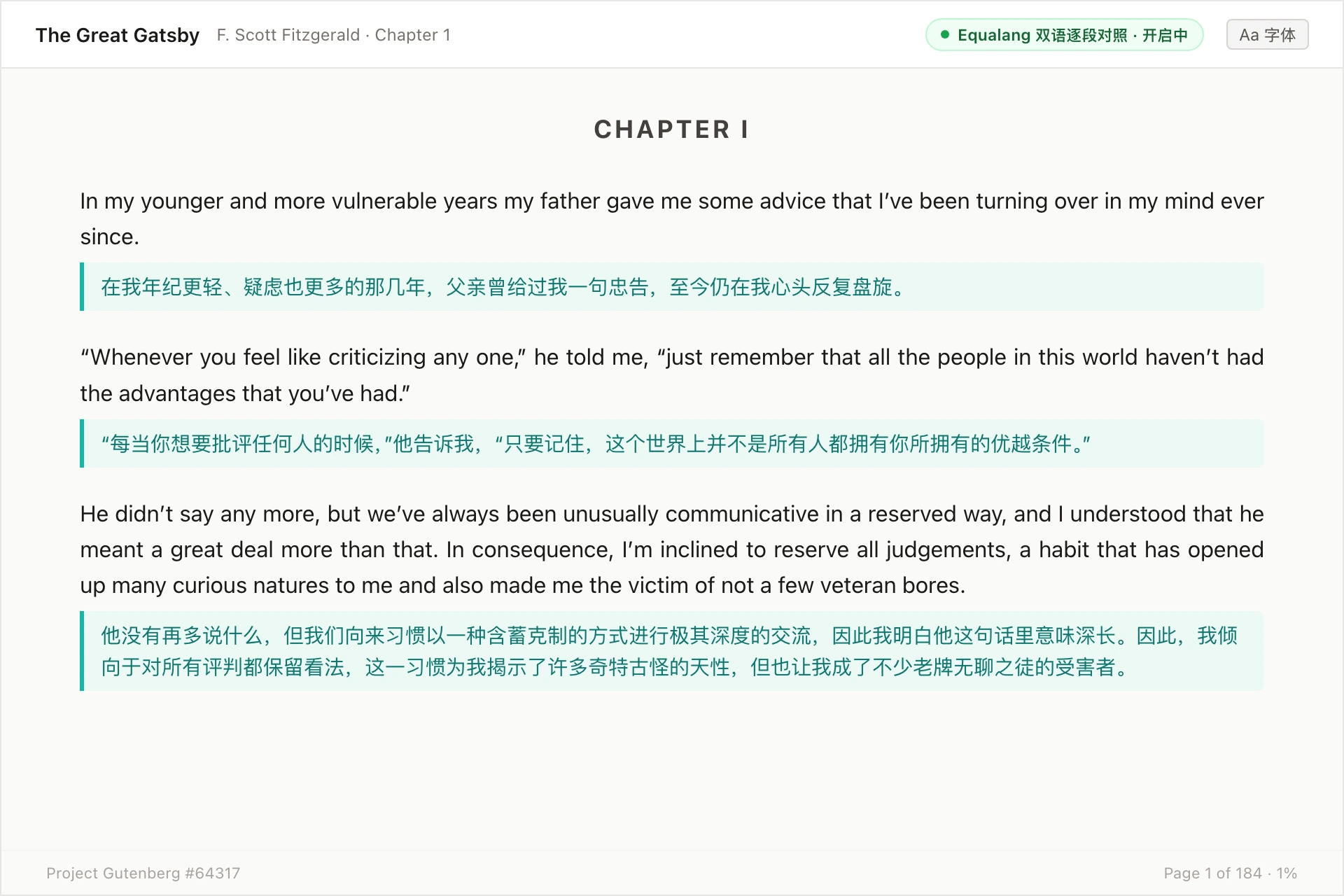
As shown in the illustrative diagram above, when reading Chapter 1 of The Great Gatsby on Project Gutenberg, each original English paragraph is followed by its corresponding Chinese translation. Your focus stays on the original English text above; if you encounter an unfamiliar idiom or term, a quick glance at the line below clarifies the context immediately. You avoid the friction of copying text back and forth to an external dictionary, while bypassing the disjointed prose of full-page machine replacements.
Step 2: Local EPUB eBooks: Generate a Chinese Reference Translation with One Click
If you are working with a standalone .epub ebook, navigate to Equalang Document Translation on your desktop and drag the EPUB file into the upload zone.
The document engine parses the book's structural hierarchy, translating the text while preserving chapter navigation, inline images, and footnote links to produce a cleanly formatted reference translation. You can place the original and translated editions side by side on a computer screen, or export the resulting translation directly to your e-reader for on-the-go reading.
Step 3: Follow Your Reading Flow and Absorb Phrasing in Context
With bilingual alignment acting as a safety net, you can set aside the burden of constant dictionary lookups.
When you encounter an unfamiliar phrasal verb or idiomatic expression, the translation directly underneath provides instant clarity. You can then highlight the original phrasing in the sentence above. Vocabulary stops being an isolated flashcard memorized out of context; instead, it is anchored to the vivid narrative of the book and retained naturally by your brain.
4. Three Practical Strategies to Maximize Your Bilingual Reading Gains
Once you have established a bilingual reading setup, pairing it with these three strategies will help you get the most out of your reading:
- Prioritize high-interest genres first: For your first few original titles, steer clear of dense, abstract philosophical treatises. Choose compelling fiction with strong momentum, engaging memoirs, or structured business and technology books where narrative curiosity pulls you forward.
- Embrace ambiguity and focus on the narrative arc: Descriptive flourishes that do not affect the central plot—such as specific botanical names, architectural ornamentation, or historical attire—do not require obsessive memorization. Glance at the translation to register the general meaning and keep moving. Maintaining momentum is the single most critical factor in finishing a book.
- Pause on brilliant phrasing to study the original line: When an insightful argument or striking metaphor stops you in your tracks, look back at the original sentence above. Notice the precise verbs, concise syntax, or understated rhythm the author used, and note the phrasing in your personal reference collection.
You no longer have to abandon books due to vocabulary fatigue, nor do you have to settle for flat translations that strip away authorial voice. With paragraph-level bilingual alignment, you can enjoy the intellectual depth of original literature while effortlessly building genuine linguistic intuition.
Sources
- Equalang Browser Extension Installation Guide
- Equalang Document & eBook Translation Portal
- Krashen, S. Principles and Practice in Second Language Acquisition (Pergamon Press): http://www.sdkrashen.com/
- Project Gutenberg: Free eBooks Library