Why Don’t Subtitles Match What the Actors Are Saying?
 Equalang
In brief
Wondering why subtitles feel shortened or rewritten? Discover how reading speed, scripts, and localization shape subtitles—and how to spot real errors.
Keywords: subtitle translation; reading speed limits; subtitle vs audio; anime subtitles; drama localization
You are watching an anime, a K-drama, or a C-drama. You have started picking up words from the language—a familiar greeting, an emotional exclamation, or a casual honorific. The actor delivers a passionate three-sentence monologue, but the subtitle at the bottom flashes just three words: "Let it go." Or the character keeps speaking for another two seconds after the text vanishes from the screen.
It is easy to wonder if the translator got lazy, if lines were carelessly cut, or if the translation is simply wrong. But the gap between what you hear and what you read is almost never an accident. Subtitling is not a direct transcript of spoken dialogue; it is a specialized discipline governed by strict reading speeds, timing rules, and production realities.
The Human Eye Reads Slower Than the Tongue Speaks
The primary reason subtitles differ from spoken dialogue comes down to human biology. In everyday conversation, people speak at an average rate of 140 to 180 words per minute, and rapid banter or heated arguments can exceed 200 words per minute. Reading, however, requires visual attention—especially when a viewer also needs to watch actors' facial expressions, track action scenes, and absorb visual storytelling.
If subtitlers transcribed every spoken word, the text would either crowd the bottom half of the screen or flash by so quickly that viewers would spend the entire episode reading text rather than watching the show.
To keep viewing comfortable, major entertainment industry standards enforce strict reading-speed thresholds. For example, the Netflix Timed Text Style Guide sets reading-speed limits for adult content at roughly 20 characters per second and restricts lines to a maximum of 42 characters across no more than two lines. When an actor speaks faster than those limits allow, the subtitler must condense the sentence, trimming filler words and subordinate clauses while preserving the core meaning and emotional weight.
Subtitles Often Come from Scripts, Not the Final Audio
Viewers often assume that subtitlers sit with headphones on, listening to the final recorded episode and translating line by line. In modern post-production pipelines, that is rarely how it happens.
Translators are typically provided with written dialogue lists, pre-production scripts, or timed master templates well before final audio mixing is completed. During filming or voice recording, actors frequently ad-lib, adjust phrasing to fit lip flaps, or reword sentences to sound more natural on camera. If those on-set changes are not back-ported into the master dialogue list, the subtitler ends up translating the line as written in the script rather than the line as delivered on set.
In other cases, international distributors translate content via an intermediate language—such as translating Japanese or Korean into English first, and then using that English text to produce subtitles for French, Spanish, or German. Each translation step introduces slight rewording, gradually widening the distance from the original spoken performance.
Localization: Choosing Between Accuracy and Comprehensibility
Cultural context creates another major split between spoken words and on-screen text. In East Asian languages, social relationships are deeply embedded in language through honorifics and kinship titles: Japanese terms like senpai or onii-chan, Korean titles like hyung or oppa, and Chinese forms of address like shifu or gege.
English lacks direct grammatical equivalents for many of these relationships. Translators face a dilemma:
- Keeping the term literally can confuse general viewers who are unfamiliar with East Asian cultural hierarchies.
- Explaining the term in text ("my respected senior colleague") takes up too much screen space and exceeds line limits.
- Replacing it with a generic English equivalent ("boss", "bro", or simply the character's first name) makes the sentence instantly readable, but strips away the cultural nuance.
Wordplay presents a similar hurdle. When a comedic scene hinges on Japanese homophones or Chinese tonal puns, a literal translation falls completely flat. Localizers usually replace the original pun with an English joke that delivers a similar comedic beat in the same amount of screen time, even if the literal words are completely different.
How to Spot Condensing vs. Actual Translation Errors
Because condensing is a normal part of subtitling, how can you tell when a subtitle is an intelligent adaptation and when it is an outright mistake?
Legitimate condensing usually:
- Drops conversational fillers, hesitation noises, and repetitions (such as turning "Wait, wait, wait, hold on!" into "Wait!").
- Simplifies sentence structures while keeping the speaker's core intent, emotional tone, and factual outcome intact.
- Omits honorifics when the relationship between the characters is already visually obvious from the scene.
An actual mistranslation, on the other hand:
- Flips polarity (turning a negative statement into an affirmative one, such as translating "I didn't do that" as "I did that").
- Changes factual details crucial to the plot, such as times, names, numbers, or key terminology.
- Misinterprets idioms literally, producing awkward or nonsensical English.
- Clashes sharply with the tone of the scene—for instance, turning delicate vulnerability into aggressive sarcasm.
A Practical Habit: Comparing Original and Translated Subtitles
If you are learning a language or simply want to catch nuances that the official subtitles trim away, relying on a single translated subtitle line will always leave gaps.
A practical habit is to display both the original-language subtitle and your preferred translation simultaneously. Seeing the original text shows you the exact words the actor spoke in their native language, while the translation line shows you how the translator handled the time limits and cultural adaptation.
The Equalang browser extension is designed around this side-by-side approach. When you watch video on supported streaming platforms, it can display the original subtitle track and an AI translation directly underneath it, giving you both the verbatim native line and a readable translation on screen at the same time. If you frequently stream across different regions, you can also consult our guides on watching foreign dramas with subtitles and navigating Chinese video platforms like Bilibili.
Below is an example of bilingual subtitles in action, captured from episode 1 of the anime Kamigami no Ki on its official YouTube channel:
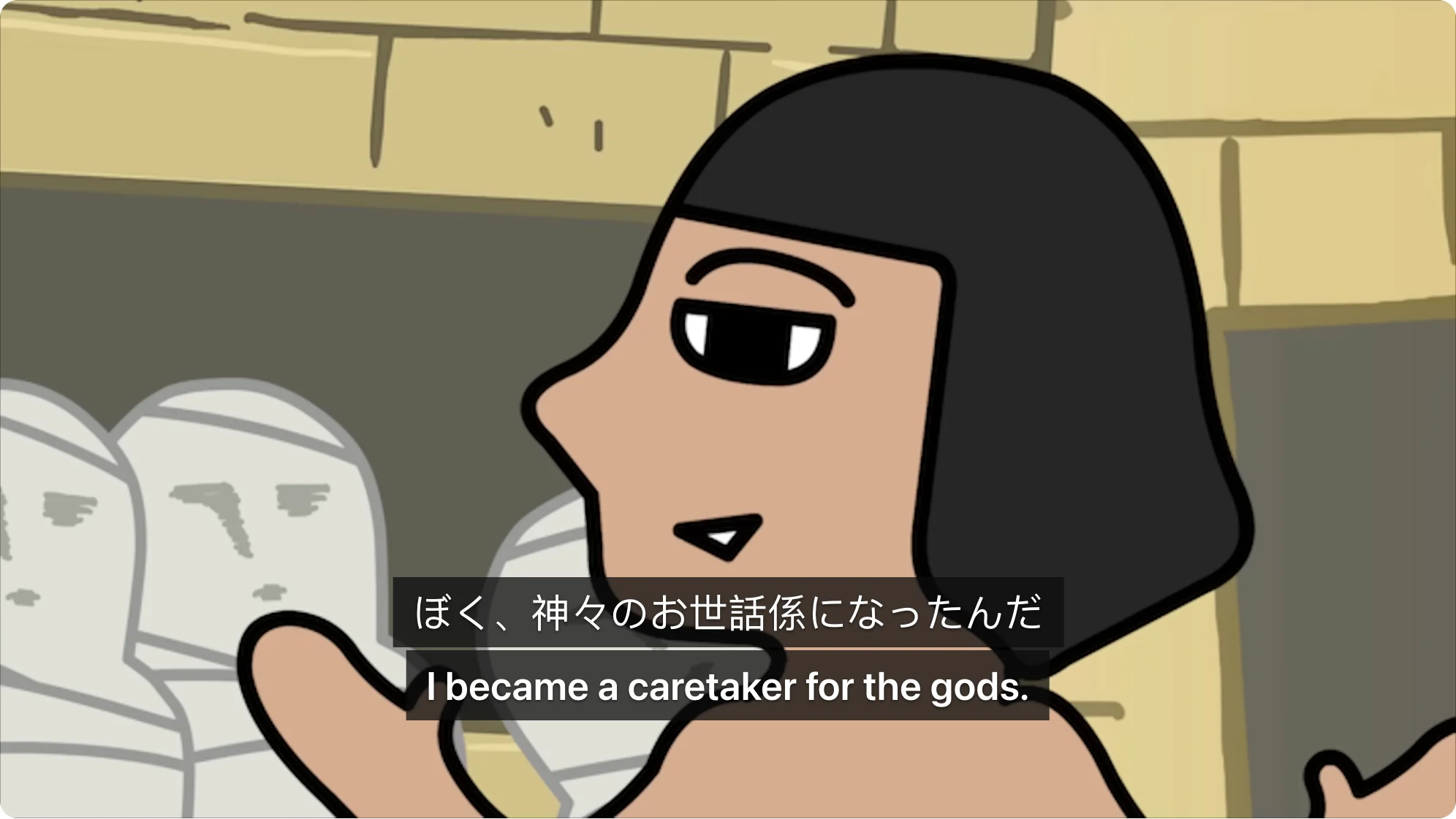
When you see both lines together, the mystery disappears. You stop wondering whether the translator missed something, and you start seeing the thoughtful balance between preserving dialogue and keeping the story effortless to watch.
Sources
- Netflix Studios. "Timed Text Style Guide: General Requirements." Netflix Partner Help.