
OpenStax vs LibreTexts: Free College Textbooks & Bilingual PDFs
In brief
Compare OpenStax, LibreTexts, and DOAB for free legal college textbooks, plus how to read and share CC BY bilingual PDFs on Equalang Plaza at 1/10 cost.
Keywords: openstax vs libretexts and free open textbooks; libretexts vs openstax; openstax alternatives; free college textbooks pdf; doab open access books
If you are comparing OpenStax vs LibreTexts and free open textbooks, choose OpenStax for cohesive, peer-reviewed introductory college and AP textbooks under a uniform CC BY 4.0 license, LibreTexts for upper-division STEM and humanities courses remixed across 15+ subject libraries, and the Directory of Open Access Books (DOAB) for peer-reviewed university press monographs. When you need to study those English textbooks in another language without paying to translate a 400-page volume alone, pair them with Equalang Plaza and Equalang Document Translation to sample side-by-side translations for free, download existing editions for 1/10 of standard translation credits, or share your own CC BY chapter translations to earn back your translation credits as classmates download them.
Quick Comparison: OpenStax vs. LibreTexts vs. DOAB vs. Equalang Plaza
OpenStax vs. LibreTexts: How Their Catalogs, Quality Control, and Licenses Differ
Both OpenStax and LibreTexts eliminate commercial textbook costs, but they are built on fundamentally different publishing models. Knowing how each repository curates and licenses its chapters determines both which file you should download for class and whether you can legally translate and redistribute it.
1. OpenStax: Cohesive Introductory Textbooks Under Uniform CC BY 4.0
Based at Rice University, OpenStax works like a traditional academic publisher that releases its output for free. Its catalog of roughly 70+ titles focuses heavily on high-enrollment introductory college and AP courses—Calculus, University Physics, Biology, Chemistry, Principles of Economics, Psychology, and Introductory Statistics.
- Editorial consistency: Every OpenStax volume is written and peer-reviewed as a single, unified textbook. Notation, chapter summaries, figure numbering, and end-of-chapter problem sets stay consistent from Chapter 1 to the appendix.
- Translation-friendly licensing: Almost every OpenStax book carries a Creative Commons Attribution (
CC BY 4.0) license. While OpenStax officially publishes Spanish and Polish editions for a subset of its catalog, theCC BY 4.0license explicitly allows anyone to translate the English PDFs into Chinese, Japanese, Korean, French, Arabic, or any other language—and even share those adaptations on commercial or community platforms—as long as proper attribution is given.
2. LibreTexts: Massive Modular Breadth Across 15+ Subject Libraries
Where OpenStax goes deep on core freshman surveys, LibreTexts goes wide. Operating as a collaborative open educational resource (OER) wiki network across 15+ subject libraries (ranging from Chemistry, Engineering, and Mathematics to Humanities, Social Sciences, and Workforce training), LibreTexts hosts thousands of course books built and remixed by university faculty.
- Upper-division coverage: If you are searching for OpenStax alternatives because OpenStax stops after General Chemistry or Calculus III, LibreTexts likely has what you need: Physical Chemistry, Quantum Mechanics, Differential Equations, Organic Chemistry lab manuals, and niche upper-level electives.
- Mixed chapter licenses (check the footer first!): Because professors remix LibreTexts books from multiple OER sources, licensing is not uniform across the site. One module may be
CC BY 4.0, while the very next chapter isCC BY-NC-SA(NonCommercial-ShareAlike) or carries another restriction. Before you redistribute or share a translated LibreTexts chapter publicly, scroll to the chapter footer to verify the exact license attached to that page.
3. DOAB (Directory of Open Access Books): Peer-Reviewed University Press Monographs
When your syllabus moves beyond undergraduate textbooks into scholarly monographs, neither OpenStax nor LibreTexts is designed to replace university press books. Jointly operated by OAPEN and OpenEdition, the Directory of Open Access Books (DOAB) indexes tens of thousands of peer-reviewed academic books from university and scholarly presses worldwide. Crucially for international readers, DOAB lets you filter search results directly by Creative Commons license, making it easy to isolate CC BY and CC BY-SA monographs that permit translation and sharing.
The International Student Bottleneck: Reading 400-Page English STEM PDFs Alone
Downloading a free college textbook PDF solves the bookstore bill, but for international students, researchers, and ESL learners, the language barrier remains. Reading dense English derivations in thermodynamics, macroeconomics, or cognitive psychology in a second language takes twice as long—and misreading a single conditional clause in a theorem can derail an entire problem set.
Until recently, students had two flawed workarounds:
- Copy-pasting paragraphs into a chat box: This strips away two-column layouts, breaks cross-references, and turns inline equations into unreadable fragments.
- Paying to translate a whole 400-page textbook PDF alone: Running a full-file document translator preserves the layout, but translating an entire textbook from scratch on a single account consumes full token credits for a file that dozens of other students in the same course are also trying to read.
How to Read and Share CC BY Textbooks and Chapters at 1/10 Cost on Equalang Plaza
We built Equalang Plaza alongside Equalang Document Translation so students and researchers do not have to pay full translation costs for the same public-domain or open-access works over and over again.
Step 1: Search Equalang Plaza First for Existing Bilingual Editions
Before uploading any textbook or paper from your computer, search Equalang Plaza by title, author, or DOI in any language, and filter by All / Books / Papers and your target language.
- What is already inside: The Plaza hosts
75,000+public-domain books (from sources such as Wikisource, Aozora Bunko, and Standard Ebooks—including foundational STEM classics like Silvanus P. Thompson's Calculus Made Easy) and24,000+open-access papers and works underCC BY,CC BY-SA, orCC0licenses (sourced from OpenAlex, PubMed Central, arXiv, and user contributions). - Free originals and 20% side-by-side preview: Once signed in, you can read and download the original source work for 0 credits, and preview the first 20% of any available translation for free in a side-by-side view with synchronized scrolling.
- 1/10-credit full downloads: Downloading a complete translation from the Plaza costs just 1/10 of the standard translation credits (rounded up and displayed clearly on the page; for example, downloading the Chinese AI translation of the OpenAlex open-access paper 3D Gaussian Splatting for Real-Time Radiance Field Rendering costs 24 credits). Downloads keep the original file format (EPUB outputs EPUB), and every PDF purchase includes both the layout-preserved translation PDF and a page-by-page alternating bilingual PDF that displays source on the left and translation on the right when opened in two-page view in your local PDF reader (see our guide on how to translate and read PDF documents side by side).
- Automatic duplicate check: Even if you go straight to Document Translation to upload a file, Equalang checks whether a translation in your target language already exists on the Plaza and prompts you to preview or download it there at 1/10 cost instead of paying to re-translate it.
Step 2: Translate a CC BY Chapter in Document Translation (With Formulas Intact)
Not every OpenStax, LibreTexts, or DOAB title has already been pre-translated into every language on Equalang Plaza today. If a work is already indexed in the Plaza without your target language, you can click Translate now directly from the Plaza source file or click Request this translation so high-demand works get prioritized.
If you are studying a specific CC BY 4.0 OpenStax textbook chapter or a CC BY DOAB monograph that is not on the Plaza yet, upload the PDF or EPUB to Document Translation (currently covering Chinese, English, Japanese, Korean, Spanish, French and other languages):
- Structure and equation preservation: PDF translation preserves two-column layouts, headers, footers, figure captions, clickable tables of contents, and internal cross-reference links, while rejoining sentences split across page breaks before translating. Merged table cells, multi-row headers, standalone equations, and inline math stay structured rather than turning into garbled characters; for dense inline math in physics or calculus chapters, you can toggle on the PDF formula optimization option (see how formula preservation works on technical PDFs).
- Keep names and terms consistent: In the translation settings for EPUB and PDF files, you can optionally toggle on Keep names and terms consistent (4 additional credits per 1,000 tokens, off by default) for long-form books.
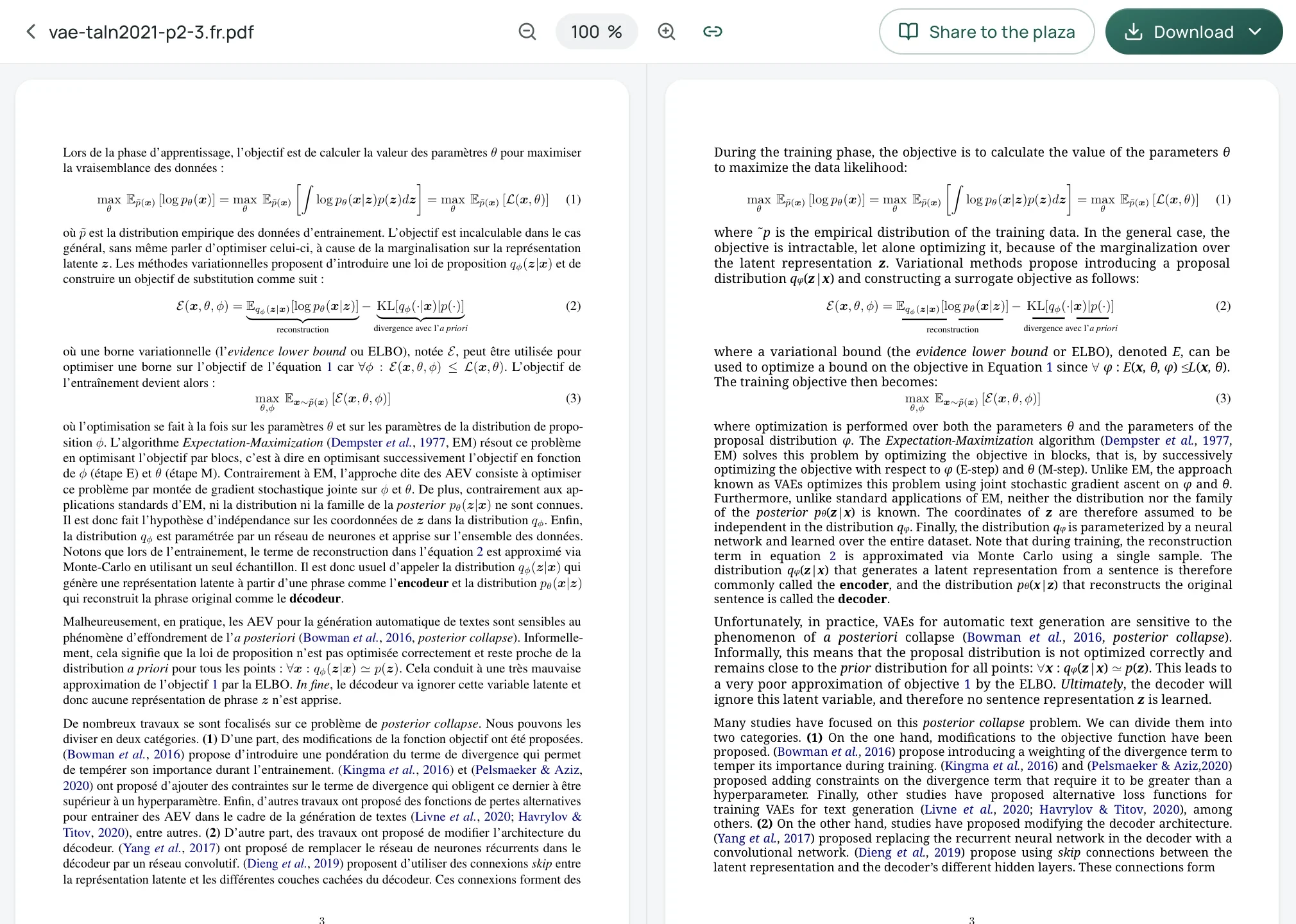
Step 3: Click "Share to the plaza" to Recover Your Translation Credits
Once your translation job finishes, open it in the Equalang translation workspace to review the original on the left and the translation on the right with synced scrolling. If the file is a public-domain book or an open-access work under CC BY, CC BY-SA, or CC0, click Share to the plaza in the top toolbar:
- License review (up to 3 submissions per day): You can submit up to 3 translated works per day. Once verified for public-domain or
CC BY/CC BY-SA/CC0license compliance, your translation goes live on Equalang Plaza. - 1/10 credit refund per download: Every time a classmate or another reader downloads your shared translation from the Plaza (paying 1/10 of standard translation credits), Equalang refunds 1/10 of the credits you originally spent on that translation job.
- Full cost recovery across a study group: Once 10 readers download your shared chapter or book, you have recovered your entire translation cost—while every one of those 10 readers paid only 1/10 of the standard price. Readers can also flag missed, mistranslated, or misaligned passages while reading, and works with frequent feedback are queued for re-translation.
Honest Boundaries You Should Know Before Uploading
To keep expectations clear and respect copyright law, here are the exact limits of how Equalang Plaza and Document Translation work:
- Sign-in is required: You must sign in to an Equalang account to read or download 0-credit originals and to preview the free 20% bilingual sample on the Plaza. Full translation downloads require credits (at 1/10 of standard translation cost) and are not zero-credit downloads.
- Strict license eligibility (
CC BY/CC BY-SA/CC0and public domain only): You cannot share works carrying NonCommercial (NC) or NoDerivatives (ND) restrictions—such asCC BY-NC-SAchapters often found on LibreTexts—nor can you share copyrighted commercial textbooks or paywalled papers. Refund credits on shared works are capped at the original credits you spent on that translation job (you cannot earn a profit above your original cost). - Layout fidelity notes: While PDF translation preserves column structure, equations, and figure placements, font sizes and line breaks adjust to fit translated text length, and PDF sidebar bookmarks are not retained in the translated output. The web upload page accepts one file at a time and runs up to 3 documents simultaneously per account, queuing additional files automatically.
Frequently Asked Questions
Can I legally translate an OpenStax textbook PDF and share it on Equalang Plaza?
Yes, for almost all OpenStax titles. Nearly the entire OpenStax catalog is published under the Creative Commons Attribution (CC BY 4.0) license, which explicitly permits translating the work and redistributing the adaptation on any platform as long as you credit OpenStax and indicate that changes were made. Always verify the specific book's copyright page first, and never submit works that carry -NC (NonCommercial) or -ND (NoDerivatives) clauses.
Why can some LibreTexts chapters be shared while others cannot?
LibreTexts is a collaborative library where faculty remix content from multiple open educational resources. As a result, one LibreTexts book or chapter may be licensed under CC BY 4.0 (eligible for Share to the plaza), while another chapter is licensed under CC BY-NC-SA (which prohibits commercial redistribution and cannot be listed on Equalang Plaza). Always check the license footer at the bottom of the exact LibreTexts chapter before sharing.
How do I read the downloaded bilingual PDF side by side on my computer?
When you purchase a PDF translation on Equalang Plaza (for 1/10 of standard translation credits) or download the bilingual file from Document Translation, you receive both a translation-only PDF and a page-by-page alternating bilingual PDF. Open the alternating bilingual PDF in your local PDF reader, switch to two-page view, and turn off separate cover-page display if the left and right pages are offset—your screen will display the original page on the left and the matching translated page on the right.
Sources
- OpenStax (Rice University free peer-reviewed textbooks): https://openstax.org/
- LibreTexts (Open Educational Resource library network): https://libretexts.org/
- Directory of Open Access Books (DOAB): https://doabooks.org/
- Equalang Plaza (public-domain books & open-access papers side by side): https://equalang.com/plaza
- Equalang Document Translation workspace: https://equalang.com/documents
- Equalang API & credit rate ratios (
/v1/rates): https://equalang.com/v1/rates - Equalang technical overview (
llms.txt): https://equalang.com/llms.txt