Why Chinese Suppliers Ignore Messages (and How to Get Fast Replies)
 Equalang
In brief
Why factory reps on Alibaba, 1688, and WeChat skip long messages, and how clear specs, numbered questions, and bilingual drafts get fast, accurate answers.
Keywords: sourcing from China; supplier communication; 1688 sourcing; Alibaba supplier messages; product sourcing
You spent an hour drafting a polite, comprehensive message to a manufacturer on Alibaba, 1688, or WeChat. You included ten detailed questions covering material specs, custom packaging, mold fees, sample lead times, and shipping terms. Days pass, and all you receive is complete silence—or a single, hurried response like "Yes, can do" that answers none of your questions.
When sourcing products overseas, silence rarely means the factory cannot produce your item. More often, it is a signal that your message created too much operational friction for the person reading it.
Inside the Supplier’s Daily Workflow
To write messages that get answered, it helps to understand who reads them and under what constraints.
Sales representatives at Chinese manufacturers and trading companies handle dozens of inbound chats daily across platforms like TradeManager, 1688’s Aliwangwang, and WeChat. Much of their work takes place on mobile phones while moving between workshops, packing areas, and shipping docks.
When an inquiry arrives as a dense wall of text containing eight or ten disparate questions, several things happen:
- Coordination bottlenecks: Answering your message requires consulting multiple people—the workshop manager for production feasibility, the purchasing agent for raw material pricing, and the shipping coordinator for carton dimensions.
- Triage and prioritization: Reps naturally prioritize straightforward conversations they can close quickly from their phones over multi-part questionnaires that require an hour of desk research.
- Screening for serious intent: Factories receive numerous casual price inquiries every day. Inquiries that ask broad questions like "What is your best price?" without stating quantities, materials, or target markets look like price-fishing from casual shoppers or competitors.
- Language distortion: Complex English sentences with idioms or nested clauses become garbled when pasted into generic translation tools, creating misunderstandings that reps would rather skip than untangle.
Understanding this daily reality makes it much easier to structure messages that make a sales rep’s job effortless.
Four Rules to Write Messages Suppliers Actually Answer
1. One goal, one topic per message
Avoid bundling mold costs, ocean freight estimates, quality inspection protocols, and payment terms into your first outreach. Treat your initial message as a feasibility check. Keep the scope confined to confirming whether they produce the specific item and can meet your primary specification.
2. Use numbered, bite-sized questions
Limit your inquiries to two or three short, numbered points. Numbered formatting allows a busy sales rep to reply on their phone in thirty seconds:
-
- Yes, we have standard molds for this shape.
-
- MOQ is 500 units for custom logo printing.
-
- Unit cost is $3.20 at 1,000 units.
If you send a solid paragraph, the recipient has to parse where one question ends and the next begins.
3. Lead with clear numbers and specifications
Reputable factories quote based on volume and technical parameters, not vague descriptions. Always include:
- Estimated order quantity: Even if you are testing the market, state your test order volume (e.g., "Initial sample order: 50 units; first production run: 500 units").
- Exact specifications: Dimensions in metric units (cm, mm, grams), material grades (e.g., 304 stainless steel, 600D polyester), and surface finishes.
- Target price and destination: If you have a firm target landed cost, stating your target unit price can immediately tell the factory whether their production tier matches your budget.
4. Provide annotated reference images
A clear image resolves technical ambiguity faster than paragraphs of text. Send reference photographs of existing products, and use simple arrows or colored circles to highlight the exact seam, zipper, texture, or logo placement you need.
Building a Clear Bilingual Communication Workflow
While export sales managers on Alibaba often speak English, many domestic manufacturers on 1688 and factory floor managers on WeChat operate entirely in Chinese. Sending a clear Chinese message alongside your English original reduces friction immediately.
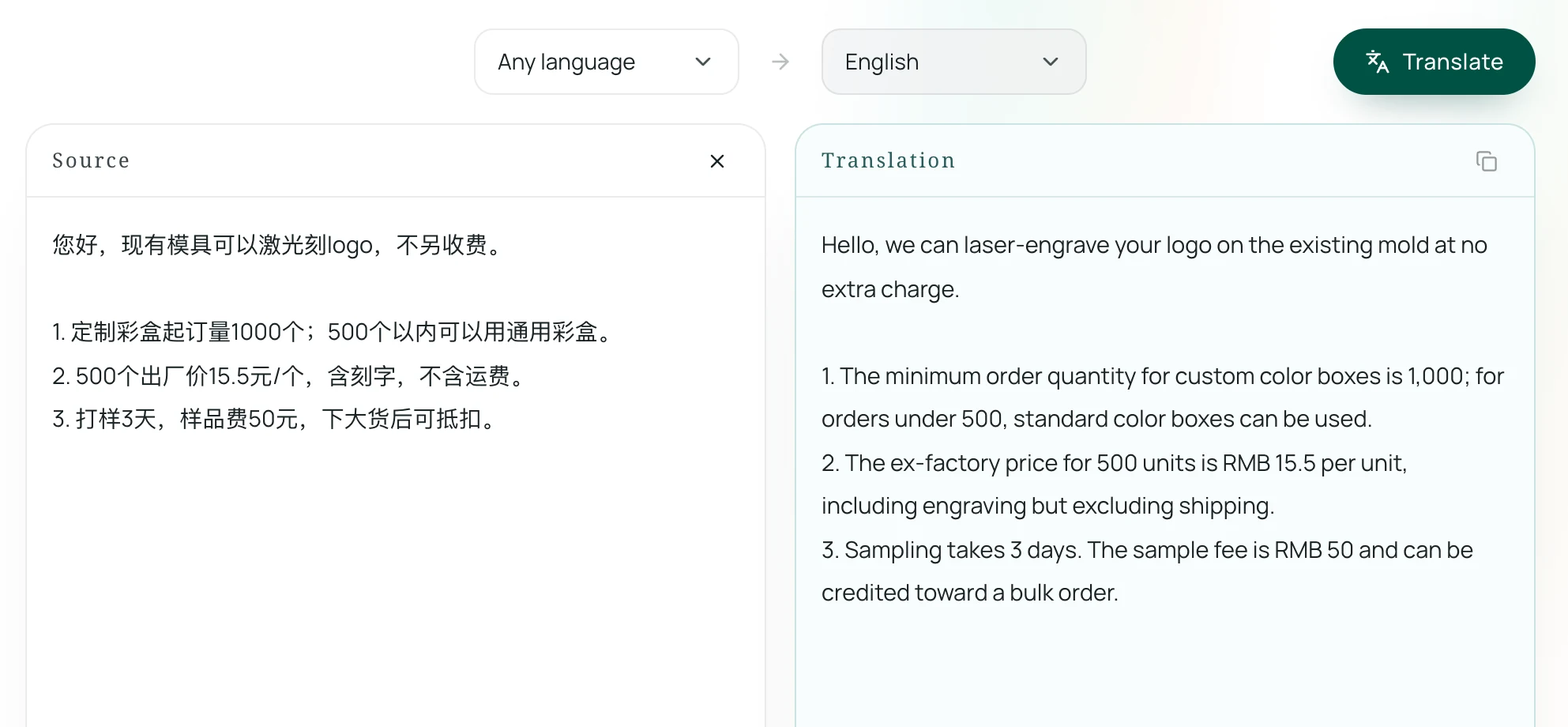
When drafting messages and reviewing supplier replies, seeing both languages side by side helps you verify that technical specifications and numbers remain intact. Below is how this works using Equalang's side-by-side text translation:
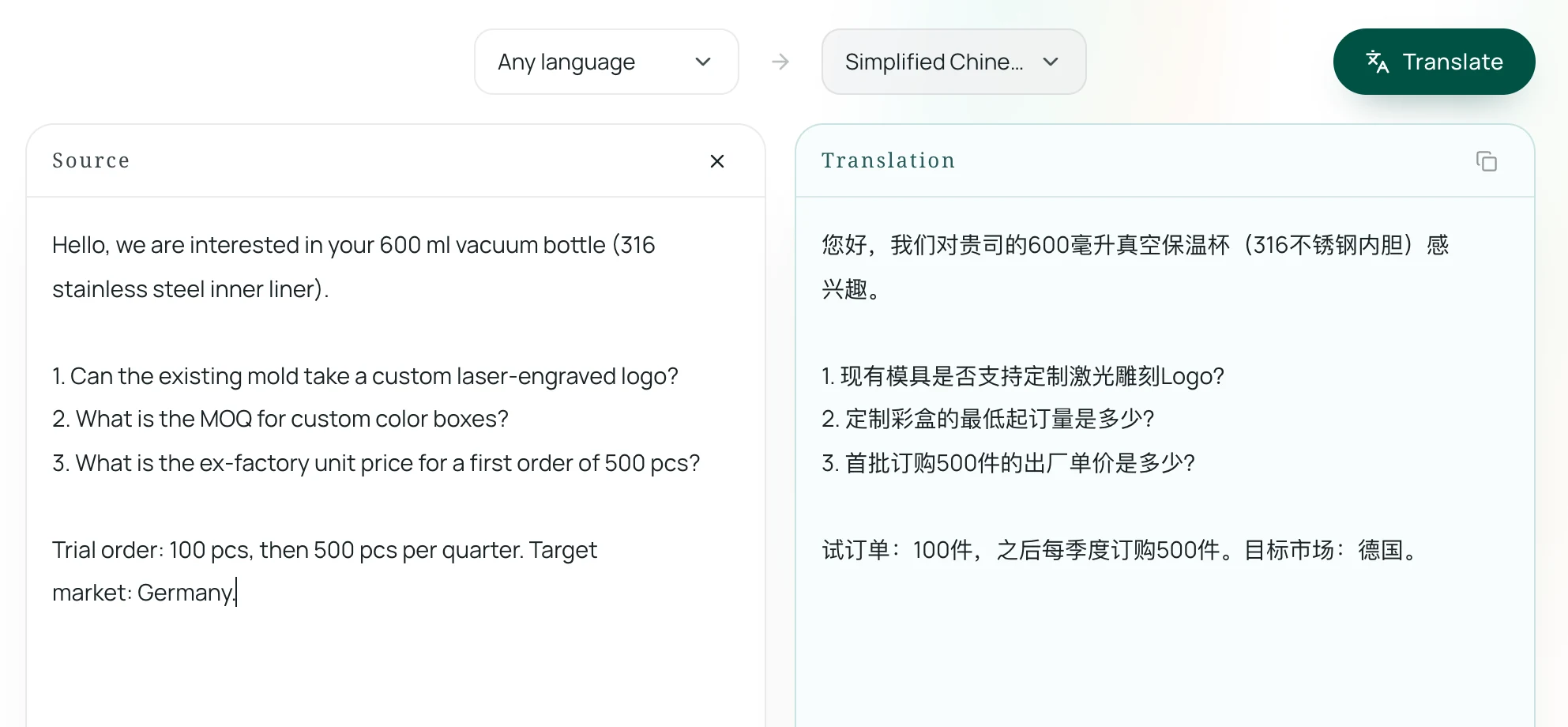
When reviewing a supplier's response in Chinese, translating it into English side by side helps you verify key terms such as pricing, MOQs, and sample policies line by line:
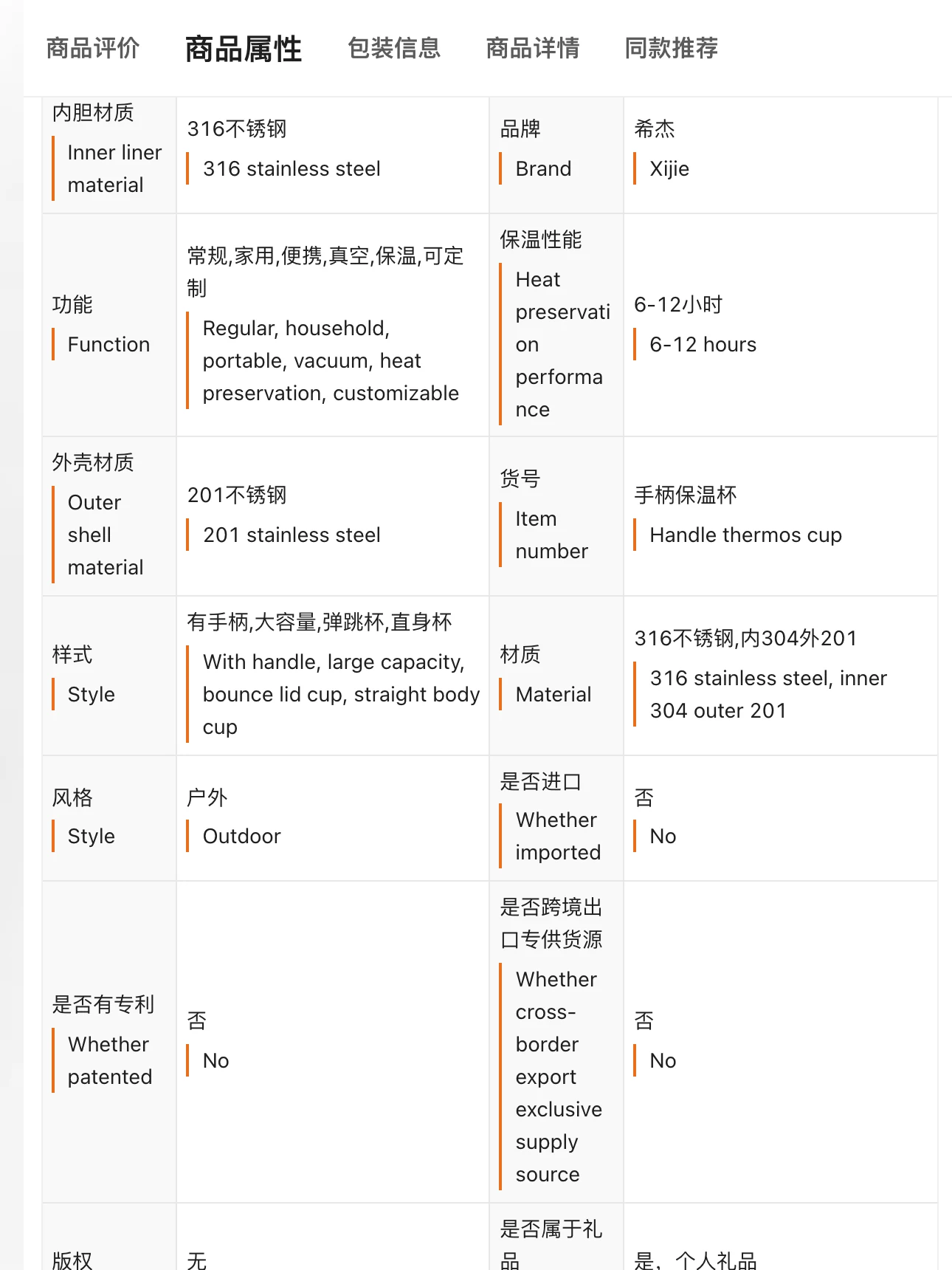
If you are sourcing directly on domestic marketplaces, exploring supplier listings requires parsing extensive tables of technical parameters. Using the Equalang browser extension, you can read product pages with bilingual paragraph translations displayed directly below the original text:
For a detailed breakdown of navigating domestic wholesale platforms and handling message translation workflows, see our guides on sourcing on 1688 and Taobao and translating and replying to emails.
Practical Chat Etiquette on WeChat and Aliwangwang
- Be mindful of working hours: Most suppliers in China work on China Standard Time (UTC+8), typically between 9:00 AM and 6:00 PM. Sending inquiries during their active workday significantly improves the likelihood of a live response.
- Close the loop: If a supplier sends a price quote that is too high or outside your timeline, send a brief, courteous note: "Thank you for the quotation. This is above our current target budget, but we will keep your contact information on file for future projects." Acknowledging quotes keeps the relationship open for future inquiries.
- Confirm key terms in writing: Once terms are discussed verbally or over chat, summarize the final unit price, packaging details, and lead time into a single bulleted confirmation list to ensure both parties share identical expectations.