Sourcing from 1688 and Taobao: How to Decode Factory Badges, Long Spec Images, and Chinese Tiered Quotations
 Equalang
In brief
A practical guide for global buyers and e-commerce sellers on decoding 1688 factory badges, translating vertical spec sheets, and auditing tiered Chinese Excel quotations.
Keywords: 1688 sourcing, Taobao direct factories, Chinese spec translation, Excel quotation translation, cross-border sourcing guide
It is 2:00 AM, and you have over a dozen 1688 and Taobao tabs open, trying to source next season's products directly from Chinese factories for your online store. For the exact same hooded sweatshirt or stainless steel tumbler, hundreds of suppliers pop up with unit prices ranging from a dozen to several dozen RMB. Some display "Verified Power Merchant" or "Super Factory" badges; others promote "one-piece dropshipping." When you finally shortlist a few candidates to inspect specifications, there is not a single line of selectable, copyable text—sizing charts, fabric weights, carton specs, and test reports are all flattened into vertical images thousands of pixels tall. And when a sales rep finally emails over an .xlsx Chinese quotation sheet, manually copying cells into a web translator and pasting them back risks overwriting =SUM() formulas with hardcoded numbers—or worse, mistaking an ex-factory bare price (EXW) for a landed cost with shipping included.
Bypassing middlemen who mark up prices by 15% to 30% to deal directly with source factories rarely fails on basic language alone. The real pitfalls lie in platform-specific merchant badges, technical terminology locked inside long spec images, and pricing conventions in Chinese quotation spreadsheets.
This guide breaks down all three hurdles with actionable comparison tables and audit checklists to help you evaluate supplier credentials, verify product specifications, and calculate true procurement costs.

1. Spotting Real Factories: Decoding 1688 Supplier Badges and Terminology
Finding low prices on 1688 is easy. What is challenging is distinguishing between a genuine source manufacturer with dedicated production lines, customization capabilities, and prototyping support and a trading company that simply sources from neighboring wholesale stalls to pocket the margin. Sourcing in-stock items from traders might offer faster turnaround on micro-orders; however, if you plan to rebrand, modify designs, or maintain strict quality control, choosing the wrong middleman leads to inflated costs—and when batch color discrepancies or production delays strike, they lack direct control over the shop floor.
The 1688 homepage and search results use specific Chinese badges and supplier profile fields. Manually copying and translating text across dozens of storefronts is tedious and breaks page layouts. A more efficient approach is reading the storefront using a side-by-side or layout-preserving translation workflow, allowing you to review credentials without disrupting original formatting. Combined with the seven core indicators below, you can quickly filter out unsuitable sellers:
Another quick sanity check: examine the variety of product categories across the entire store. Constrained by equipment and tooling, genuine source factories typically carry only a few dozen styles with a tight focus on specific materials and processes. If a single store sells stainless steel tumblers, Bluetooth earbuds, yoga leggings, and pet beds simultaneously—even if branded as a "factory direct outlet"—it is almost certainly a trading company consolidating disparate wholesale inventory.
2. Reading Long Product Spec Images: High-Frequency Chinese-English Sourcing Glossary
Once you have shortlisted candidate factories, the next step is verifying product specifications. Chinese e-commerce designers typically embed sizing charts, fabric weights, hardware materials, temperature tolerances, and packaging dimensions into tall, vertical banner images. Standard browser translation cannot extract or parse text inside images. Overlooking key details—such as confusing "Asian slim fit" with US/EU sizing, or missing a small footnote stating "gift box not included"—can lead to costly mistakes once inventory lands at an overseas fulfillment center.
When reviewing long spec banners or physical sample tags, manually retyping text is prone to errors, especially with specialized manufacturing jargon and multi-column tables. In practice, using an image translation tool that preserves original layouts—placing the translated text directly into the original table cells and callout badges—allows you to cross-reference specifications seamlessly against the original Chinese artwork.
Taking the long specification sheet of a 500 ml outdoor double-wall vacuum insulated tumbler (KW-1001)—a high-frequency cross-border sourcing item—as an example, the image below illustrates the effect of layout-preserving translation:
| Long Specification Image (Team Sample) | Layout-Preserved Translation (Illustrative English Diagram) |
|---|---|
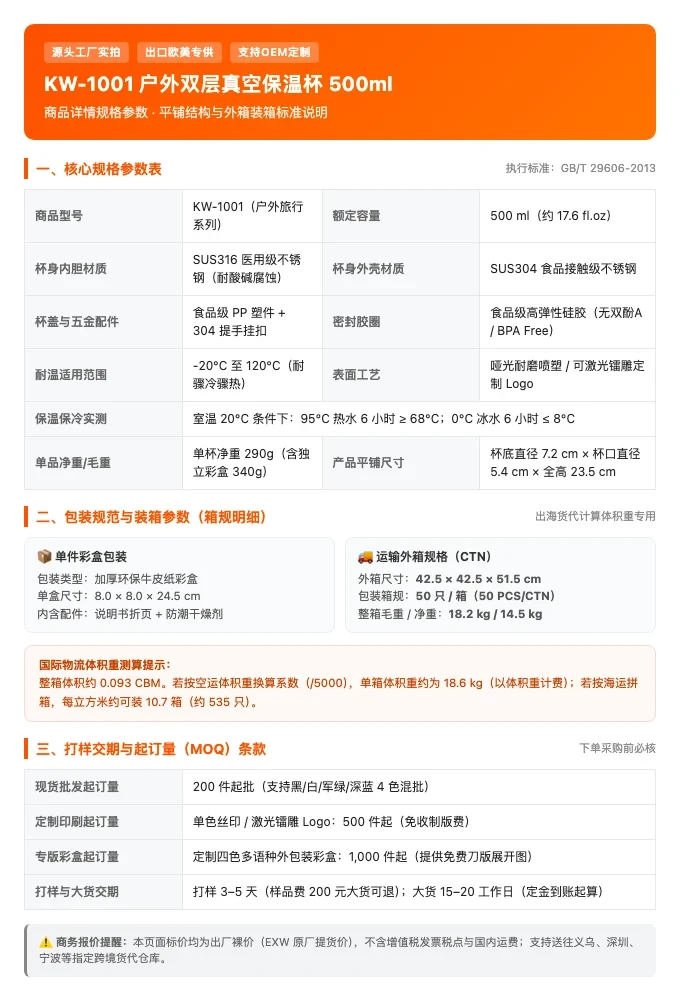 | 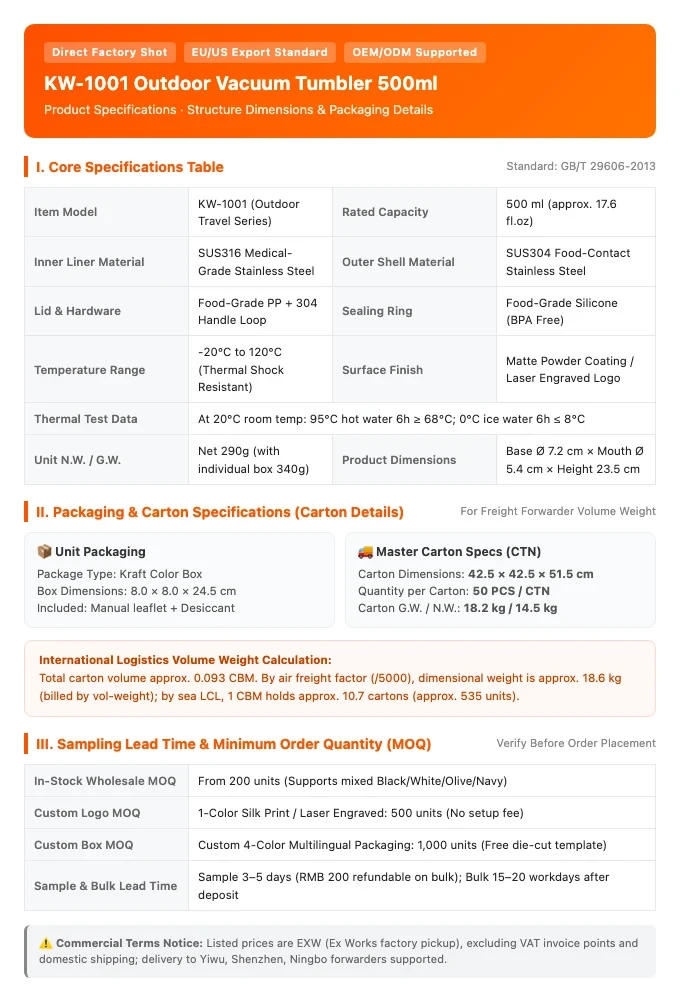 |
Comparing the sample image with the illustrative diagram highlights several key verification checkpoints:
- Component-by-component material and temperature verification: The inner liner (
SUS316 medical-grade stainless steel), outer shell (SUS304 food-grade stainless steel), and sealing ring (BPA Free food-grade silicone) are mapped to their respective components. The temperature range (-20°C to 120°C) is fully preserved, preventing food contact safety and compliance risks caused by misidentifying parts. - Carton dimensions and volumetric weight: Carton dimensions (
42.5 × 42.5 × 51.5 cm), carton quantity (50 PCS/CTN), and gross weight (18.2 kg) appear in their original positions. You can plug these figures directly into your freight forwarder’s volumetric weight formula (divided by 5000 gives 18.6 kg) to calculate first-leg shipping costs in advance. - MOQ and commercial boundaries: The wholesale MOQ for in-stock units (200 pcs), custom color box MOQ (1,000 pcs), and the EXW ex-factory pricing notice are all clearly presented, giving you transparent commercial terms before contacting the supplier.
Keep in mind that image translation focuses on rapidly identifying headers and core metrics. Translated fonts and line breaks may vary slightly from the original artwork; in rare cases with complex photographic backgrounds or ultra-dense typography, small characters may require double-checking. Before placing an official sample order, cross-reference your key parameters against the glossary below:
3. Auditing Chinese Excel Quotations: Preserving Formulas and Sheet Formatting
After selecting your preferred styles, the factory sales representative will typically send a tiered quotation spreadsheet in .xlsx format. Working with these files poses two major risks: first, manually copying and translating text can easily overwrite dynamic =SUM() or multiplication formulas with static numbers, breaking automatic recalculations when quantities change; second, missing fine print in header remarks can lead you to mistake an ex-factory price (EXW) excluding freight and taxes for a customs-cleared landed cost.
When translating quotation spreadsheets, the key is using a tool that preserves file structure and calculation logic: translating only product descriptions and table headers while keeping pure numeric values, currency symbols, and formulas (like =SUM(), multiplications, and subtractions) completely intact, alongside formatting such as bold text, cell background colors, and text wraps. This ensures you can understand every line item while maintaining an interactive, recalculating spreadsheet.
Here is a side-by-side test of a procurement quotation sheet (.xlsx) containing four kitchenware items:
| Chinese Original (.xlsx Input) | English Translation (.xlsx Output with Formulas Preserved) |
| :---: |
|---|
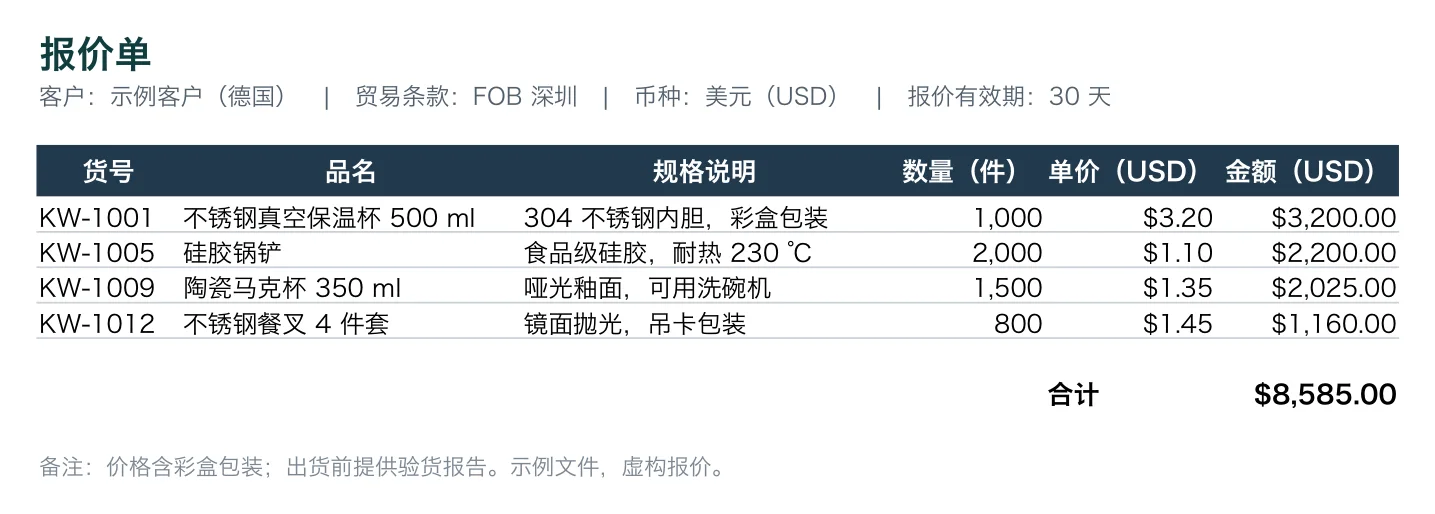 |
The original sheet contains four itemized lines:
- KW-1001: Stainless Steel Tumbler 500 ml (304 inner liner, color box included), 1,000 pcs, Unit Price $3.20, Total $3,200.00
- KW-1005: Silicone Spatula (Food-grade silicone, heat resistant to 230 °C), 2,000 pcs, Unit Price $1.10, Total $2,200.00
- KW-1009: Ceramic Mug 350 ml (Matte glaze, dishwasher safe), 1,500 pcs, Unit Price $1.35, Total $2,025.00
- KW-1012: Stainless Steel Fork 4-Piece Set (Mirror polish, blister card), 800 pcs, Unit Price $1.45, Total $1,160.00
In the English sheet, trade terms (FOB Shenzhen), currency (USD), and price validity (30 days) are translated cleanly. Crucially, the =SUM(F5:F8) formula behind the grand total of $8,585.00 remains intact. If you update the tumbler quantity to 1,500, the sheet recalculates the new grand total dynamically.
Two practical tips when working with translated sheets:
- Auto-fit column widths: English words are generally longer than Chinese characters, and Excel does not automatically widen columns upon opening. Select all cells and double-click the column boundary lines to expand the layout properly.
- Review text-dependent conditional formulas: If the sheet uses complex logic dependent on specific Chinese strings (such as
=IF(C2="含税", ...)), verify these conditions manually, as conditional arguments may retain their source phrasing.
4. The 6-Point Checklist Before Wiring Deposits to Chinese Factories
Once you have a fully translated quotation sheet, avoid wiring a deposit immediately. Domestic Chinese quotation practices differ substantially from international trade standards. Always clarify these six items before committing:
- Is the quote an "Ex-Factory Bare Price (EXW)" or a "Delivered Warehouse Price (Domestic Warehouse Delivery)"? Most prices listed on 1688 are bare prices that exclude VAT invoices and domestic freight. If you need official export clearance and tax refunds, the factory will charge an extra tax point (开票加点). If shipping to a domestic freight forwarder's warehouse, clarify whether delivery is prepaid or freight collect (运费到付).
- Are packaging specifications and packaging fees included? Factory standard quotes typically assume bulk packing or simple OPP polybags. If you require drop-tested corrugated mailer boxes, barcoding/FNSKU labeling, or multilingual instruction manuals, expect an additional fee of ¥0.5–¥3 RMB per unit.
- Tooling and Mold/Setup Fee Ownership: Silkscreen logo printing often incurs a screen setup fee, while custom hardware or plastic tooling involves mold costs. Your agreement should clearly state who owns the mold, the order threshold required to reimburse setup costs, and strict terms prohibiting the factory from using your custom tooling for other clients.
- When Does the Lead Time Actually Begin? When a factory quotes a "15-day lead time," they typically mean production working days counted only after receiving the deposit AND signing off on the pre-production sample (PPS), not from the date you wire the funds. Always build in a 7- to 10-day buffer ahead of peak shopping seasons.
- Defective Allowance and Spare Units: Returning or reworking defective goods overseas is prohibitively expensive. Agree upon an Acceptable Quality Limit (such as AQL 2.5) before paying, and negotiate a 1%–2% buffer of spare components or extra units included free of charge with the mass shipment.
- Communication Protocol for Factory-Floor Sample Tweaks: When adjusting sampling details (such as tightening collar ribbing or tweaking a mold snap-fit), text descriptions can easily be misunderstood. Set up real-time multilingual or video calls with the workshop team to walk through modifications, and always follow up with written confirmation for your records.
By following this streamlined workflow—screening credentials via bilingual web browsing, extracting parameters from long spec images, auditing spreadsheets with live formulas, and locking down terms with the six-point checklist—you can eliminate the vast majority of costly surprises caused by information asymmetry on 1688 and Taobao. Save these criteria and translation checklists as standard operating templates before signing off on your next sample or production run.
The quotation spreadsheet translation screenshot featured in this article was generated using Equalang Documents, while the long specification sheet is an illustrative diagram.