
Japanese Literature Classics for Learners: N3 to N1 Guide
In brief
Follow a JLPT N3 to N1 reading order through Akutagawa, Dazai, and Natsume Soseki with modern-kana Aozora Bunko books and side-by-side translations.
Keywords: japanese literature classics for learners; easy aozora bunko books; akutagawa ryunosuke short stories japanese; osamu dazai hashire merosu bilingual; natsume soseki kokoro botchan japanese
Finishing your intermediate Japanese textbooks feels like a milestone until you open a famous Meiji-era novel and stall out on page one. Most learners do not fail because their grammar is too weak for authentic fiction; they fail because they accidentally pick a 300-page philosophical novel or download an unedited file written in pre-1946 historical orthography (旧仮名遣い).
If you start instead with crisp 15-page short stories set in modern kana (新字新仮名) and pair the Japanese text with a side-by-side translation for tricky literary phrasing, you can read Ryunosuke Akutagawa, Osamu Dazai, and Natsume Soseki in a clear progression from JLPT N3 to N1. Every title in this guide is in the public domain on Aozora Bunko and available to read or download on Equalang Plaza.
Quick-Reference Canon: JLPT N3 to N1 Reading Order
Why Jumping Straight into a 300-Page Meiji Novel Stalls Learners
Two hidden traps derail intermediate readers before chapter two:
- Archaic kana and unstandardized kanji (
旧字旧仮名): On Aozora Bunko, many works appear in multiple editions. If you open an older bibliographic entry, verbs ending in-auappear as-afu(思ふinstead of思う), and particles or auxiliaries use historical spellings (てふ,けり,なり). Always verify that the edition is labeled新字新仮名(modern kanji and modern kana usage). For a full breakdown of how to filter catalog editions and strip furigana clutter, see our guide on how to read Aozora Bunko books in English and bilingual Japanese. - Narrative pacing and sentence density: Even when a novel uses comparatively simple vocabulary, maintaining focus across 250 pages of introspective monologue is exhausting if you have never finished an unadapted Japanese story. Building confidence with 10-to-20-page stories lets you celebrate a complete read in a single weekend.
Tier 1 (JLPT N3–N2, 10–25 Pages): Build Momentum with Fables and Fast Pacing
1. Ryunosuke Akutagawa — The Spider's Thread (蜘蛛の糸)
If you have never read an unabridged Japanese classic, start here. Akutagawa published 蜘蛛の糸 in 1918 for the first issue of Akai Tori (赤い鳥), a literary magazine founded by Miekichi Suzuki for young readers. Because of its intended audience, the narrative follows a crisp three-act symmetry: tranquil Paradise in the morning, the murky Blood Pool of Hell below, and the tense climb up a single silvery thread.
- What you will practice: Polite narrative framing (
でございますstyle in standard editions), vivid onomatopoeia (しんと,きらきら), and Buddhist imagery (極楽,地獄,蓮の池) that recurs often enough to memorize naturally without flashcards. - Where to find it: Search
蜘蛛の糸on Equalang Plaza to open the clean Aozora Bunko EPUB edition right in your browser.
2. Osamu Dazai — Run, Melos! (走れメロス)
Once you finish Akutagawa's fable, step up to Dazai's 1940 retelling of an ancient Greek legend of friendship and honour. Japanese middle-school textbooks have included 走れメロス for decades because Dazai writes with urgent, staccato energy. Already in the opening sentence—メロスは激怒した ("Melos was enraged")—the grammar is direct and unmistakable.
- What you will practice: Rapid-fire spoken dialogue between Melos and King Dionysius, physical movement verbs, and shifting registers between blunt masculine declarations and heightened literary resolve.
- Linguistic hurdle to expect: Dazai peppers the action with expressive Sino-Japanese compounds (
激怒,邪智暴虐,信実). Having a side-by-side translation open lets you absorb these dramatic compounds in stride without breaking the rhythm of Melos's race against the setting sun.
Tier 2 (JLPT N2, 20–40 Pages): Psychological Short Fiction
3. Ryunosuke Akutagawa — Rashomon (羅生門)
Moving from children's literature to adult short fiction means tackling longer relative clauses and historical atmosphere. Set beneath the ruined southern gate of Heian-period Kyoto during a string of natural disasters, 羅生門 follows a recently dismissed servant weighing starvation against theft.
- What you will practice: Classical-flavored nouns for Heian architecture, clothing, and social roles (
下人,檜皮色,太刀), alongside Akutagawa's clinical dissection of human self-justification. - How to handle the opening pages: The first three paragraphs establish the desolate setting with dense architectural and weather vocabulary. Once the servant climbs the stairs into the gate's upper floor, the syntax tightens around direct observation and confrontation.
4. Ryunosuke Akutagawa — The Nose (鼻)
Published in 1916 and praised by Natsume Soseki himself, 鼻 tells the story of Zenchi Naigu, an accomplished priest whose dignity is consumed by anxiety over his five-inch-long nose. Compared with 羅生門, the tone here is wry and analytical.
- What you will practice: Nuanced expressions of social embarrassment, passive constructions, and ironic observations on how bystanders secretly resent a person's relief from misfortune.
- Why it prepares you for novels: The story relies on internal psychological shifts rather than physical suspense, making it an ideal bridge to Natsume Soseki.
Tier 3 (JLPT N2–N1): Stepping Up to Natsume Soseki's Novels
5. Natsume Soseki — Botchan (坊っちゃん)
Before tackling Soseki's late philosophical works, read his 1906 comedic novel 坊っちゃん. Narrated by a hot-headed, plain-spoken young maths teacher from Tokyo who takes a post at a provincial middle school in Matsuyama, the book reads like an extended, spirited rant.
- What you will practice: Colloquial Tokyo speech (
江戸っ子cadence), colorful character nicknames (赤シャツ,野だいこ,山嵐), and brisk narrative momentum. - Linguistic hurdle to expect: Conversational contractions, early twentieth-century student slang, and regional Matsuyama dialect lines (
なもし). When a slang phrase does not show up in a standard J-E learners' dictionary, checking the aligned paragraph on Equalang Plaza clarifies the joke immediately.
6. Natsume Soseki — Kokoro (こころ)
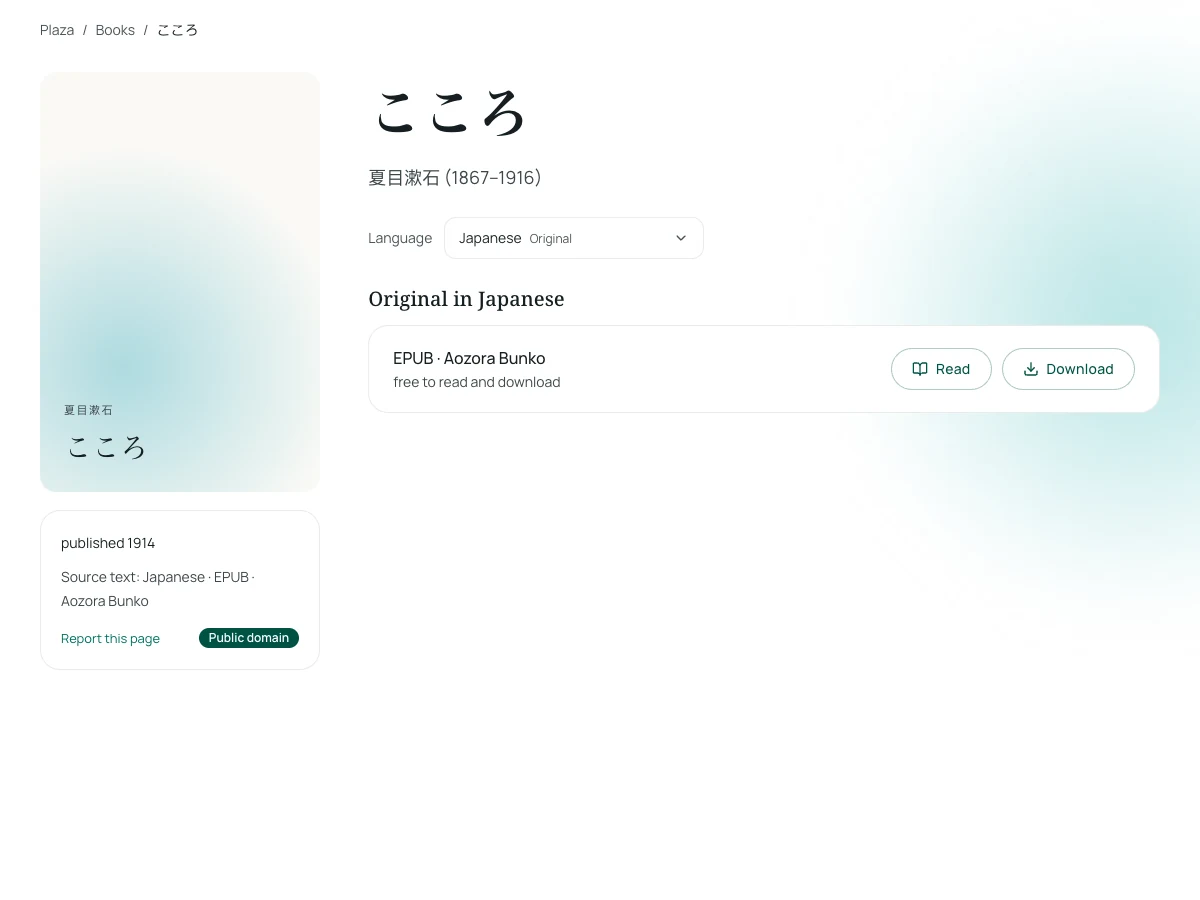
Written in 1914, こころ is widely considered a cornerstone of modern Japanese prose. Even though it spans roughly 300 pages, Soseki's mature sentence structure is remarkably lucid. He avoids ornamental vocabulary in favour of quiet, precise reflections on loneliness, guilt, and the transition from the Meiji era to modern individuality.
- What you will practice: Extended first-person epistolary narration (especially in Part III, Sensei's long testament letter), subtle emotional qualifiers, and abstract connectors that mirror N1 reading-comprehension passages.
- Pacing strategy: Read
こころin three stages matching its three divisions (Sensei and I, My Parents and I, and Sensei's Testament). The vocabulary remains consistent throughout, so your reading speed in Part III will be noticeably faster than in Part I.
How to Read These Classics Side by Side on Equalang Plaza
Rather than juggling raw text files, browser dictionary pop-ups, and separate translations, you can use Equalang Plaza to keep the original Japanese and your target language aligned paragraph by paragraph. If you are curious about the cognitive science behind pairing source texts with parallel translations, read our overview on whether bilingual reading is effective for language learners.
Here is how the workflow operates in practice:
- Search in any language: Visit Equalang Plaza and search by the Japanese title (
蜘蛛の糸,走れメロス,羅生門,鼻,坊っちゃん,こころ), author name (夏目漱石,芥川龍之介,太宰治), or English/Chinese keywords. - Sign in for 0-credit originals and 20% bilingual previews: Once signed in, you can read or download the clean Aozora Bunko original EPUB for 0 credits. When a translation in your target language is available, you can also preview the first 20% for free in a side-by-side reader with synchronized scrolling.
- Download full translations at 1/10 cost or trigger a new language: Downloading an existing full translation from Plaza costs 1/10 of the standard translation credit rate (rounded up and displayed on the work page), delivered in the same format as the source file (EPUB for EPUB; PDF translation purchases include both a layout-preserved translated PDF and a page-by-page alternating bilingual PDF). If your preferred target language is not yet listed on a book page, click Translate now to run it immediately from the verified source file or click I want this translation to register demand.
- Bring your own Aozora Bunko EPUB or PDF: If you pick another public-domain title directly from Aozora Bunko, you can upload your EPUB, TXT, HTML, or PDF file to Document Translation. If Plaza already hosts that translation, the workspace will notify you so you can sample or download it at the 1/10 Plaza rate instead of paying for a duplicate translation. And if you translate a public-domain work (or an open-access paper licensed under
CC BY,CC BY-SA, orCC0) that is not yet on Plaza, you can submit it via Share to Plaza (up to 3 submissions per day, subject to copyright review) and earn back 1/10 of your translation cost each time another reader downloads it, up to your original spend. Works withNC(non-commercial) orND(no-derivatives) restrictions, as well as books still under copyright, cannot be shared on Plaza.
Frequently Asked Questions
Should I read Japanese classics with furigana turned on or off?
For Tier 1 stories (蜘蛛の糸 and 走れメロス), keeping Aozora Bunko's ruby furigana intact is helpful because literary kanji compounds appear alongside standard N3 grammar. By the time you reach こころ, try reading paragraphs first without looking at the furigana or parallel translation, using the side-by-side pane only to verify unfamiliar idioms or cultural references.
Are all of Osamu Dazai's and Natsume Soseki's works in the public domain?
Yes. Under Japanese copyright law, works by authors who passed away before 1956—including Natsume Soseki (died 1916), Ryunosuke Akutagawa (died 1927), and Osamu Dazai (died 1948)—are in the public domain in Japan and cataloged on Aozora Bunko. Always check whether a specific title is already hosted on Equalang Plaza or upload the 新字新仮名 edition from Aozora Bunko via Document Translation.
Do I need to pay credits just to read the Japanese originals on Equalang Plaza?
No. Signing in is required, after which every public-domain original hosted on Equalang Plaza can be read online and downloaded for 0 credits, and the first 20% of any existing translation can be read side by side for free.
Sources
- https://www.aozora.gr.jp/
- https://www.aozora.gr.jp/cards/000879/card92.html
- https://www.aozora.gr.jp/cards/000035/card1567.html
- https://www.aozora.gr.jp/cards/000879/card127.html
- https://www.aozora.gr.jp/cards/000879/card42.html
- https://www.aozora.gr.jp/cards/000148/card752.html
- https://www.aozora.gr.jp/cards/000148/card773.html
- https://equalang.com/plaza