
French, German & Russian Bilingual Classics by Level
In brief
Read French, German, and Russian public-domain classics side by side. Explore a B1-C1 reading progression with grammar warnings and free original editions.
Keywords: french german russian public domain books bilingual; french bilingual books online free; german parallel text books kafka; russian dual language books chekhov dostoevsky; read foreign classics side by side
Jumping from graded readers to authentic European literature usually fails for one reason: learners pick books by fame rather than syntax. Starting German with Thomas Mann or Russian with a 600-page philosophical novel often ends on page four, exhausted by nested subordinate clauses and dictionary lookups.
Yet the public domain holds dozens of French, German, and Russian masterpieces that are surprisingly approachable at an intermediate (CEFR B1–B2) level—if you know which works rely on brisk dialogue or linear plots, and if you read them with a synchronized side-by-side translation so you never lose the narrative thread.
We mapped ten verified public-domain classics across French, German, and Russian into a structured B1-to-C1 reading ladder. Every title listed below is available in community-proofread archives like Wikisource and live on Equalang Plaza, where you can sign in to read or download the original text for 0 credits, preview the first 20% of available translations side by side for free, or download a complete translated EPUB for 1/10 of standard translation credits.
B1–C1 Reading Progression: French, German, and Russian Classics
Use this progression table to pick a book that matches your current grammar comfort zone rather than guessing from cover blurbs.
French Progression: From Verne's Linear Quests to Dumas's Dialogues
When transitioning into unabridged French literature, the biggest shock is the passé simple—the literary past tense that rarely appears in spoken French. Once you train your eye to recognize third-person endings (-a, -it, -ut, -èrent, -irent), 19th-century French prose opens up rapidly.
B1–B2 Entry: Jules Verne and Gaston Leroux
Jules Verne's Le Tour du monde en quatre-vingts jours (Around the World in Eighty Days) is one of the most forgiving full-length novels in the French canon. Phileas Fogg's itinerary provides a clear chronological backbone: train schedules, steamer departures, and wagers keep the context obvious even when a sentence contains an unfamiliar nautical noun.
If you enjoy Verne's pacing, Vingt Mille Lieues sous les mers (Twenty Thousand Leagues Under the Seas) uses the same clear syntax while expanding your descriptive vocabulary. Be ready for stretches of marine taxonomy—lists of shells, fish, and submarine instruments—where having a side-by-side translation saves you from looking up obscure biological terms that you do not need to memorize.
For readers who prefer mystery over travelogues, Gaston Leroux's Le Fantôme de l'Opéra (The Phantom of the Opera) reads like an investigative thriller. Because Leroux worked as a courtroom reporter, his prose relies on sharp, plot-driven chapters and lively dialogue among theater managers, dancers, and detectives.
B2–C1 Milestone: Alexandre Dumas
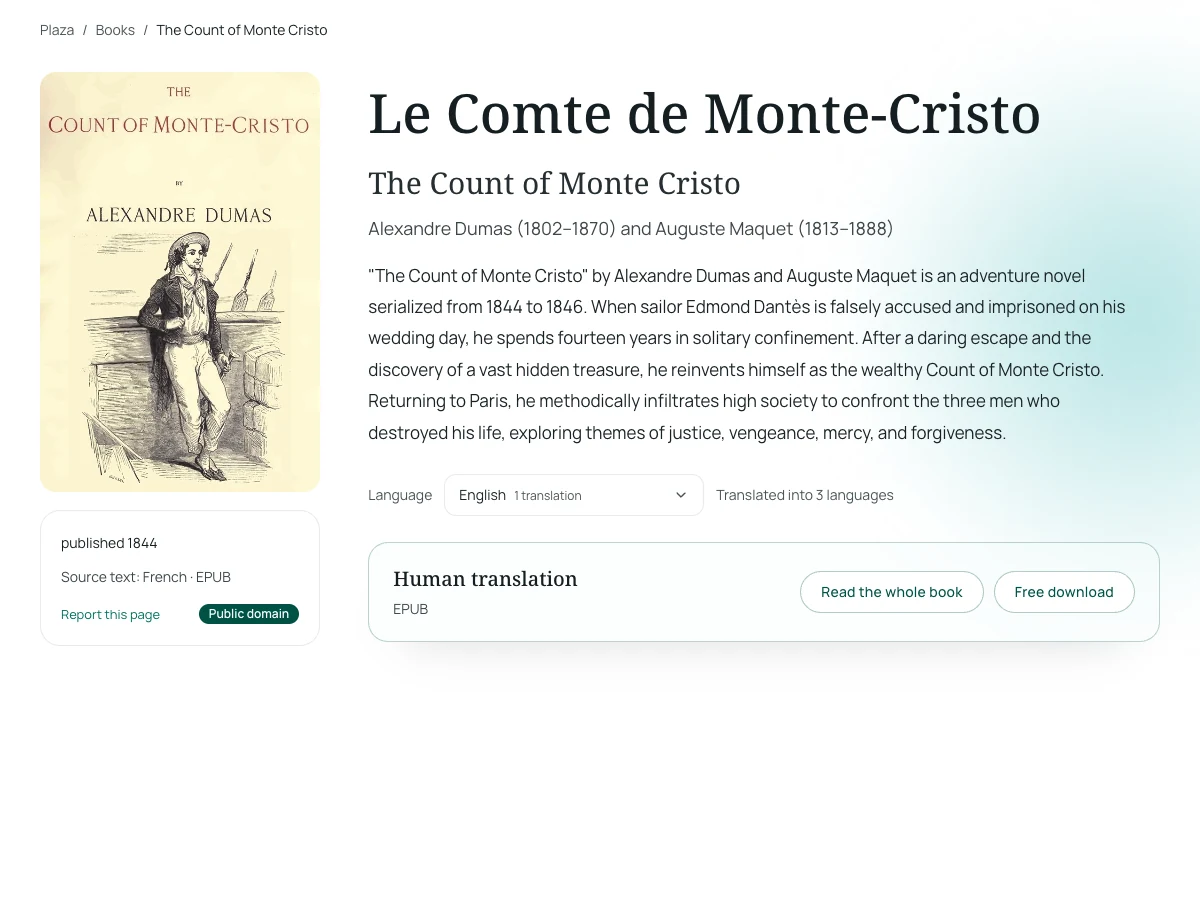
At first glance, the sheer page count of Alexandre Dumas's Le Comte de Monte-Cristo (The Count of Monte Cristo) intimidates learners. Linguistically, however, Dumas is famous for fast-moving, serialized newspaper dialogue. Chapters are built around rapid exchanges where characters repeat key verbs and nouns across short lines. On Equalang Plaza, the French original of Le Comte de Monte-Cristo is already paired with its public-domain English translation, allowing you to read the Marseilles and Paris chapters side by side.
German Progression: Folktale Rhythm to Kafka's Nested Clauses
German literary difficulty rarely comes from exotic vocabulary alone; it comes from sentence architecture. Verbs waiting at the end of subordinate clauses and long pre-nominal participial phrases (erweiterte Partizipialattribute) force you to hold half a paragraph in working memory.
B1–B2 Entry: Grimms Märchen
Jacob and Wilhelm Grimm's Grimms Märchen (Grimms' Fairy Tales) remain the most practical bridge into literary German. Because folktales rely on rule-of-three repetition—three brothers, three trials, repeated riddles—new verbs in the simple past (Präteritum) appear two or three times on the same page. You will encounter occasional archaic nouns (such as das Spinnrad or old feudal titles), which a parallel English or Chinese column resolves in half a second without breaking your reading rhythm.
B2–C1 Milestone: Franz Kafka's Deceptive Simplicity
Learners searching for German parallel text books almost always arrive at Franz Kafka's Die Verwandlung (The Metamorphosis) and Der Process (The Trial). Kafka is a fascinating linguistic paradox:
- Clean, high-frequency vocabulary: Unlike Romantic poets, Kafka wrote in sober, everyday Prague German. You will not need a specialized dictionary for most individual words.
- Deeply nested clauses: A single Kafka sentence can chain a main clause, a relative clause, a causal weil or da clause, and an infinitive um ... zu construction, stacking conjugated verbs at the very end.
When you read Die Verwandlung or Der Process side by side on Equalang Plaza, the synchronized view acts as a structural X-ray. You can read the German sentence straight through to the final verb, then glance across to verify which subject belongs to which subordinate clause.
Russian Progression: Chekhov's Precision to Dostoyevsky's Polyphony
Russian learners face a steep jump from textbook dialogues to authentic prose because of six grammatical cases, shifting word stress, and verbal participles (причастия and деепричастия) that pack an entire clause into a single word.
B1–B2 Entry: Anton Chekhov's Short Stories and Plays
Before tackling a 500-page Russian novel, build stamina with Anton Chekhov. We recommend starting with two distinct formats live on Equalang Plaza:
- The short story — Дама с собачкой (The Lady with the Dog): At roughly twenty pages, this Yalta-set masterpiece uses concise, crystalline sentences. It is a masterclass in Russian verbal aspect: watching how Chekhov alternates imperfective verbs (ongoing promenade habits and seasonal moods) with sudden perfective verbs (a decisive glance or realization) teaches you more about aspect than any grammar chart.
- The stage play — Дядя Ваня (Uncle Vanya): Plays strip away dense third-person landscape descriptions and leave pure spoken Russian. Reading Дядя Ваня side by side helps you internalize conversational particles (ведь, же, ну, -то) and elliptical replies where Russian speakers drop pronouns or verbs that are obvious from context.
C1 Milestone: Fyodor Dostoyevsky's Преступление и наказание
Once you are comfortable with Chekhov, Fyodor Dostoyevsky's Преступление и наказание (Crime and Punishment) is the ultimate C1 proving ground. Dostoyevsky's syntax mirrors Raskolnikov's psychological agitation: sentences dash through sudden dashes, self-interruptions, colloquial particles, and philosophical debate.
On Equalang Plaza, the Russian original of Преступление и наказание is paired alongside a public-domain English edition. Having the English translation anchored next to the Cyrillic paragraphs lets you unpack long strings of Russian participles and 19th-century bureaucratic ranks without losing the urgency of the story.
How to Read These Classics Side by Side
You can combine open-access text archives with bilingual reading tools in two ways, depending on whether your book is already hosted or freshly downloaded.
1. Search and Read Directly on Equalang Plaza
Equalang Plaza collects public-domain books (from sources such as Wikisource, Standard Ebooks, and Aozora Bunko) alongside open-access research papers (CC BY, CC BY-SA, and CC0). You can search the catalog by title or author in French, German, Russian, English, or Chinese, and filter by Books and your target language.
Keep the following rules and boundaries in mind when using Plaza:
- Sign-in required: You need to sign in to your account before reading or downloading originals or opening bilingual previews.
- 0-credit originals and 20% bilingual previews: Once signed in, you can read and download the original French, German, or Russian edition for 0 credits, and sample the first 20% of any available translation for free in a side-by-side reader with synchronized scrolling.
- 1/10-credit full downloads: Downloading a complete translated book costs 1/10 of the standard translation credit cost (rounded up and displayed clearly on the work's page). Downloaded ebooks keep the original file format, such as EPUB to EPUB; if you purchase a PDF translation, you receive both a layout-preserved translated PDF and a page-by-page alternating bilingual PDF.
- Request or translate missing target languages: Not every classic has been translated into every target language yet. If your preferred language pair is not listed on a Plaza work, click Translate now to run a translation from the Plaza source file, or click Request this translation so high-demand titles are prioritized.
If you are comparing different dual-language reading workflows, see our guide to online bilingual book readers and Beelinguapp alternatives.
2. Download from Wikisource and Translate Your Own EPUB
What if you want to read another public-domain work from fr.wikisource.org, de.wikisource.org, or ru.wikisource.org that is not on Plaza yet?
- Export the proofread work as an EPUB from the national Wikisource portal.
- Upload the file on the Document Translation page (which accepts EPUB, PDF, DOCX, HTML, and TXT files one file at a time, running up to 3 documents concurrently per account). If Plaza already has that translation, the workspace will prompt you so you can grab the Plaza edition instead of paying to re-translate it. For details on how chapter hierarchy and styles are handled, read our walkthrough on translating EPUB ebooks while keeping formatting.
- Once your translation finishes, if the book is in the public domain (or carries a
CC BY,CC BY-SA, orCC0license with noNCnon-commercial orNDno-derivatives restrictions), you can click Share to Plaza at the top of the workspace (up to 3 submissions per day, published after copyright verification). Each time another reader downloads your shared translation, you receive 1/10 of your original translation credit cost back until your initial spend is recouped.
Frequently Asked Questions
Do I need an account to read public-domain books on Equalang Plaza?
Yes. Once you sign in, you can read and download the original public-domain texts for 0 credits and preview the first 20% of any available translation side by side with synchronized scrolling for free. Downloading a full translated edition costs 1/10 of standard translation credits.
Which language classic is easiest for an intermediate (B1) learner to start with?
In French, Jules Verne's Le Tour du monde en quatre-vingts jours offers a clear, chronological plot with high-frequency travel vocabulary. In German, Grimms Märchen builds confidence with short tales and repetitive narrative patterns. In Russian, Anton Chekhov's play Дядя Ваня or short story Дама с собачкой keeps sentence length manageable compared with 19th-century epic novels.
Can I upload and share any French, German, or Russian book to Equalang Plaza?
No. Only public-domain works whose copyright term has expired, or open-access works published under CC BY, CC BY-SA, or CC0 licenses that permit adaptations and commercial use, can be shared to Plaza after review. Copyrighted modern books and files with NC (Non-Commercial) or ND (No Derivatives) restrictions cannot be shared.
Sources
- Equalang Plaza Public Domain & Open-Access Catalog: https://equalang.com/plaza
- French Wikisource (Bibliothèque numérique libre): https://fr.wikisource.org
- German Wikisource (Freie Quellensammlung): https://de.wikisource.org
- Russian Wikisource (Викитека — свободная библиотека): https://ru.wikisource.org
- Standard Ebooks Public-Domain Library: https://standardebooks.org