
Free Open-Access Math, Stats & Economics Textbooks
In brief
A curated progression of peer-reviewed open-access textbooks for calculus, linear algebra, statistics, and economics, plus bilingual study workflows.
Keywords: free open access math statistics economics textbooks; free calculus and statistics textbooks pdf; openstax math textbooks; american math society open math notes; bilingual stem textbooks for international students
Why Finding the Right Open-Access STEM Textbook Is Only Half the Battle
Every semester, thousands of undergraduate and self-directed students search for free open-access math, statistics, and economics textbooks only to end up with broken links, unvetted lecture slides, or commercial editions they cannot legally download. Even when you locate an official open-access PDF, a second obstacle appears immediately for international students taking English-medium university courses: understanding dense English word problems, formal theorem statements, and policy case studies while trying to master the underlying quantitative concepts.
Fortunately, universities and mathematical institutes maintain peer-reviewed, completely free textbook collections released under open licenses such as Creative Commons Attribution (CC BY 4.0). Instead of guessing which PDF is trustworthy, you can follow a structured progression from first-year foundational courses to proof-based undergraduate mathematics—and read key editions side by side with translations on Equalang Plaza.
Curated Reading Progression: Verified Open-Access STEM & Economics Textbooks
To save you hours of sifting through scattered repositories, we organized the core open-access canon by academic stage. Every title below is peer-reviewed, adopted by university departments, and free to access from its official source.
Stage 1: Mastering First-Year Foundations with OpenStax (CC BY 4.0)
When students search for openstax math textbooks or free calculus and statistics textbooks pdf, OpenStax from Rice University is the gold standard for first-year university study. Unlike informal lecture notes, OpenStax volumes go through rigorous faculty peer review, include full exercise sets with odd-numbered solutions, and are published under a CC BY 4.0 license that explicitly permits redistribution and translation.
If you are preparing for an English-medium STEM or business degree, start here:
- Bridge the Algebra-to-Calculus Gap: Before diving into multivariable derivatives or differential equations, review Intermediate Algebra, Algebra and Trigonometry, and Precalculus. In university exams, students rarely fail because they cannot manipulate symbols; they lose points because they misread English rate-of-change or optimization word problems.
- Master Statistical Phrasing Early: Introductory Statistics and Introductory Business Statistics introduce sampling distributions, p-values, and regression. Reading the English original alongside your native language helps you distinguish phrases like "probability of observing a sample mean at least as extreme" from everyday conversational English.
- Connect Quantitative Models to Real Contexts: In Principles of Macroeconomics, Principles of Microeconomics, Psychology, and The AP Physics Collection, equations sit inside multi-page real-world case studies. If you want a deeper comparison of how major open textbook libraries handle licensing and structure, see our guide on OpenStax vs. LibreTexts for bilingual textbook reading.
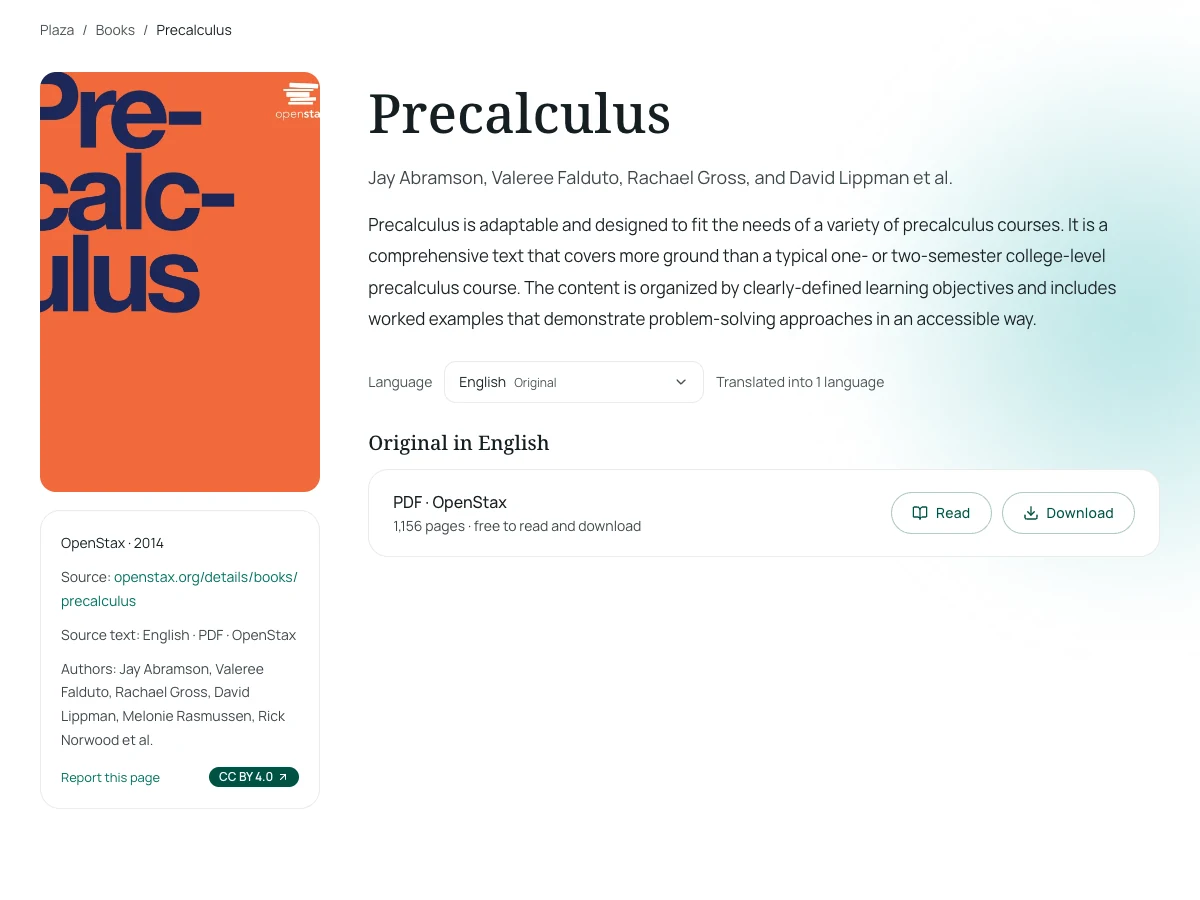
Because Precalculus, Introductory Statistics, Principles of Macroeconomics, Principles of Microeconomics, Psychology, and The AP Physics Collection are already hosted with translations on Equalang Plaza, you do not need to upload those huge PDFs from scratch.
Stage 2 & 3: Stepping Up to AIM Approved Textbooks and MIT OpenCourseWare
Once you finish introductory courses, standard computational drills give way to theorem-proof mathematics. Students often search for american math society open math notes or faculty-vetted undergraduate monographs to cover upper-division requirements.
Two official directories stand out at this stage:
- American Institute of Mathematics (AIM) Approved Open Textbooks: The AIM editorial board evaluates open-source undergraduate mathematics textbooks against strict pedagogical and adoption criteria. If you are moving into proof-based coursework, Richard Hammack's Book of Proof teaches you how mathematical English operates. From there, Active Calculus develops conceptual calculus fluency, Robert Beezer's A First Course in Linear Algebra builds rigorous matrix and vector-space theory, and Thomas Judson's Abstract Algebra introduces algebraic structures.
- MIT OpenCourseWare (OCW) Free Online Textbooks: MIT OCW provides complete online textbooks and book-length lecture notes across linear algebra, probability, and computer science, paired with actual course calendars and assignments.
Pay attention to license boundaries before sharing or redistributing: OpenStax titles use CC BY 4.0, and several AIM-listed textbooks use permissive open-source licenses (CC BY or CC BY-SA). However, many MIT OCW materials carry a Creative Commons Non-Commercial (NC) license. That distinction matters when you use collaborative translation archives.
How to Read and Download Bilingual STEM Textbooks on Equalang Plaza
We built Equalang Plaza so students and researchers can read public-domain books and permissively licensed open-access works (CC BY, CC BY-SA, and CC0) with the original and translation side by side. Here is how to use it for your semester reading list—along with its exact rules and boundaries:
- Sign In for 0-Credit Originals and 20% Side-by-Side Previews: Sign-in is required to read or download books on Plaza. Once signed in, you can read or download any English original PDF for 0 credits. You can also read the first 20% of any available translation for free, displayed side by side with synchronized scrolling so you can check English math, physics, or economics terminology against your native language in real time.
- Full Bilingual Downloads at 1/10 of Standard Credits: If you want the complete translated textbook for offline tablet or laptop study, you can unlock and download the full edition for 1/10 of the standard translation credit cost (rounded up and displayed clearly on the work's page). For PDF works, a single purchase gives you both the layout-preserved translated PDF and a page-by-page alternating bilingual PDF, and you can re-download them anytime.
- Avoid Duplicate Costs Automatically: If you go to Document Translation to upload a textbook PDF that already has a translation in your target language on Equalang Plaza, the workspace prompts you to preview or download the existing Plaza edition at the 1/10 credit rate instead of paying full translation credits.
- Translating & Sharing New
CC BYTextbooks: What if an open-access textbook you need isn't on Plaza yet, or lacks your target language? If the work is already on Plaza without your language, click Translate now on the source edition or click Request this translation to register demand (high-demand works are prioritized). If you have aCC BY,CC BY-SA, orCC0PDF from an external archive, upload it to Document Translation. Our PDF translation keeps multi-column layouts, headers, captions, bold emphasis, and internal table-of-contents links working, while keeping inline and display math formulas intact (see how we handle formulas in technical PDFs). After translation finishes, you can click Share to Plaza at the top of the workspace (up to 3 submissions per day, subject to copyright verification). Each time another reader downloads your shared translation, you receive back 1/10 of the credits you spent on that translation until your original translation cost is recouped. Keep in mind that copyrighted commercial textbooks and documents carryingNC(Non-Commercial) orND(No Derivatives) restrictions cannot be shared to Plaza.
Frequently Asked Questions
Are OpenStax and AIM-approved textbooks really free for university study?
Yes. OpenStax textbooks are published under Creative Commons licenses (primarily CC BY 4.0), and the American Institute of Mathematics (AIM) directory only lists open-access undergraduate math textbooks that are free to read and download online.
Do I need an account to read OpenStax translations on Equalang Plaza?
Yes, signing in is required. Once signed in, you can read and download the original English edition for 0 credits, preview the first 20% of any translated edition side by side for free, and download the full translated and alternating-page bilingual PDFs for 1/10 of standard translation credits.
Can I upload and share any MIT OpenCourseWare textbook to Equalang Plaza?
Only works in the public domain or licensed under CC BY, CC BY-SA, or CC0 can be shared to Equalang Plaza after copyright review. Many MIT OpenCourseWare materials use a CC BY-NC-SA (Non-Commercial) license, so those cannot be published on Plaza.