
Foundational AI & LLM Papers Reading List (Bilingual Guide)
In brief
Follow a 4-stage foundational AI and LLM papers reading list from Transformers and DPO to 3D Gaussian Splatting, with open-access bilingual PDF workflows.
Keywords: foundational ai and llm papers reading list; must read llm papers; foundational deep learning papers pdf; dpo paper explained; how to read ai papers effectively
Why Most AI Paper Reading Lists Stall After Week Two
Bookmarking fifty foundational deep learning papers is easy; finishing three without getting derailed by dense notation is where most self-study plans break down. When engineers and graduate students search for a foundational AI and LLM papers reading list, they rarely fail for lack of links. They stall because most lists dump raw arXiv URLs in chronological order without warning which sections introduce heavy mathematical derivations, or how to read two-column proofs alongside a clear translation when English is not their first language.
While building our open-access academic catalog on Equalang Plaza and testing two-column LaTeX PDF reconstruction in Document Translation, our team noticed a second hurdle: licensing determines how you can access bilingual editions. Some modern landmarks—such as Direct Preference Optimization (DPO) and 3D Gaussian Splatting—are published under permissive CC BY licenses, allowing us to host the original PDFs and side-by-side translated editions directly in a public catalog. Older classics like the 2017 Transformer paper use arXiv's default non-exclusive distribution license, meaning you grab the PDF from arxiv.org first and run a private translation yourself.
Below is a structured, four-stage reading curriculum covering transformer architectures, post-training preference alignment, 3D neural rendering and embodied AI, and domain-specific clinical models—complete with the mathematical bottlenecks to watch for and where to read each paper legally.
The 4-Stage Foundational AI & LLM Reading List
Rather than reading randomly from a massive spreadsheet, work through these eight papers in four functional stages. Every entry below has been verified for its exact archive identifier and open-access license status.
Stage 1: Transformer Architecture and Scaling Laws
Every serious curriculum starts with the mechanics of self-attention and in-context learning. Your goal in Stage 1 is not just memorizing block diagrams, but tracking tensor shapes and compute budgets.
1. Attention Is All You Need (Vaswani et al., 2017)
- Why it belongs first: It replaced recurrent and convolutional layers with scaled dot-product attention and multi-head attention, establishing the backbone of modern foundation models.
- Technical & linguistic hurdles: Section 3.2 packs dense matrix multiplication terminology ($Q, K, V$ projections) and explains why scaling by $\frac{1}{\sqrt{d_k}}$ prevents softmax gradients from vanishing when $d_k$ is large. Readers often misread the subtle distinction between encoder-decoder cross-attention and masked decoder self-attention.
2. Language Models are Few-Shot Learners (Brown et al., 2020)
- Why it belongs here: The GPT-3 paper shifted the field from task-specific fine-tuning with thousands of labeled examples to zero-shot, one-shot, and few-shot prompting at 175 billion parameters.
- Technical & linguistic hurdles: At over 70 pages, reading it cover to cover is a trap. Focus on Section 2 (training dataset weights, compute scaling in PF-days) and Section 3 (evaluation methodology), plus the contamination analysis in Section 4.
3. Attention mechanisms in computer vision: A survey (CC BY)
- Why it bridges Stage 1 and Stage 3: Once you understand sequence attention, this survey categorizes channel attention, spatial attention, temporal attention, and self-attention variants in vision backbones. Because it carries a
CC BYlicense, you can search its title or DOI directly on Equalang Plaza after signing in to inspect the terminology side by side.
Stage 2: Post-Training, Preference Alignment, and Output Diversity
Pre-trained base models predict the next token; post-training turns them into controllable assistants and exposes behavioral failure modes across models.
4. Direct Preference Optimization (DPO) (Rafailov et al., NeurIPS 2023 Outstanding Main Track Runner-Up)
- Why it is essential: Reinforcement Learning from Human Feedback (RLHF) traditionally required fitting a separate reward model and running unstable PPO updates. DPO proves mathematically that the KL-constrained reward maximization objective has a closed-form optimal policy, letting you align an LLM directly on human preference pairs using a simple binary cross-entropy loss.
- Where readers get stuck: Section 4 and Appendix A derive the change-of-variables trick from the Bradley-Terry preference model: $$p^(y_1 \succ y_2 \mid x) = \sigma\left(\beta \log \frac{\pi^(y_1\mid x)}{\pi_{\text{ref}}(y_1\mid x)} - \beta \log \frac{\pi^*(y_2\mid x)}{\pi_{\text{ref}}(y_2\mid x)}\right)$$ Keeping track of the reference policy $\pi_{\text{ref}}$, the partition function $Z(x)$ cancellation, and gradient weightings in Section 4.1 is much easier when you can read the English derivation next to a synchronized translation.
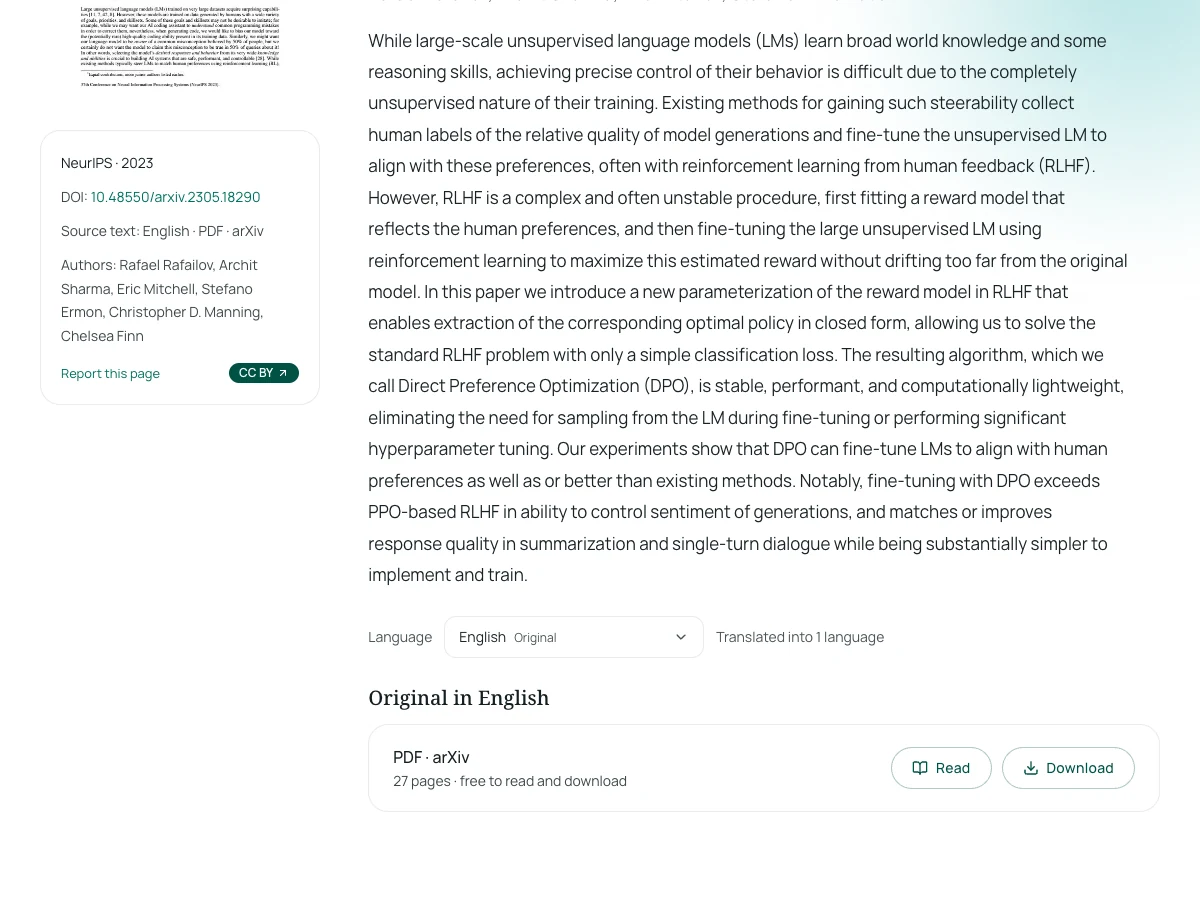
Because Rafailov et al. released the paper under CC BY (DOI 10.48550/arxiv.2305.18290), it is already live with a side-by-side Chinese AI translation on Equalang Plaza. Once signed in, you can read and download the original PDF for 0 credits, preview the first 20% of the translation side by side with synchronized scrolling at no cost, and download the full bilingual edition for 1/10 of the standard translation cost.
5. Artificial Hivemind: The Open-Ended Homogeneity of Language Models (CC BY)
- Why pair it with DPO: While alignment methods like DPO sharpen model helpfulness, post-training can collapse output diversity across different model families on open-ended tasks. Reading Artificial Hivemind right after DPO gives you a balanced view of what alignment optimizes—and what distributional variety it sacrifices.
Stage 3: 3D Neural Rendering, Shape Latents, and Embodied VLA
Modern AI research increasingly connects language and diffusion priors to 3D geometry and physical robot control. All three papers in Stage 3 are published under CC BY and hosted on Equalang Plaza.
6. 3D Gaussian Splatting for Real-Time Radiance Field Rendering (Kerbl et al., SIGGRAPH 2023 Best Paper)
- Why it changed 3D vision: Neural Radiance Fields (NeRFs) achieved high visual quality but required costly ray-marching through continuous MLPs. Kerbl et al. (DOI
10.1145/3592433) represent scenes with explicit 3D anisotropic Gaussians, adaptive density control (splitting and cloning splats), and a fast tile-based differentiable alpha rasterizer achieving real-time 1080p rendering. - Technical & linguistic hurdles: Watch the coordinate transformations in Section 4—specifically projecting the 3D covariance matrix $\Sigma = R S S^T R^T$ into 2D camera coordinates via the viewing transformation $W$ and the Jacobian $J$ of the affine approximation, alongside spherical harmonics (SH) coefficients for view-dependent color. On Equalang Plaza, the full Chinese AI translation of 3D Gaussian Splatting costs just 24 credits to download (1/10 of standard translation cost), and a single PDF purchase includes both the layout-preserved translated PDF and an alternating-page bilingual PDF.
7. 3DShape2VecSet (ACM TOG, CC BY) and 8. TinyVLA (IEEE RA-L, CC BY)
- From 3D representations to robotic action: 3DShape2VecSet encodes 3D meshes and point clouds into compact latent vector sets suitable for generative diffusion models, while TinyVLA brings multimodal vision-language backbones down to fast, data-efficient robotic manipulation policies without requiring massive pre-training clusters. Both are live with Chinese AI translations on Equalang Plaza.
Stage 4: Domain-Specific and Clinical Foundation Models
9. Large language models encode clinical knowledge (Singhal et al., Nature, CC BY 4.0)
- Why finish here: Benchmarks like GSM8K or MMLU do not capture high-stakes professional reasoning. This Nature study introduced MultiMedQA and evaluated Flan-PaLM and Med-PaLM using clinician panels across scientific consensus, comprehension, retrieval, and potential for harm.
- What to focus on: Pay attention to how prompt tuning (instruction prompt tuning) adapts a general foundation model to clinical terminology and how human evaluation rubrics separate factual recall from clinical omissions. Because it is published under
CC BY 4.0, you can look it up on Equalang Plaza by title or DOI.
How to Read and Translate Any AI Paper Without Breaking Equations
When working through this reading list, match your workflow to the paper's license:
- Check Equalang Plaza first for
CC BY,CC BY-SA, andCC0papers: You can search by title, author, or DOI in any language, and filter by Papers and target language. After signing in, all originals are 0 credits to read online or download, and every existing translation lets you sample the first 20% side by side for free. If a paper in the catalog does not yet have a translation in your target language, click Translate now directly from the Plaza copy or register interest with Want this translation so high-demand papers are prioritized. - Understand Plaza boundaries: Not every paper or commercial book can live in a public library. Plaza only indexes public-domain books (from sources such as Aozora Bunko, Wikisource, and Standard Ebooks) and open-access papers under
CC BY,CC BY-SA, orCC0. Works with Non-Commercial (NC) or No-Derivatives (ND) restrictions, paywalled journal articles, and copyrighted modern books cannot be hosted or shared there. - Use Document Translation for default-license arXiv preprints: For papers like Attention Is All You Need or GPT-3 that use arXiv's standard non-exclusive distribution license, download the PDF from
arxiv.organd upload it to Document Translation (one file per upload, up to 3 documents processed concurrently per account with additional files queued automatically). Turn on formula optimization for tricky inline math—see our step-by-step guide to translating AI papers with complex formulas. If you upload a document that already has a translation on Plaza, the workspace will prompt you so you can preview or download it there for 1/10 the credits instead of paying to re-translate. - Share eligible open-access translations to earn back credits: If you translate a
CC BY,CC BY-SA, orCC0paper (or public-domain book) that is not yet on Plaza, you can click Share to Plaza at the top of the workspace after translation (up to 3 submissions per day, published after copyright review). Each time another reader downloads your shared edition, you receive 1/10 of your original translation credit cost back until your full translation cost is recovered.
If you manage your reading queue in a reference manager, you can also connect this workflow with our Zotero translation guide, or compare daily discovery trackers in our review of alphaXiv vs. Hugging Face Daily Papers vs. papers.cool.
Frequently Asked Questions
Why are some arXiv papers on Equalang Plaza while others like the 2017 Transformer paper are not?
Equalang Plaza only hosts public-domain works and open-access papers licensed under CC BY, CC BY-SA, or CC0 (sourced from OpenAlex, PubMed Central, arXiv, and user contributions after copyright review). Direct Preference Optimization (10.48550/arxiv.2305.18290) and 3D Gaussian Splatting (10.1145/3592433) carry CC BY licenses, so they can be hosted and shared publicly. Older papers uploaded under arXiv's default non-exclusive license to distribute, or papers with NC (Non-Commercial) or ND (No-Derivatives) clauses, cannot be redistributed on Plaza; you can translate your own personal copy privately in Document Translation.
What files do I get when I download a translated PDF paper from Equalang Plaza?
Once signed in, downloading a translated PDF from Equalang Plaza costs 1/10 of the standard translation credit price (rounded up and displayed on the page—for example, 24 credits for 3D Gaussian Splatting). A single PDF purchase includes two files: a layout-preserved translated PDF that keeps the two-column structure, figures, tables, and equations intact, and an alternating-page bilingual PDF where original and translated pages are interleaved for side-by-side comparison. You can also read the full text online and re-download anytime after purchase.
What should I do if a formula or paragraph in a Plaza paper translation has a formatting glitch?
While reading any translated edition on Equalang Plaza, you can submit feedback directly on missing lines, mistranslations, or equation formatting issues. Editions that accumulate reader reports are queued for re-translation. For your own uploads in Document Translation, enabling the formula optimization toggle helps keep dense inline symbols and multi-line derivations clean.
Sources
- Vaswani et al. (2017), Attention Is All You Need: https://arxiv.org/abs/1706.03762
- Brown et al. (2020), Language Models are Few-Shot Learners: https://arxiv.org/abs/2005.14165
- Guo et al. (2022), Attention mechanisms in computer vision: A survey: https://doi.org/10.1007/s41095-022-0271-y
- Rafailov et al. (2023), Direct Preference Optimization: Your Language Model is Secretly a Reward Model: https://doi.org/10.48550/arxiv.2305.18290
- Kerbl et al. (2023), 3D Gaussian Splatting for Real-Time Radiance Field Rendering: https://doi.org/10.1145/3592433
- Zhang et al. (2023), 3DShape2VecSet: A 3D Shape Representation for Neural Fields and Generative Diffusion Models: https://doi.org/10.1145/3592442
- Wen et al. (2024), TinyVLA: Toward Fast, Data-Efficient Vision-Language-Action Models for Robotic Manipulation: https://arxiv.org/abs/2409.12514
- Singhal et al. (2023), Large language models encode clinical knowledge: https://doi.org/10.1038/s41586-023-06291-2
- Equalang Plaza Open-Access Catalog: https://equalang.com/plaza