
alphaXiv vs Hugging Face Daily Papers vs Cool Papers
In brief
Compare Hugging Face Daily Papers, alphaXiv, Cool Papers, and Equalang Plaza to build a fast daily workflow for screening and reading arXiv AI papers.
Keywords: alphaxiv vs hugging face daily papers vs cool papers; alphaxiv vs arxiv; hugging face daily papers; papers.cool; bilingual arxiv pdf
If you track machine learning preprints every morning, Hugging Face Daily Papers, Cool Papers (papers.cool), alphaXiv, and Equalang Plaza are not direct clones—they solve four distinct stages of your reading pipeline. Use Hugging Face Daily Papers to spot trending releases tied to open weights and demos, Cool Papers to triage dozens of daily arXiv abstracts with one-click AI summaries, and alphaXiv to read line-by-line community discussions or ask an AI assistant questions directly over an arXiv preprint. Once you pick the two or three papers worth reading equation by equation in your native language, move to Equalang Plaza to sample the first 20% side by side for free and download full layout-preserved and bilingual PDFs of open-access papers for 1/10 of standard translation credits.
Quick Comparison: Four Tools for Your Daily arXiv Workflow
Why Relying on Just One arXiv Tool Slows You Down
Over a hundred new preprints land in cs.AI, cs.LG, and cs.CV every weekday. When you rely on raw arXiv lists alone, you face two bottlenecks:
- Triage fatigue: Skimming a hundred abstracts in a browser tab takes over an hour, and an abstract rarely tells you whether the authors actually released weights or whether a theorem in Section 3 has a known flaw.
- Deep-reading friction: AI summary cards tell you what a paper claims, but reproducing a method requires reading all 15 to 30 pages of two-column derivations, ablation tables, and figure captions. If English is not your first language, translating the same trending PDF individually inside your research group means five teammates pay five separate full-file translation bills for the exact same document.
Combining a discovery feed, a discussion layer, and a shared bilingual repository removes both bottlenecks.
Hugging Face Daily Papers: Track What Ships With Code and Weights
Hugging Face Daily Papers (https://huggingface.co/papers) filters the daily arXiv firehose through community curation. Instead of sorting by submission timestamp, it surfaces preprints that engineers and researchers are actively upvoting and implementing.
Where It Shines
- Direct artifact linking: Every paper page connects directly to the authors' or community's model checkpoints, training datasets, and interactive Spaces demos hosted on Hugging Face.
- Implementation signal: Before investing an afternoon into a new architecture, you can see in seconds whether runnable weights exist and how practitioners rate the release.
Where It Stops
- If your sub-field is theoretical machine learning, statistical physics, or niche domain science without immediate Hub checkpoints, Daily Papers may miss relevant preprints.
- It does not provide full-text layout-preserved PDF translations or side-by-side bilingual reading.
Cool Papers (papers.cool): Triage Dozens of Abstracts in Minutes
When you need comprehensive coverage of a specific arXiv category or a top conference without missing quieter releases, Cool Papers (https://papers.cool/) strips away visual clutter.
Where It Shines
- Fast feed filtering: Widely used across ML labs—especially among Chinese-speaking researchers—Cool Papers presents clean daily feeds for arXiv subject categories and major conference tracks.
- One-click AI FAQ and summary views: With integrated AI summarization (such as Kimi integration), you can expand a structured breakdown of the problem, method, and key results right inside the feed to decide whether a paper deserves a closer look.
Where It Stops
- Summaries are built for screening, not verification. To inspect hyper-parameter tables, proof appendices, or dense architectural diagrams, you still have to open and read the full PDF.
alphaXiv: Inline Peer Review and Interactive Q&A Over arXiv
Once a paper passes your morning screen, alphaXiv (https://www.alphaxiv.org/) turns a static preprint into an interactive margin conversation.
Where It Shines
- Zero-friction URL swap: When viewing any preprint on
arxiv.org, changing the domain in your browser bar toalphaxiv.orgopens the exact same paper inside alphaXiv's collaborative reader. - Line-anchored comments and AI Q&A: You can highlight a specific equation or paragraph to read public comment threads from other researchers, check author clarifications, or ask the built-in AI assistant to explain a notation without losing your place on the page.
Where It Stops
- Discussions and Q&A happen primarily in English inside the web viewer. When you want to read the complete paper in your native language offline, annotate a two-page bilingual spread on a tablet, or archive a translated PDF in your reference manager, alphaXiv is not designed to export translated PDFs.
Equalang Plaza: Full-Text Bilingual Reading at 1/10 the Translation Cost
On the Equalang team, we built Equalang Plaza (https://equalang.com/plaza) to pick up right where discovery feeds and summary tools leave off: reading the full paper word for word, equation for equation, without paying full translation costs over and over.
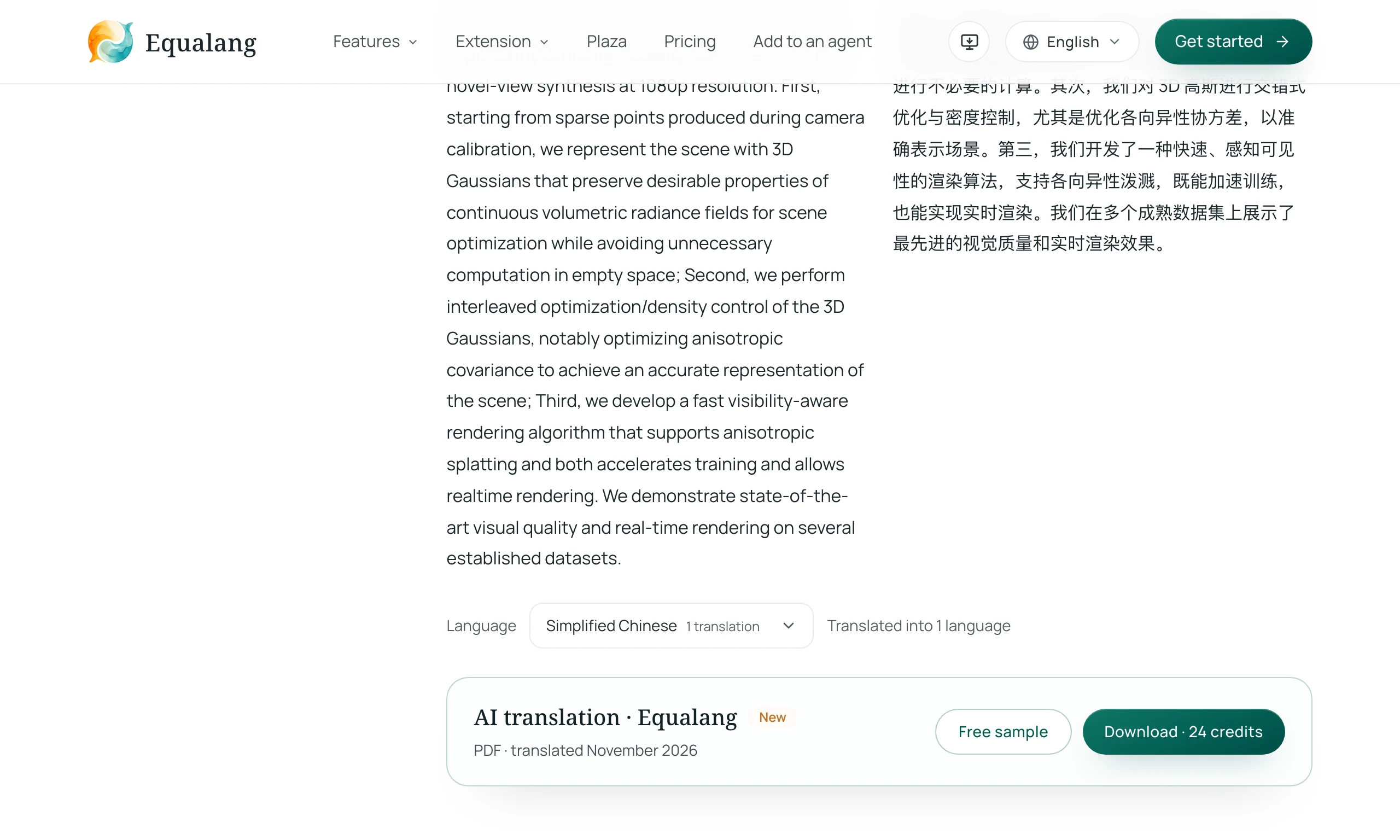
What You Can Do on Equalang Plaza
- Search 24,000+ open-access papers and public-domain books: Filter by All / Books / Papers and your target language, or search by title, author, or DOI in any language. The catalog indexes
CC BY,CC BY-SA, andCC0papers from OpenAlex, PubMed Central, and arXiv—including landmark papers such as the SIGGRAPH 2023 Best Paper 3D Gaussian Splatting for Real-Time Radiance Field Rendering (DOI10.1145/3592433). - Read originals for 0 credits and sample 20% side by side: After signing in, you can read or download the original paper for free (0 credits) and preview the first 20% of any existing translation at no cost, with the source and translation displayed side by side and synchronized scrolling enabled.
- Download full dual PDFs for 1/10 of standard credits: Instead of paying the full cost of a fresh translation job, downloading an existing Plaza edition costs 1/10 of standard translation credits (rounded up and displayed directly on the card—for example, 24 credits for the 14-page 3D Gaussian Splatting Chinese AI edition). Every PDF purchase gives you both a layout-preserved translated PDF (keeping two-column structure, figures, cross-references, and equations intact; see our AI paper formula translation breakdown) and a page-by-page alternating bilingual PDF that displays source on the left and translation on the right in any two-page PDF reader view.
- Translate new
CC BYpapers and earn credit refunds: If a brand-new open-access paper has no translation in your language yet, click Translate now on the Plaza entry (or Request this translation so popular requests get prioritized). Even better, if you translate aCC BY,CC BY-SA, orCC0paper yourself in Document Translation, click Share to the plaza at the top of the workspace (up to 3 submissions per day). Once approved, every other researcher who downloads your shared edition refunds 1/10 of your translation cost until your original spend is completely paid back.
Honest Boundaries You Should Know
- Sign-in is required: You must sign in to read or download 0-credit originals and to open the free 20% side-by-side preview.
- License rules strictly apply: Only public-domain works and open-access papers licensed under
CC BY,CC BY-SA, orCC0can be hosted or shared on Equalang Plaza. Many arXiv preprints are uploaded under arXiv's default non-exclusive license to distribute,CC BY-NC, orCC BY-ND. Those papers cannot be publicly shared on Plaza—though you can always translate them privately for your own research in Document Translation or directly inside your reference library via the Equalang Zotero Plugin. - Duplicate upload protection: If you upload a file to
/documentsthat already has a translation in your target language on Plaza, the workspace notifies you so you can jump to Plaza, sample 20% for free, and grab it at 1/10 the cost instead of paying for a redundant run.
How to Combine All Four Into a 20-Minute Daily Routine
- Morning scan (5 minutes on Cool Papers & Hugging Face Daily Papers): Open Cool Papers to sweep your primary arXiv categories using its one-click AI FAQ summaries, then check Hugging Face Daily Papers to see which releases already have open weights or Spaces demos.
- Sanity-check claims (5 minutes on alphaXiv): For the 2–3 papers that look promising, swap
arxiv.orgtoalphaxiv.orgto check whether other researchers have flagged baseline issues or asked clarifying questions on key equations. - Deep bilingual reading & archiving (10 minutes on Equalang Plaza): Search the paper's title or DOI on Equalang Plaza. Preview the first 20% side by side, download the layout-preserved and alternating bilingual PDFs for 1/10 of standard credits, and drop them into your local note system or reference library. If it is a brand-new
CC BYpreprint that nobody has translated yet, translate it in Document Translation and click Share to the plaza so your lab mates' downloads refund your credits.
Frequently Asked Questions
Does alphaXiv or Hugging Face Daily Papers translate full arXiv PDFs while keeping equations and layout intact?
No. Hugging Face Daily Papers focuses on community curation and linking papers to models and datasets, while alphaXiv adds an inline comment layer and interactive AI Q&A over the English preprint. When you need a downloadable, layout-preserved translated PDF or a page-by-page alternating bilingual PDF with equations kept in place, search for the paper on Equalang Plaza or translate the PDF in Document Translation.
Why can some arXiv papers be shared on Equalang Plaza while others cannot?
Equalang Plaza only hosts and accepts open-access papers with licenses that permit derivatives and commercial reuse—specifically CC BY, CC BY-SA, and CC0. If an author uploads a preprint under arXiv's default non-exclusive distribution license, CC BY-NC (Non-Commercial), or CC BY-ND (No Derivatives), copyright rules prevent it from being publicly listed on Plaza. You can still translate those PDFs privately in /documents.
How does the 1/10 credit download and sharing refund work on Equalang Plaza?
When a paper already has a translation on Equalang Plaza, signed-in users can sample the first 20% for free and download the full translated and bilingual PDFs for 1/10 of the standard translation credit cost (rounded up on the edition card, such as 24 credits for the 14-page 3D Gaussian Splatting paper). If you translate an eligible CC BY, CC BY-SA, or CC0 paper in /documents and share it to Plaza (up to 3 per day), each download by another reader refunds 1/10 of the credits you spent, up to your original translation cost.
Sources
- Hugging Face Daily Papers: https://huggingface.co/papers
- alphaXiv Interactive arXiv Reader: https://www.alphaxiv.org/
- Cool Papers Daily Feed: https://papers.cool/
- Equalang Plaza (Open-Access Papers & Public-Domain Books): https://equalang.com/plaza
- Equalang Plaza Edition — 3D Gaussian Splatting for Real-Time Radiance Field Rendering: https://equalang.com/v1/plaza/works/3d-gaussian-splatting-for-real-time-radiance-field-rendering-f467b4?locale=zh-CN
- Equalang Document Translation: https://equalang.com/documents
- Equalang Credit Rates API: https://equalang.com/v1/rates