
10 English Public-Domain Novels for B1–C1 Learners
In brief
Start reading classic English literature with 10 public-domain novels ranked from B1 to C1, plus free Standard Ebooks EPUBs and bilingual previews.
Keywords: English public domain novels for intermediate learners; classic English books for B1 B2 learners; easy classic novels to read in English; free English classics EPUB; read English novels with bilingual translation
Jumping from simplified graded readers to unabridged classic literature is where many intermediate English learners stall. If you pick up Pride and Prejudice or Jane Eyre as your very first classic novel, nineteenth-century subordinate clauses and unfamiliar social idioms can turn every page into a slow dictionary drill.
The fix is not going back to abridged textbooks. It is sequencing unabridged public-domain novels by sentence architecture, chapter length, and narrative style—starting with brisk B1 episodic stories and modern scientific prose before tackling Victorian Gothic or Regency irony. Because these works are in the public domain, you can download typography-checked English editions for free or read them with side-by-side translation on Equalang Plaza whenever a complex passage slows you down.
The 10-Book Progression: From B1 Episodic Prose to C1 Classics
Publication date alone is a poor guide to reading difficulty. An 1895 science-fiction novella like H. G. Wells's The Time Machine uses far cleaner, more direct syntax than an 1813 drawing-room novel. The table below orders ten verified public-domain classics from approachable B1 entry points to rich C1 literary prose.
Stage 1 (B1 to Low B2): Fast Momentum and Linear Storytelling
When you transition out of graded readers, your primary enemy is fatigue across long chapters. The first three books on this list keep scenes concrete and self-contained.
1. Alice's Adventures in Wonderland (Lewis Carroll, B1)
Carroll wrote Alice to be read aloud to children, which keeps the baseline grammar straightforward and the chapters brief. You will meet frequent dialogue tags, movement verbs, and everyday nouns. The main linguistic quirk is deliberate nonsense and wordplay—when the Mouse puns on "mine" and "tail/tale," do not assume your grammar failed. Treat the riddles as playful bonuses while enjoying a book you can finish in a weekend.
2. The Adventures of Tom Sawyer (Mark Twain, B1–B2)
Twain's third-person narration is vivid and accessible, driven by pranks, bargaining, and small-town suspense. The one hurdle every intermediate learner notices is the phonetic spelling of nineteenth-century Mississippi River dialect in the dialogue (such as "warn't" for "wasn't" or "hain't"). Reading tricky dialogue lines aloud—or glancing at a parallel translation for two seconds—unlocks the rhythm quickly without breaking the story.
3. The Time Machine (H. G. Wells, B1–B2)
If you prefer adult themes over childhood adventures, start here. At roughly 32,000 words, Wells's novella is less than a third the length of a standard Victorian novel. The Time Traveller recounts his journey to the year 802,701 in lucid, observational prose trained by Wells's background in biology and journalism. Because the plot follows a single linear hypothesis—observing a future world and deducing how it evolved—context clues carry you through unfamiliar adjectives.
Stage 2 (Solid B2): Episodic Mysteries and Domestic Realism
Once you are comfortable reading twenty pages of English at a stretch, you are ready for standard B2 vocabulary where social nuance and deduction take center stage.
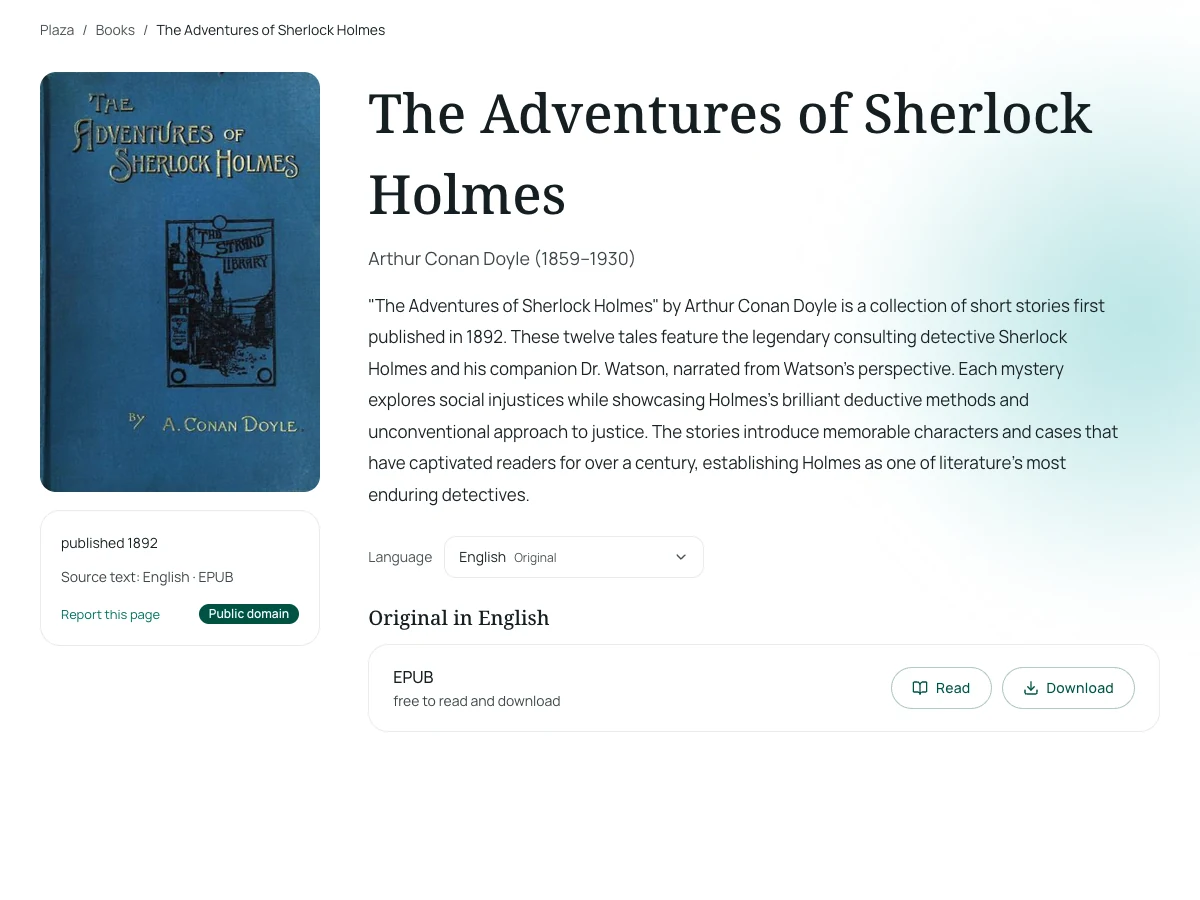
4. The Adventures of Sherlock Holmes (Arthur Conan Doyle, B2)
Full-length Victorian novels often bog learners down in subplots, but Conan Doyle's 1892 collection gives you twelve standalone cases averaging 25 pages each, starting with "A Scandal in Bohemia" and "The Red-Headed League." Dr. Watson narrates in clear, journalistic Victorian English. Every story follows a predictable structural arc—client arrival, clues, investigation, and Holmes's step-by-step explanation—which reinforces comprehension even when you meet period vocabulary like hansom cab or gasogene.
5. Little Women (Louisa May Alcott, B2)
For learners who want high-frequency conversational English, emotional vocabulary, and household idioms, Alcott's portrait of the four March sisters remains unmatched. Each chapter works almost like a television episode with a clear domestic conflict and resolution. The vocabulary leans heavily toward family life, character traits, and everyday feelings, making it much more transferable to modern spoken English than gothic or nautical fiction.
6. The Picture of Dorian Gray (Oscar Wilde, B2)
Wilde's only novel alternates between lush sensory descriptions and rapid-fire drawing-room banter. Lord Henry Wotton speaks in paradoxical one-liners ("The only way to get rid of a temptation is to yield to it"). Grammatically, these epigrams use clean parallel structures—antithesis, inversion, and balanced clauses—that make an excellent masterclass for intermediate learners studying how English rhythm creates emphasis.
Stage 3 (Upper B2 to C1 Bridge): Modern Classics and Epistolary Thrillers
At upper B2, you can handle richer imagery and shifting points of view, provided the book's structure keeps you anchored.
7. The Great Gatsby (F. Scott Fitzgerald, B2)
Because works published in 1925 entered the United States public domain in 2021, intermediate learners can now read one of the defining novels of twentieth-century American literature for free. Nick Carraway's narration is modern in grammar—free of nineteenth-century archaisms—yet rich in impressionistic colour and metaphor. Across just nine tightly edited chapters, you get Jazz-Age dialogue alongside lyric descriptions that bridge B2 comprehension and C1 stylistic appreciation.
8. Dracula (Bram Stoker, B2–C1)
Dracula looks intimidating at roughly 160,000 words, but its epistolary structure—assembled entirely from Jonathan Harker's journal entries, Mina Murray's letters, newspaper clippings, and Dr. Seward's phonograph diaries—makes it surprisingly approachable. Instead of facing forty-page chapters, you read dated entries of two to five pages each. The urgency of first-person diary prose keeps sentences direct, with only occasional regional dialect in minor sailors' logs.
Stage 4 (C1): Mastering Regency Irony and Gothic Depth
When you reach C1, the challenge shifts from knowing individual words to tracking irony, unstated social tension, and multi-layered clauses.
9. Pride and Prejudice (Jane Austen, C1)
Austen's vocabulary is actually smaller and more abstract than Dickens's or Brontë's, using words like civility, consequence, amiable, and sensible (in its older sense of "sensitive/aware"). What makes Pride and Prejudice a C1 milestone is its syntax and irony: characters say the polite opposite of what they mean inside balanced, multi-clause Regency sentences. Having a side-by-side translation open while reading the first five chapters helps you calibrate to Austen's dry wit so you never miss a punchline.
10. Jane Eyre (Charlotte Brontë, C1)
Brontë's first-person autobiography combines intense psychological reflection with a vast descriptive lexicon covering Yorkshire moorlands, Victorian architecture, and moral conflict. Sentences lengthen when Jane reflects on injustice or passion, then sharpen into tense, minimalist exchanges during her dialogues with Mr. Rochester. Finishing Jane Eyre comfortably in the original English is a genuine benchmark of advanced reading fluency.
Where to Read and Download These 10 Classics: Standard Ebooks vs. Equalang Plaza
Not all free public-domain files treat readers well; poorly OCR-scanned files often have broken quotation marks, missing chapter breaks, and mangled italics. Depending on whether you want a monolingual file for your e-reader or a bilingual setup, two verified sources stand out:
- Standard Ebooks (
https://standardebooks.org/) for monolingual e-readers: Standard Ebooks takes public-domain texts and applies modern professional typography, curly quotes, clean semantic markup, and high-resolution covers. You can download EPUB, AZW3, or Kepub files directly without creating an account. If you want to load a pure English edition onto an e-ink screen, see our guide on how to translate an ebook and read it on Kindle or compare other archives in our overview of Open Library alternatives for public-domain ebooks. - Equalang Plaza for side-by-side bilingual reading and 1/10-credit translated downloads: All ten novels in this guide are available on Equalang Plaza, which curates public-domain books (from sources such as Standard Ebooks, Wikisource, and Aozora Bunko) alongside open-access research papers (
CC BY,CC BY-SA, andCC0).
If you use Equalang Plaza to support your reading, keep these practical rules and boundaries in mind:
- Sign-in required for free originals and 20% bilingual previews: Once signed in, you can read or download the original English EPUB of any of these ten classics for 0 credits. You can also read the first 20% of any available translation for free in the browser, with the English original and your target language displayed side by side with synchronized scrolling. For tips on using parallel text without becoming dependent on it, read our walkthrough on how to read English books with bilingual immersion.
- 1/10-credit full translation downloads: If you decide you want the complete translated edition after sampling the 20% preview, downloading a full translation from Plaza costs 1/10 of the standard document translation price (rounded up and displayed on the work's page). The downloaded file keeps the original format—an EPUB book downloads as an EPUB, while a PDF purchase includes both a layout-preserved translated PDF and an alternating-page bilingual PDF.
- Requesting or translating missing languages: Not every classic on Plaza already has a completed translation in every target language. If your preferred language is not listed yet, you can click "Want this translation" to register demand (popular works are prioritized) or click "Translate now" to run a full translation directly from the verified Plaza source file. Conversely, if you upload a file to the document translator that already has a translation on Plaza, Equalang prompts you so you can grab the Plaza edition instead of paying for a duplicate translation.
- Public-domain and open-license boundary: Plaza only hosts and accepts public-domain works and open-access papers under
CC BY,CC BY-SA, orCC0licenses. Works under copyright or carryingNC(Non-Commercial) orND(No-Derivatives) restrictions cannot be shared to Plaza. If you translate an eligible public-domain book that is not yet on Plaza and share it (up to 3 submissions per day, subject to copyright review), you earn back 1/10 of your translation cost each time another reader downloads it, capped at your original translation spend.
Pick one book from Stage 1 or Stage 2 today—The Time Machine for a brisk sci-fi weekend or The Adventures of Sherlock Holmes for a 25-page mystery tonight—open the first chapter on Equalang Plaza or download the EPUB from Standard Ebooks, and build your classic reading habit one manageable chapter at a time.
Frequently Asked Questions
Which classic English novel is easiest for a B1 intermediate learner to finish first?
Alice's Adventures in Wonderland and H. G. Wells's The Time Machine are the two most approachable starting points. Alice uses short episodic chapters and everyday action verbs, while The Time Machine is a compact ~32,000-word novella written in clear, linear scientific prose that avoids sprawling Victorian subplots.
Why is The Great Gatsby now available as a free public-domain ebook?
First published in 1925, F. Scott Fitzgerald's The Great Gatsby entered the United States public domain on January 1, 2021, after its 95-year US copyright term expired. That allows archives like Standard Ebooks and platforms like Equalang Plaza to offer the complete, unabridged 1925 text legally.
Can I read these classic novels with side-by-side translation for free on Equalang Plaza?
Once you sign in to Equalang Plaza, you can read and download the original English editions for 0 credits and preview the first 20% of any existing translation side by side with synchronized scrolling for free. Downloading the full translated book in its original format costs 1/10 of the standard translation credit rate.