English, Chinese, or Both: Which Subtitles Help You Learn Faster?
 Equalang
In brief
Not sure which subtitles to use when watching shows? Here is a practical guide on what each setting trains, when to switch, and how to use dual subtitles.
Keywords: language learning subtitles; dual subtitles; learning with TV shows; subtitle settings; language immersion
When you sit down to watch a show in a language you are learning, you inevitably face the subtitle dilemma: English subtitles, Chinese subtitles, or both?
It is easy to see why this question comes up so often. Choosing your native language feels like cheating: an hour passes, you enjoy the episode, but your ears barely process a single foreign sound. Switching to target-language subtitles only can be brutal: ten minutes in, you miss three crucial plot points, get exhausted looking up vocabulary, and feel like closing the video. Turning on dual subtitles seems like the obvious compromise, yet your eyes instinctively gravitate toward the familiar translation line, leaving the original text unread.
There is no permanent, one-size-fits-all answer. Neither mode is inherently "better" than the others; rather, each setting trains a distinct cognitive skill. The key to making rapid progress lies in understanding what each option actually trains, knowing when to switch, and setting up dual subtitles so they act as a supportive scaffold rather than a passive crutch.
What Each Subtitle Mode Actually Trains
To choose the right setting, it helps to look honestly at how your brain processes each combination of audio and text.
- Native-language subtitles (translation only): This mode maximizes entertainment and plot comprehension. However, the human brain naturally follows the path of least resistance. When your native language is on screen, your auditory system treats the foreign dialogue as ambient background noise. It is great for relaxing after a long workday, but it provides minimal listening or vocabulary gains.
- Target-language subtitles (original only): This setting builds the bridge between sound and spelling or characters. You learn where word boundaries fall in rapid connected speech, recognize recurring colloquial expressions, and improve your reading speed. The limitation is cognitive fatigue: if the gap between your current comprehension and the dialogue is too wide, frustration quickly sets in.
- Dual subtitles (original plus translation): Dual subtitles offer an immediate safety net. You can follow natural, unsimplified content without pausing every thirty seconds. The primary challenge is visual discipline: because your native language is processed almost instantaneously, your eyes can easily lock onto the translation line while ignoring the target language altogether.
A Stage-by-Stage Roadmap: When to Switch
Rather than sticking with one setting forever, treat subtitles as a dial that you adjust as your comprehension grows.
Stage 1: Beginner to Lower-Intermediate (Building Vocabulary and Ear)
At this stage, watching with target subtitles alone often leads to total disengagement. If you lose the storyline, you lose the motivation to keep watching.
Use dual subtitles during this phase. The goal is not to understand every grammatical nuance on first listen, but to maintain continuous immersion while building an initial bank of high-frequency words and sentence patterns. Seeing the translation directly alongside the original dialogue prevents frustration and keeps you engaged with native material.
Stage 2: Intermediate to Upper-Intermediate (Bridging the Comprehension Gap)
Once you can comfortably catch basic conversational exchanges, make target-language subtitles your default setting for everyday genres like contemporary slice-of-life dramas, comedy series, or conversational vlogs.
Reserve dual subtitles for content with dense information, unfamiliar terminology, or rapid delivery—such as documentaries, technical discussions, or when watching online courses with bilingual subtitles. If you encounter an episode where the dialogue moves too fast, switch dual subtitles back on temporarily to maintain comprehension, then return to target-language subtitles for simpler scenes.
Stage 3: Advanced (Real-World Fluency)
At an advanced level, reading subtitles—even in your target language—can become a subtle crutch that slows down real-time audio processing.
Make a habit of turning subtitles completely off for routine dialogue. This forces your brain to rely entirely on acoustic cues, intonation, and conversational pacing. Re-enable target-language subtitles only when dealing with heavy regional accents, rapid-fire slang, muffled audio tracks, or specialized domain jargon.
How to Use Dual Subtitles Without Leaning on the Translation
Dual subtitles only work if you actively manage where your eyes land. Here are three practical habits to keep the original language front and center:
1. Establish an "Original First" Eye Track
Train yourself to look at the original subtitle line first as the character speaks. Listen to the audio and attempt to parse the sentence from the target text. Only drop your eyes to the translation line if you encounter an unfamiliar term or lose the thread of the sentence.
2. Adjust Subtitle Hierarchy and Position
Visual layout plays a major role in preventing your gaze from wandering. Placing the translation line in a secondary position makes a substantial difference.
Below, we will demonstrate using the Equalang browser extension to provide side-by-side bilingual subtitles on platforms like YouTube and Netflix. While video platforms often provide native single-track captions, and third-party tools offer dual displays, language learners specifically need control over visual priority.
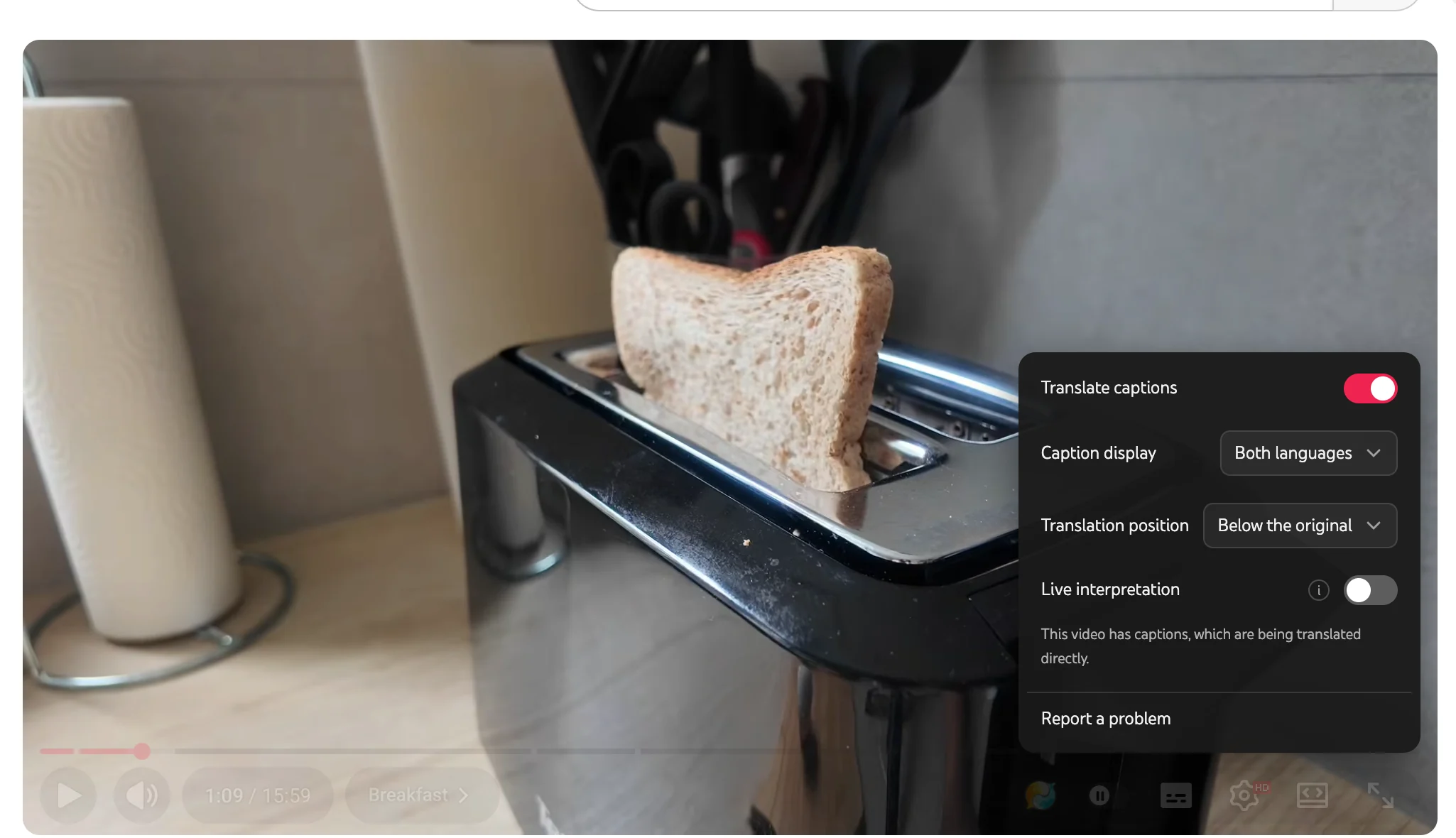
Inside the Equalang caption panel in the player, you can enable caption translation, set caption display to both languages, and place the translation below the original text. Keeping the translation positioned underneath the original text allows you to focus your line of sight on the target language, glancing downward only when you need quick clarification.

When working with video content that already has a subtitle track, the tool translates existing captions side by side. For videos without pre-existing subtitle tracks, real-time transcription is available where supported, though heavy background music or sound effects can affect accuracy.
3. The Three-Minute Rewatch Loop
Instead of trying to analyze an entire 45-minute episode in detail, pick one short, interesting scene—about two to three minutes long—and apply a short loop:
- First pass: Watch with dual subtitles to ensure you fully grasp the context, humor, and vocabulary.
- Second pass: Rewatch the same scene immediately with target-language subtitles only, paying close attention to how each word is pronounced and connected.
- Third pass (optional): Turn subtitles off entirely and see how much your ear can track based purely on sound.
Because the scene is short and the plot is already clear, this targeted repetition trains listening comprehension without turning your viewing time into a slog.
How to Collect Words Without Ruining the Show
A common pitfall that ruins the joy of watching shows is hitting the pause button every time an unfamiliar word appears. Pausing every thirty seconds turns an enjoyable story into an exhausting vocabulary drill.
To build your vocabulary effectively:
- Filter for repetition and plot relevance: Ignore one-off obscure terms unless they are central to the scene. If you notice a word appearing two or three times across an episode, that is your signal to note it down.
- Collect complete short phrases: When recording a word, write down the three-to-five-word phrase it appeared in. Context anchors meaning and shows you natural preposition pairings and verb combinations.
- Pair video immersion with reading: Video trains quick auditory processing, while text reinforces structure and vocabulary depth. If you want to expand your vocabulary further across both mediums, combining video listening with bilingual immersion reading helps you encounter the same words in different formats until they become second nature.
Finding the Rhythm That Works for You
You do not need to feel guilty for keeping a translation visible while watching shows, nor do you need to endure total confusion just to prove you are practicing "pure immersion."
Start with the setting that lets you follow the story comfortably. Use dual subtitles as an anchor to understand unfamiliar phrases, practice prioritizing the original text with your eyes, and step up to the next subtitle stage when your current level starts feeling easy. Consistent, enjoyable exposure will always take you further than an exhausting routine you dread opening.