
DOAB vs. OAPEN: Free Open-Access Academic Books Compared
In brief
Compare DOAB and the OAPEN Library for finding free peer-reviewed university press books, checking Creative Commons licenses, and reading PDFs.
Keywords: doab vs oapen open access academic books; directory of open access books; oapen library vs doab; free university press open access books; open access monographs pdf
DOAB (Directory of Open Access Books) and the OAPEN Library are sister scholarly infrastructures, not competing bookstores: DOAB is a global discovery directory indexing 80,000+ peer-reviewed open-access academic books across 700+ publishers, while the OAPEN Library is a dedicated full-text hosting and digital preservation repository. When you search DOAB, your download link may send you either to a publisher's own platform (such as Cambridge University Press, MIT Press, or Springer Nature) or directly to an OAPEN Library record where the full-text PDF or EPUB is stored. Both platforms give you free, legal access to original-language monographs, whereas Equalang Plaza adds side-by-side bilingual reading and low-cost translated editions for works published under permissive licenses (CC BY, CC BY-SA, CC0) or in the public domain.
DOAB vs. OAPEN Library vs. Equalang Plaza at a Glance
How DOAB Works: The Global Discovery Index for Peer-Reviewed Monographs
Jointly operated by the OAPEN Foundation and OpenEdition, the Directory of Open Access Books (DOAB) functions like the monograph equivalent of DOAJ (Directory of Open Access Journals). Rather than storing every book file on its own servers, DOAB vets academic publishers for transparent peer-review standards and open-access licensing procedures, then aggregates chapter- and book-level metadata into a single searchable catalog.
When you need a comprehensive survey across university presses and commercial scholarly imprints, DOAB is usually the strongest starting point:
- Broad publisher coverage: DOAB indexes over 80,000 peer-reviewed monographs and edited collections from more than 700 publishers, including Cambridge University Press, MIT Press, Springer Nature, De Gruyter, Taylor & Francis, Brill, and Amsterdam University Press.
- Granular license and language filtering: You can filter search results by exact Creative Commons license (
CC BY 4.0,CC BY-NC-ND, etc.), publication language (English, German, French, Spanish, Italian, Portuguese, and more), publisher, and subject classification. - Verified peer-review quality assurance: Every publisher listed in DOAB must document its academic peer-review process, making it easy for researchers and librarians to distinguish legitimate open-access monographs from unreviewed self-published PDFs.
The main caveat with DOAB is that it is a directory, not a single file host. Clicking a book's reading link in DOAB routes you to whichever platform actually hosts the file—sometimes the OAPEN Library, sometimes OpenEdition Books (where HTML reading may be free while PDF/EPUB downloads vary by press), and sometimes a publisher's own portal where chapters are split into separate PDFs.
How the OAPEN Library Works: Direct Full-Text Hosting and Funder Preservation
The OAPEN Library (library.oapen.org) is the full-text repository layer run by the non-profit OAPEN Foundation based in the Netherlands. Many university presses lack the technical infrastructure to guarantee long-term open archiving, and major European research funders require grantees to deposit open-access monographs in a certified repository. OAPEN fills both roles.
Going directly to the OAPEN Library makes sense when you want immediate, single-file downloads or need to track grant-funded scholarship:
- Guaranteed full-text file hosting: Every record in the OAPEN Library stores the downloadable book file directly (most commonly as a complete single-file PDF, and frequently in EPUB format as well) alongside MARCXML, KBART, and ONIX metadata feeds for university library catalogs.
- Funder collection browsing: OAPEN maintains dedicated collections for monographs funded by the European Research Council (ERC), Horizon Europe, UK Research and Innovation (UKRI), the Austrian Science Fund (FWF), and the Swiss National Science Foundation (SNSF).
- Persistent identifiers and preservation: Hosted titles receive stable handle URLs and DOIs, avoiding the broken links that often occur when small departmental presses redesign their websites.
Because OAPEN only lists books that are physically deposited in its repository (or aggregated through its partner nodes), its total catalog is smaller than DOAB's directory. If a university press hosts its open-access titles exclusively on its own website without depositing files into OAPEN, you will find that book in DOAB, not in the OAPEN Library.
Why Creative Commons Licenses Matter Before You Translate or Share a Monograph
For researchers reading outside their native language, downloading a 350-page monograph from DOAB or OAPEN is only half the workflow—the real bottleneck is working through dense theoretical prose, methodological footnotes, and domain terminology in a second language. Before using any translation or sharing platform, check the License field on the DOAB or OAPEN record page.
Open-access academic books generally fall into two licensing groups:
- Permissive open licenses (
CC BY 4.0,CC BY-SA,CC0): Thousands of monographs—especially those funded by Horizon Europe, ERC, UKRI, or Wellcome—carry aCC BYorCC BY-SAlicense. These licenses explicitly permit adaptations, translations, and platform redistribution across any medium, provided the original authors, publisher, and license are properly credited. - Restricted open licenses (
CC BY-NC,CC BY-ND,CC BY-NC-ND): Roughly half of the titles listed in DOAB and the OAPEN Library include Non-Commercial (NC) or No-Derivatives (ND) clauses. You are completely free to read and download these PDFs on your own device, and you can translate your own copy privately for personal research, but they cannot be publicly redistributed as translated editions on a commercial platform.
If you are comparing undergrad and graduate instructional materials rather than research monographs, see our companion guide on OpenStax vs. LibreTexts for free bilingual textbooks, which breaks down how textbook licenses work across STEM fields.
How to Read and Share CC BY Monographs Bilingually on Equalang Plaza
While DOAB and the OAPEN Library solve discovery and original-file preservation, they only deliver monographs in their original publication language. Equalang Plaza bridges the cross-language gap for public-domain books and permissively licensed (CC BY, CC BY-SA, CC0) open-access monographs and papers.
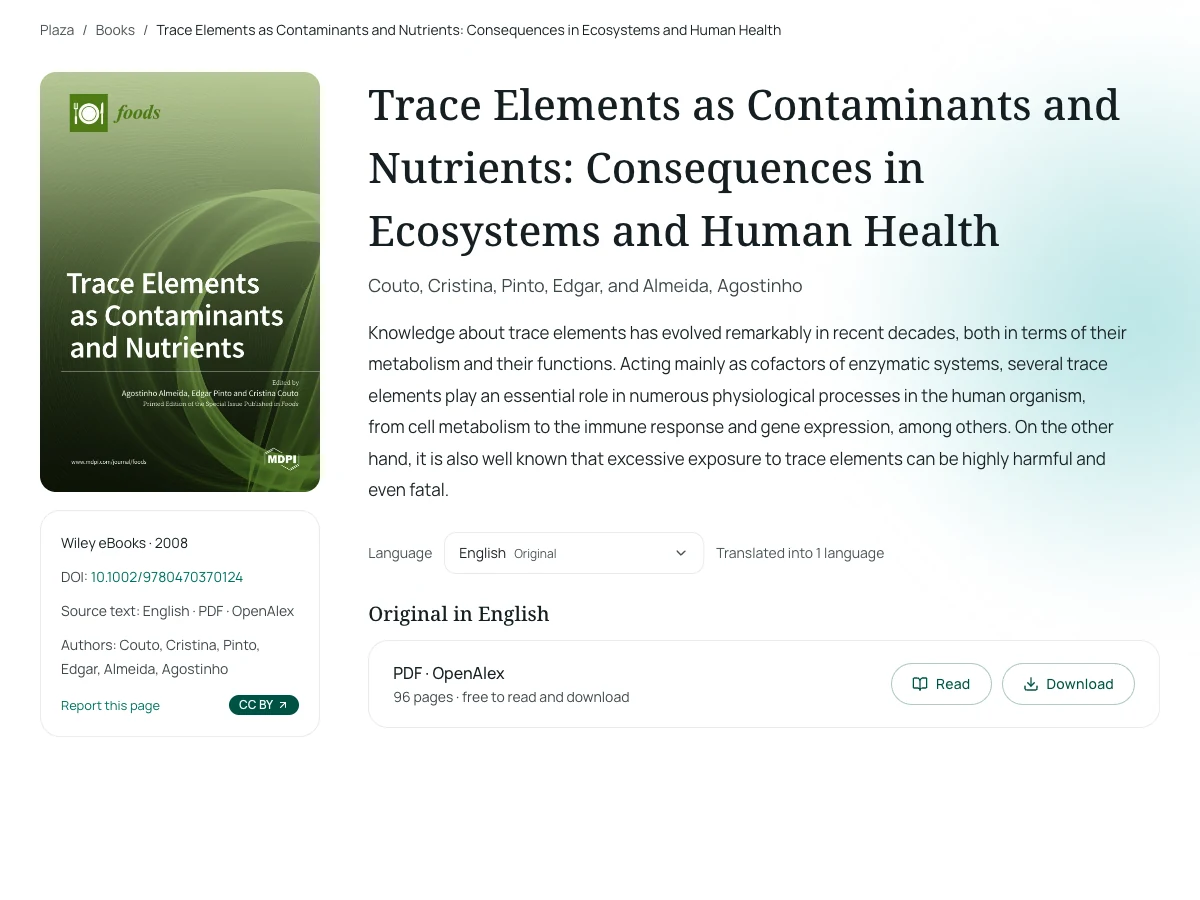
On Equalang Plaza, you can search by book title, author, or DOI in any language, or filter by Books and your target language (including open-access university press and Wiley volumes such as Trace Elements as Contaminants and Nutrients). Here is how the Plaza workflow fits into your literature review:
- 0-credit original access and free 20% side-by-side preview: Once signed in, you can read and download the original monograph for free (0 credits) and preview the first 20% of any available translation for free with the original and translation aligned side by side in synchronized scrolling. Sampling the first 20% covers the table of contents, introduction, and opening literature review chapters so you can confirm whether the book is relevant to your thesis before spending a single credit.
- 1/10-credit full downloads with bilingual PDFs: If you decide to read the entire translated monograph, downloading the full edition costs 1/10 of the standard translation credits (rounded up and displayed clearly on the work page). Downloaded files keep the source format (EPUB outputs EPUB; PDF purchases include both a layout-preserved translated PDF and a page-by-page alternating bilingual PDF), and you can read the full text online or re-download anytime after purchase.
- Request or translate missing editions: If a monograph on Plaza does not yet have a translation in your target language, you can click Want this translation to register demand (high-demand works are prioritized for translation) or translate the Plaza source file immediately. Also, if you upload a file to translate privately and Plaza already has an edition in that language, Equalang notifies you so you can sample or download the Plaza copy at 1/10 the cost instead of paying for a duplicate translation.
- Share
CC BYtranslations to earn back your credits: When you download aCC BY,CC BY-SA, orCC0monograph from DOAB or OAPEN that is not yet in Plaza and translate it via Document Translation, you can click Share to the plaza at the top of the workspace after translation finishes (up to 3 submissions per day, listed after copyright review). Each time another reader downloads your shared edition, you receive 1/10 of your original translation credit cost back, up to the total credits you spent translating that book.
How to Translate CC BY-NC or CC BY-NC-ND Books Privately
What if the monograph you found in DOAB or the OAPEN Library carries a CC BY-NC or CC BY-NC-ND license? Because Equalang Plaza respects licensing boundaries and never lists NC, ND, or all-rights-reserved books for public sharing, the right workflow for those volumes is private translation in Document Translation.
- Download the full-text PDF or EPUB from the OAPEN Library or the publisher link provided in DOAB.
- Upload the file to Document Translation: You upload one file at a time (you can queue as many files one after another as you need; each account runs up to 3 documents concurrently and queues the rest automatically).
- Read with preserved scholarly structure: Equalang reconstructs multi-column layouts, running headers and footers, figure captions, footnote hierarchies, complex tables, and inline or display equations. Sentences split across page breaks are rejoined before translation so theoretical arguments stay coherent, and table-of-contents links and internal cross-references continue pointing to their target pages. For a deeper walkthrough of long academic PDFs, read our guide on how to translate and read PDF documents.
One practical limitation to keep in mind: while document translation keeps structural hierarchy and bold or italic emphasis mapped to corresponding terms, font sizing and line wraps adjust automatically when translated text expands or contracts, and dense scanned archival PDFs without clean text layers may occasionally show minor layout shifts around tight diagram labels.
Frequently Asked Questions
What is the difference between DOAB and the OAPEN Library?
DOAB (doabooks.org) is a searchable discovery directory indexing metadata for over 80,000 peer-reviewed open-access books across 700+ publishers, linking out to wherever each book is hosted. The OAPEN Library (library.oapen.org) is a dedicated full-text repository operated by the OAPEN Foundation that directly hosts and preserves tens of thousands of downloadable PDF and EPUB monographs on its own servers.
Are all books in DOAB and OAPEN free to download as full PDFs?
All books listed in DOAB and the OAPEN Library are peer-reviewed and free to read online under open-access terms. In the OAPEN Library, full-text PDFs (and often EPUBs) are always directly downloadable at no cost. In DOAB, most links lead to free full-book PDFs on OAPEN or university press websites, though a few partner platforms (such as certain OpenEdition Books collections) provide free full-text HTML reading online while selling print or e-reader formats separately.
Which DOAB and OAPEN books can be shared on Equalang Plaza?
Only public-domain books and open-access works published under CC BY, CC BY-SA, or CC0 licenses can be hosted or shared via Share to the plaza on Equalang Plaza (subject to copyright review, up to 3 submissions per day). Monographs carrying NC (Non-Commercial) or ND (No-Derivatives) restrictions cannot be shared publicly on Plaza, though you can download them from DOAB or OAPEN and translate them privately for your own research in Document Translation.