
How to Watch Nobel Week 2026 Lectures Live with Subtitles
In brief
Nobel Week 2026 lecture schedule, live stream channels, and how to watch with live bilingual subtitles in your native language.
Keywords: Nobel Week 2026; Nobel Prize lectures; live subtitles; Nobel live stream; English subtitles; bilingual translation
Watching the Nobel Lectures Live: The Academic Language Barrier
Every year in early December, newly named laureates gather in Stockholm and Oslo for Nobel Week. From December 7 to 10, 2026, the laureates will present their official Nobel Prize lectures, breaking down the discoveries that earned them the prize—from optogenetics and asymmetric autocatalysis to astroparticle physics.
For students, researchers, and science enthusiasts across the globe, tuning into the live stream is the first chance to hear these breakthroughs described by the scientists themselves. But watching live presents an immediate hurdle: the lectures are delivered in rapid, specialized academic English packed with discipline-specific terminology. The Nobel streams have no live translation into other languages, and keeping up with the slides while deciphering complex spoken remarks can be exhausting. Waiting days for edited transcripts or community translations means missing the excitement of the live event.
Here is the complete schedule for the 2026 Nobel Prize lectures, where to watch them live, and how you can follow the presentations in real time with synchronized bilingual subtitles.
Nobel Week 2026 Lecture Schedule and Time Zones
All lecture times are announced in Central European Time (CET). Below is the schedule converted to UTC and US Eastern Time (ET):
- December 7 (Monday)
- Physiology or Medicine Lecture: 14:00 CET (13:00 UTC / 8:00 AM ET) at Karolinska Institutet Aula Medica. Laureates: Karl Deisseroth, Peter Hegemann, and Georg Nagel.
- Literature Lecture: 17:00 CET (16:00 UTC / 11:00 AM ET) at the Swedish Academy. Laureate: Anne Carson.
- December 8 (Tuesday) — Stockholm University Aula Magna
- Physics Lecture: 10:05–10:40 CET (09:05–09:40 UTC / 4:05–4:40 AM ET). Laureate: Francis Halzen.
- Chemistry Lecture: 10:55–12:10 CET (09:55–11:10 UTC / 4:55–6:10 AM ET). Laureates: Henri B. Kagan and Kenso Soai.
- Economic Sciences Lecture: 14:00–15:15 CET (13:00–14:15 UTC / 8:00–9:15 AM ET). Laureates: Robert E. Hall and Michael Woodford.
- December 9 (Wednesday)
- Nobel Week Dialogue ("Life with AI"): 10:00–15:30 CET (09:00–14:30 UTC / 4:00–9:30 AM ET).
- December 10 (Thursday)
- Stockholm Prize Award Ceremony: 16:00 CET (15:00 UTC / 10:00 AM ET) at the Stockholm Concert Hall.
- (Note: The Nobel Peace Prize ceremony for Navi Pillay takes place separately in Oslo on December 10.)
How to Watch on YouTube with Real-Time Bilingual Subtitles
Official live streams for each lecture are hosted on the Nobel Prize YouTube channel and linked directly from the nobelprize.org press programme.
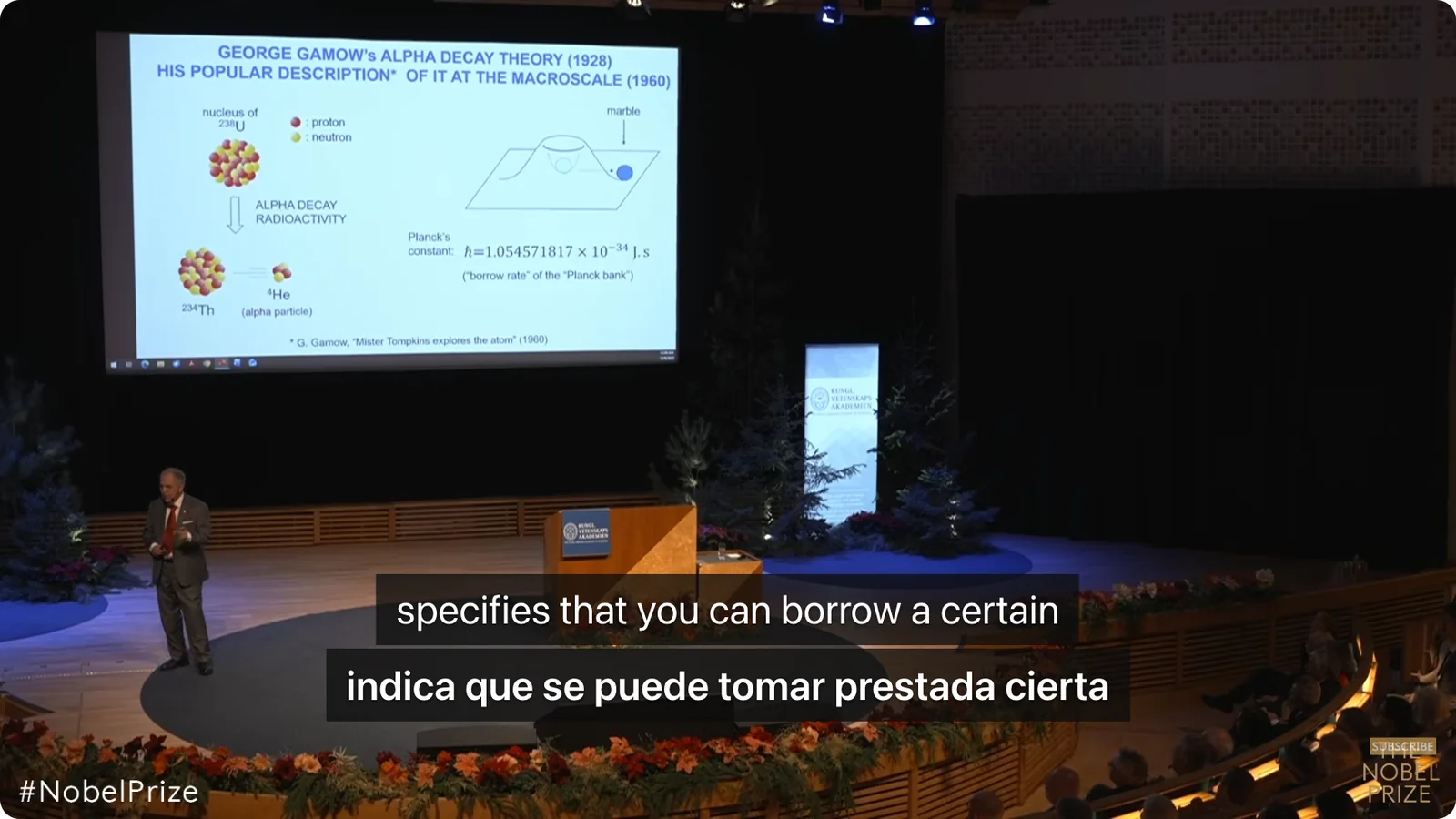
When watching on desktop via Chrome, Edge, or Firefox, you can use the Equalang browser extension to generate side-by-side bilingual subtitles:
- If the stream provides captions: When YouTube has native or automated English captions enabled, Equalang translates the captions into your preferred target language, showing the original English text and the translated text together directly on the screen.
- If the stream lacks captions: If the live broadcast does not include a caption track, Equalang's live interpretation mode can listen to the stream's audio in real time, transcribing the English speech and generating bilingual subtitles automatically.
- Synchronized delivery: In live interpretation the stream plays about 10 seconds behind real time so each line can appear as it is spoken.
Watching on nobelprize.org or Mobile Devices
If you prefer watching the video embedded on the official Nobel Prize website or want to follow along on a phone or tablet:
- Open Live Listening in your mobile or secondary browser.
- Place your phone or tablet near your computer or television speakers.
- Set the spoken language to English and select your target reading language. The tool will capture the live audio and display a continuous, scrolling transcript with original sentences and translations stacked.
Lecture Replays and Practical Tips
- Watching replays: If the lecture takes place during your working hours or middle of the night, the lectures of past years are on the Nobel Prize YouTube channel (e.g. the 2025 lectures), so replays can usually be watched there afterwards. You can use the Equalang extension on replays just as you would during a live event. For more examples on following technical talks, see our guide on following foreign academic lectures and AWS re:Invent 2026 keynote subtitles.
- Ceremony speeches in Swedish: While the prize lectures are usually given in English, the Stockholm Award Ceremony on December 10 features introductory presentations delivered primarily in Swedish. Because Swedish is currently not included in Equalang's speech recognition catalog, live audio interpretation cannot process the Swedish ceremony remarks.
- Audio clarity: Live speech interpretation works best with clear speech in the video. In dense academic presentations, background audio interference inside the video (such as overlapping auditorium chatter or opening music) may occasionally cause minor transcription inaccuracies.