
How to Find and Read Free Nature, Science & Cell OA Papers
In brief
Filter legally free Open Access papers from Nature, Science, Cell, and sister journals via OpenAlex and Europe PMC, and read CC BY PDFs bilingually.
Keywords: nature open access papers; read nature science cell papers free; nature communications open access; europe pmc open access filter; bilingual scientific pdf reader
Seeing a citation from Nature, Science, or Cell—often called the CNS triad—causes many independent researchers, graduate students, and clinicians outside major university networks to close the tab before clicking the DOI. For decades, flagship scientific publishing meant steep institutional subscriptions or single-article paywalls.
That reflex is now outdated for a massive share of top-tier research. Between fully open-access sister journals and strict open-science mandates from global funders, tens of thousands of CNS ecosystem papers are published every year under permissive licenses such as CC BY 4.0. Once you know how to filter for them in academic indexes—and how to read dense, two-column PDFs side by side in your own language—you can build a frontier reading habit without hitting paywalls.
Why So Much of the Nature, Science, and Cell Ecosystem Is Legally Free
Two structural shifts in academic publishing have opened up the CNS catalog:
- 100% Gold Open Access Sister Journals: All three flagship publishers run high-impact sister journals where every single research article is free to read and reuse from day one, predominantly under
CC BY 4.0. These include Nature Communications, Scientific Reports, Communications Biology, Communications Physics, and Communications Chemistry from Springer Nature; Science Advances from AAAS; and Cell Reports, Cell Reports Medicine, iScience, and Patterns from Cell Press. - Transformative and Funder-Mandated OA in Flagship Nature, Science, and Cell: When a study in flagship Nature, Science, or Cell is funded by the US National Institutes of Health (NIH), the Howard Hughes Medical Institute (HHMI), the Wellcome Trust, the European Research Council (ERC), the Max Planck Society, or Plan S coalition members, the authors or institutions frequently publish the version of record immediately under
CC BY 4.0, or deposit the final peer-reviewed manuscript in PubMed Central and Europe PMC.
Understanding which tier a paper belongs to tells you both where to download the legal PDF and what kind of linguistic and structural hurdles to expect when reading it.
A Staged Reading Progression for CNS Open-Access Papers
Rather than diving straight into an ultra-compressed flagship letter outside your specialty, we recommend progressing through four tiers of open-access CNS literature. Each tier introduces different structural conventions, technical density, and figure-to-text ratios:
4 Fast, Legal Ways to Filter CNS Open-Access Papers
Instead of clicking random links on a search engine and hoping not to meet a paywall, use four dedicated workflows that filter strictly for open-access full texts. (For a broader look at open-science search tools, see our guide to legal alternatives for finding open-access papers.)
1. Filter by Journal and License in OpenAlex
OpenAlex indexes over 250 million scholarly works and tracks both open-access status and specific Creative Commons licenses.
- Open the OpenAlex web interface and set the Source filter to
Nature,Science,Cell,Nature Communications, orScience Advances. - Add the filter Open Access = True to see all legally free versions, or narrow further by selecting License = cc-by if you specifically want papers whose publisher PDFs allow redistribution and derivative translation.
- Sort by citation count or publication year to surface landmark free papers in your subfield.
2. Query Europe PMC and PubMed Central Directly
For life sciences, clinical medicine, genomics, and neuroscience, Europe PMC and PubMed Central are the fastest ways to isolate full-text CNS papers.
- In the Europe PMC search bar, run an exact query such as
JOURNAL:"Nature" AND OPEN_ACCESS:yorJOURNAL:"Cell" AND OPEN_ACCESS:y. - Add your topic keyword—for example,
JOURNAL:"Nature" AND OPEN_ACCESS:y AND "single-cell"—to get immediate PDF and XML full-text links without touching a paywalled landing page.
3. Let Unpaywall Surface Repository Copies on DOI Pages
When you are already on a flagship Nature, Science, or Cell abstract page and aren't sure whether a funder mandate applies, the Unpaywall browser extension checks the paper's DOI against over 50,000 institutional repositories and PMC archives. If a legal Gold, Hybrid, or Green OA copy exists, a green tab appears in the browser margin linking directly to the PDF.
4. Search and Read CC BY CNS Papers Side by Side on Equalang Plaza
Finding a 20-page Nature or Science Advances PDF is only half the work. Reading it across two columns of dense academic English—where a single sentence splits across a page break interrupted by an eight-panel figure—often slows non-native readers to a crawl.
Equalang Plaza collects public-domain books (from sources such as Aozora Bunko, Wikisource, and Standard Ebooks) and permissively licensed open-access papers (CC BY, CC BY-SA, and CC0 from OpenAlex, PubMed Central, and arXiv). You can search the catalog by title, author, or DOI in any language, filter by Papers and your target language, and open landmark CNS studies right in your browser.
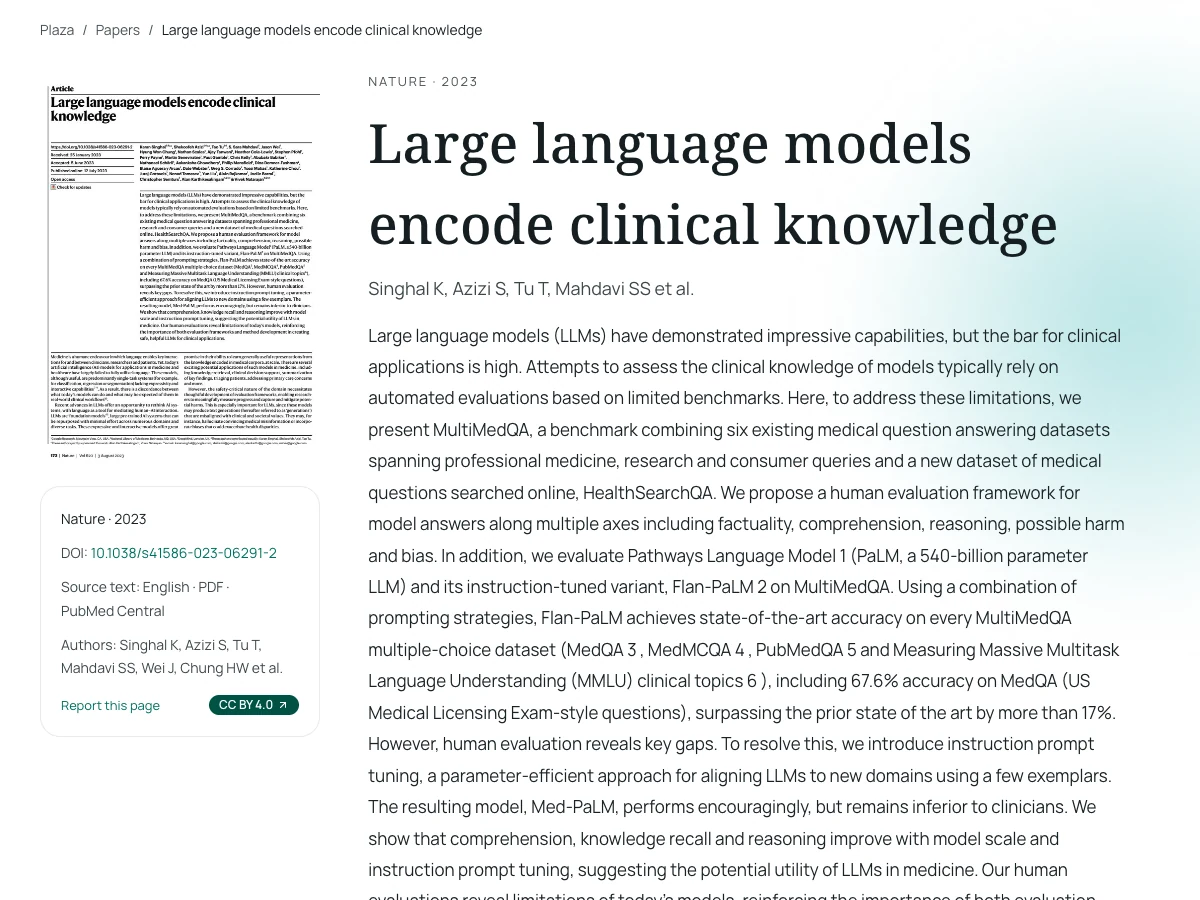
For example, the flagship Nature article Large language models encode clinical knowledge (Singhal et al., published under CC BY 4.0) is indexed directly on Equalang Plaza. Here is how the workflow and boundaries work in practice:
- 0-Credit Originals and 20% Bilingual Previews (Sign-In Required): Once signed in, you can read and download the original English paper for free (0 credits) and sample the first 20% of any available translation for free, with the original and translation displayed side by side with synchronized scrolling.
- 1/10-Credit Full Bilingual Downloads: If you want the complete translated edition, downloading it from Plaza costs 1/10 of the standard translation cost (rounded up and displayed on the page). A PDF translation purchase includes two downloadable files: a layout-preserved translated PDF (which keeps multi-column structures, headers, figure captions, bold terms, and equations intact while rejoining sentences split across page breaks before translation) and a page-by-page alternating bilingual PDF.
- Requesting, Translating, and Sharing Back: Not every paper on Plaza has a translation in every language yet. If a listed paper lacks your target language, you can click Translate now using the Plaza source file or click Request this translation so high-demand papers are prioritized. If you upload a PDF to Document Translation that already has a translation in that language on Plaza, the workspace will prompt you to preview or download it on Plaza for 1/10 the credits instead of paying to re-translate.
- Strict Licensing Boundaries: Paywalled CNS articles and papers carrying non-commercial (
NC) or no-derivatives (ND) restrictions cannot be hosted or shared on Plaza. However, if you translate aCC BY,CC BY-SA, orCC0open-access paper that is not yet in the catalog (whether uploaded directly or synced via our Zotero plugin), you can click Share to Plaza at the top of the workbench after translation (up to 3 submissions per day, published after copyright verification). Each time another reader downloads your shared translation, you receive 1/10 of your original translation credit cost back, up to the full amount you spent.
Frequently Asked Questions
Are all Nature Communications and Science Advances papers free to read and translate?
Every research article published in Nature Communications and Science Advances is Gold Open Access and free to read on the publisher's site. The vast majority use the CC BY 4.0 license, which legally permits sharing and derivative translations. Always check the bottom of the first PDF page or the "Rights and permissions" section on the article web page: if it lists CC BY 4.0, it can also be shared on Equalang Plaza; if an older article specifies CC BY-NC or CC BY-ND, you can translate it privately in your own account, but it cannot be publicly listed on Plaza.
Why are some flagship Nature, Science, or Cell articles free while others sit behind a paywall?
Flagship Nature, Science, and Cell operate as hybrid journals. Authors whose grants come from open-access-mandating funders (such as the Wellcome Trust, HHMI, NIH, or European Research Council) either pay an open-access fee or publish under institutional transformative agreements so the article is immediately released under CC BY 4.0, or deposit the peer-reviewed manuscript in PubMed Central. Studies without an open-access mandate or OA option remain behind a subscription wall.
Do I need an account to read open-access papers on Equalang Plaza?
Yes. Signing in is required before you can read or download the 0-credit original files or use the free 20% side-by-side bilingual preview. Full translation downloads require credits equal to 1/10 of the standard translation cost, and purchasing a PDF translation gives you permanent online access plus both the layout-preserved translation PDF and the page-by-page alternating bilingual PDF.