
How to Find Free Full-Text Papers by DOI Legally in 5 Steps
In brief
Turn any raw DOI into a legal, free full-text PDF in under 30 seconds using Unpaywall redirects, OpenAlex locations, arXiv prefixes, and repository checks.
Keywords: how to find free full text paper by doi legally; doi lookup free pdf; unpaywall doi search; check if a doi has open access version; how to use doi to find article
Why doi.org Hits a Paywall Even When a Paper Is Free
A Digital Object Identifier (DOI) such as 10.1145/3592442 is a permanent handle managed by the International DOI Foundation. When you paste https://doi.org/10.1145/3592442 into your browser, the resolver does exactly one job: it forwards you to the publisher's canonical landing page for the Version of Record (VoR).
That default redirect creates a common misconception. Hitting a subscription paywall on a publisher's site does not mean the paper lacks a legal, free full-text PDF. Under public-funder mandates (such as NIH, Wellcome Trust, and Horizon Europe) and university open-access policies, authors routinely deposit the identical peer-reviewed text into institutional repositories, disciplinary preprint servers, or PubMed Central. Because the primary Crossref record stays pointed at the publisher's commercial URL, you need an open-access resolution layer to bridge the gap between a raw DOI string and those legal repository copies.
Below is the five-step resolution workflow our team uses to turn a raw DOI into a verified, free full-text PDF in under 30 seconds, ordered from fastest direct URL redirect to deep metadata fallback.
Quick Comparison: 5 Legal Ways to Resolve a DOI to a Free PDF
The 5-Step Resolution Checklist (Under 30 Seconds)
Step 1: Swap doi.org for oadoi.org (The 3-Second Unpaywall Redirect)
Before installing browser extensions or searching databases, test the direct redirect maintained by OurResearch (the nonprofit team behind Unpaywall). Unpaywall harvests legal open-access copies from over 50,000 publishers, institutional repositories, and preprint servers worldwide.
Take your raw DOI string and append it directly to https://oadoi.org/:
Standard publisher lookup: https://doi.org/10.1038/s41586-021-03819-2
Direct OA PDF lookup:      https://oadoi.org/10.1038/s41586-021-03819-2
If a legal Gold, Hybrid, Bronze, or Green open-access copy exists in Unpaywall's index, oadoi.org skips the paywalled abstract page and routes your browser straight to the full-text PDF or open repository record. If you manage references in a desktop library, you can also configure your reference manager to check the Unpaywall index automatically—see our guide on integrating open-access lookups with Zotero and our technical breakdown of Unpaywall vs. Open Access Button vs. CORE.
Step 2: Query OpenAlex for Every Alternate Repository Location and License
Sometimes a paper is hosted in three different places—a paywalled journal site, a university archive with an embargo lift, and a preprint server—and you want to see every option plus its exact reuse license. OpenAlex indexes these relationships in a single record.
You can search the DOI in the web interface at https://openalex.org/, or inspect the raw JSON metadata directly in your browser by pasting:
https://api.openalex.org/works/https://doi.org/<DOI>
Look at two fields in the response:
open_access.oa_url: The direct link to the primary open-access full text.locations: An array listing every repository where the work resides (such as Zenodo, HAL, Europe PMC, or a universityeprintsserver), along withis_oa,version(publishedVersion,acceptedVersion, orsubmittedVersion), andlicense.
Checking locations is especially useful when one institutional server is temporarily offline or when you need to confirm whether a figure carries a CC BY license before reusing it in a presentation.
Step 3: Decode Preprint Prefix Patterns and Check Biomedical Mandates
You can often tell where a free PDF lives simply by reading the digits before and after the slash in the DOI:
- DataCite arXiv DOIs (
10.48550/arxiv.XXXX.XXXXX): Every arXiv paper automatically receives a DataCite DOI with the prefix10.48550. You do not even need a lookup tool—strip10.48550/arxiv.and append the remaining identifier tohttps://arxiv.org/pdf/. For example,10.48550/arxiv.2305.18290maps directly tohttps://arxiv.org/pdf/2305.18290. - Biomedical & Life Sciences DOIs (PubMed Central / Europe PMC): Even when an article is published in a subscription medical journal, research funded by the NIH, Howard Hughes Medical Institute, or European agencies must be deposited in PubMed Central (
https://pmc.ncbi.nlm.nih.gov/) or Europe PMC (https://europepmc.org/), usually immediately or after a 6-to-12-month embargo. Paste the raw DOI into the PMC or Europe PMC search bar; if aPMCID(such asPMC8376543) is linked to that DOI, the full text and downloadable PDF are legally free.
For a broader overview of disciplinary archives that index legal manuscripts by DOI, see our guide to legal open-access alternatives for finding research papers.
Step 4: Turn the DOI Title into a Quoted Google Scholar Version Search
Why do DOI-based tools occasionally miss a free PDF that is sitting on an author's lab website? Because when a researcher uploads their Author Accepted Manuscript (AAM) to a personal faculty page or departmental repository, that PDF often isn't tagged with the publisher's Crossref DOI in its metadata.
When Steps 1 through 3 return no open copy:
- Open
https://doi.org/<DOI>(everyone can view the title and abstract for free, even behind a paywall). - Copy the exact paper title.
- Search Google Scholar (
https://scholar.google.com/) with the title wrapped in straight double quotes:"Exact Paper Title". - Look at the right margin for a
[PDF]link from an.edu,.ac.uk, or institutional repository domain, or clickAll N versionsunderneath the citation to expand self-archived drafts that share the same title and author list.
Step 5: Search the DOI on Equalang Plaza for Bilingual Open-Access Reading
If you have a DOI for an open-access paper and need to read it across languages—or check whether a translated edition already exists—you can paste the raw DOI string directly into the search bar on Equalang Plaza (https://equalang.com/plaza).
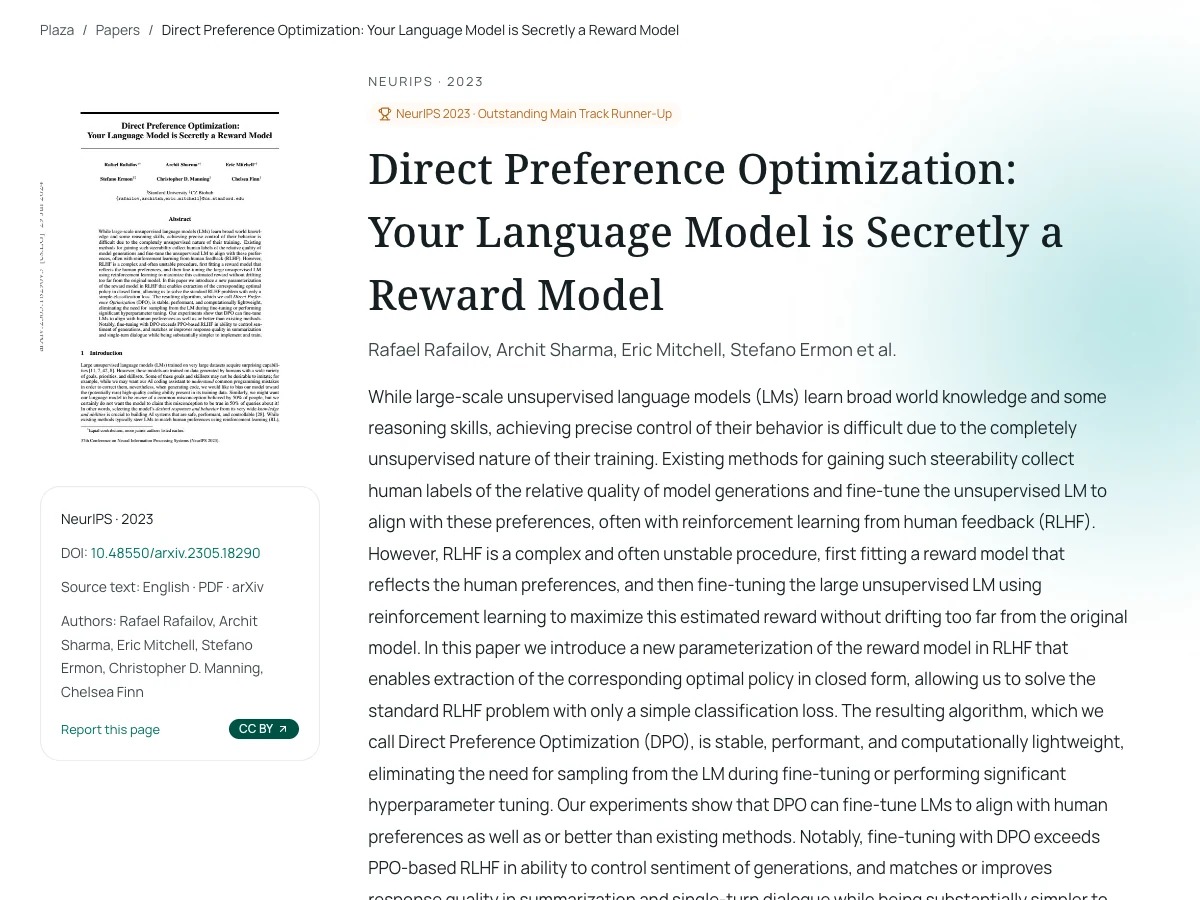
Equalang Plaza collects public-domain books (from sources such as Aozora Bunko, Wikisource, and Standard Ebooks) and over 24,000 open-access papers licensed under CC BY, CC BY-SA, or CC0 from OpenAlex, PubMed Central, and arXiv. Searching by title, author, or raw DOI (for example, 10.48550/arxiv.2305.18290) resolves directly to the work's details page.
Keep two rules in mind when using Equalang Plaza for DOI lookups:
- What is covered: Only open-access papers carrying permissive licenses (
CC BY,CC BY-SA,CC0) and public-domain books are hosted or eligible to be shared on Plaza. Closed-access journal articles and papers with Non-Commercial (NC) or No-Derivatives (ND) restrictions cannot be listed or shared there. - How access and credits work: Once signed in, you can read and download the original PDF for free (0 credits) and sample the first 20% of any existing translation for free side by side with synchronized scrolling. Downloading a full translated edition in the original format costs 1/10 of the standard translation cost (rounded up on the page; for example, the Chinese AI translation of the OpenAlex open-access paper 3D Gaussian Splatting for Real-Time Radiance Field Rendering is 24 credits to download), and PDF translation purchases include both the layout-preserved translated PDF and a page-by-page alternating bilingual PDF. If you translate an unindexed
CC BY,CC BY-SA, orCC0paper yourself in the workspace, you can click "Share to Plaza" (up to 3 submissions per day, subject to copyright review) to earn back 1/10 of your translation cost in credits each time another reader downloads it, up to your original translation spend.
How to Verify Which Manuscript Version You Found
When a DOI resolves to a free repository PDF rather than the publisher's site, take five seconds to check which stage of the publication lifecycle you are reading. Both OpenAlex (version) and Unpaywall (oa_locations.version) label copies under three standard categories:
If you retrieve an acceptedVersion from a university repository via oadoi.org, you still cite the canonical publisher DOI in your bibliography—the DOI identifies the intellectual work, and the Author Accepted Manuscript contains the final peer-reviewed text.
Frequently Asked Questions
Can every DOI be unlocked for free legally?
No. While roughly half of recent scholarly articles have a legal Gold or Green open-access copy indexed by Unpaywall and OpenAlex, older articles or papers published in closed subscription journals whose authors never self-archived a postprint may not have a free web copy. When all five steps above show no open version, use your university library's Interlibrary Loan (ILL) service or email the corresponding author listed on the doi.org abstract page for a personal copy.
What is the difference between a journal DOI and a preprint DOI for the same paper?
A paper first posted on arXiv or bioRxiv receives a preprint DOI (such as 10.48550/arxiv.2305.18290 or 10.1101/...). Once accepted and published by a journal, the publisher assigns a separate Crossref DOI for the Version of Record. OpenAlex and Google Scholar link these versions together under one work cluster, which is why searching the journal DOI in OpenAlex (locations) or Unpaywall often leads you straight back to the free preprint or accepted manuscript.
Why can't I find an open-access paper with a CC BY-NC or CC BY-ND license on Equalang Plaza?
Creative Commons licenses that include NC (Non-Commercial) or ND (No-Derivatives) prohibit commercial redistribution or derivative adaptations such as full-text translations. You can still locate and read those papers for free via oadoi.org, OpenAlex, or PubMed Central, whereas Equalang Plaza strictly hosts and accepts community shares for public-domain works and open-access papers licensed under CC BY, CC BY-SA, or CC0.
Sources
- International DOI Foundation — DOI Resolution Documentation: https://www.doi.org/
- Unpaywall &
oadoi.orgDirect Resolution Service (OurResearch): https://unpaywall.org/ - OpenAlex API Works & Open Access Location Schema: https://docs.openalex.org/api-entities/works/work-object
- PubMed Central (PMC) Open Access Subset & NIH Public Access Policy: https://pmc.ncbi.nlm.nih.gov/
- Europe PMC RESTful Web Service & DOI Search: https://europepmc.org/
- arXiv DataCite DOI Assignment Specification (
10.48550): https://info.arxiv.org/help/doi.html - Equalang Plaza Open-Access & Public-Domain Catalog: https://equalang.com/plaza
- Equalang Public Rates & Plaza Rules API: https://equalang.com/v1/rates