
How to Check if a Book Is in the Public Domain (2026 Guide)
In brief
Verify if a book or translation is in the public domain in 2026 across the US, EU, UK, Japan, and China using copyright rules and renewal databases.
Keywords: how to check if a book is in the public domain; what books enter public domain in 2026; how to check copyright renewal stanford; public domain rules by country; is a translation in the public domain
Assuming an old book is free to reprint, translate, or adapt just because its author died a century ago is one of the fastest ways to trigger a copyright takedown. While Fyodor Dostoyevsky died in 1881—putting his original Russian novels firmly in the public domain worldwide—a 1992 English translation, a 2015 critical introduction, or a modern cover design remains under active copyright.
To check if a book is in the public domain in 2026, you must verify three facts in order: which country's law applies to your use, when the original work's term expired under that country's calendar rules, and whether the specific edition or translation you are holding carries separate downstream copyright.
1. Check the Jurisdiction: Publication Date vs. Author's Death Year
There is no single global public domain. Copyright expiration depends on the laws of the country where you plan to publish, distribute, or read the work. Broadly, jurisdictions split into two systems:
- The United States pre-1978 publication system, which calculates terms from the year a book was first published with a valid copyright notice (and whether that registration was renewed).
- The Berne Convention life-plus-years system used by the European Union, the United Kingdom, Japan, China, Canada, and the US for works created in or after 1978, which calculates terms from the calendar year the last surviving author died.
Because copyright terms expire at the end of the calendar year in almost every major jurisdiction, works enter the public domain on January 1 following the final year of protection.
2026 Public Domain Cutoff Rules by Country
Notice how transitional laws create non-obvious cutoffs in Japan and Canada. When Japan extended its copyright term from 50 to 70 years on December 30, 2018, it did not revive copyright for authors whose works had already expired. Because an author who died in 1967 entered the Japanese public domain on January 1, 2018, classics by Natsume Soseki (d. 1916), Ryunosuke Akutagawa (d. 1927), and Osamu Dazai (d. 1948) remain permanently in the public domain on Aozora Bunko.
2. How to Check US Books Published Between 1931 and 1963
If a book was first published in the United States before January 1, 1931, your job in the US is done: as of January 1, 2026, William Faulkner's As I Lay Dying (1930), Dashiell Hammett's The Maltese Falcon (1930), and Agatha Christie's The Murder at the Vicarage (1930) are in the US public domain.
However, many readers stop there and assume every book published between 1931 and 1977 is locked up for 95 years. Under the US Copyright Act of 1909, works published with a valid copyright notice had an initial term of 28 years, after which the rightsholder had to file a formal renewal with the US Copyright Office to secure the remaining term. For works published between 1931 and 1963, renewal was mandatory (Congress made renewal automatic starting with 1964 publications). According to US Copyright Office studies, fewer than 15% of books from that era were actually renewed.
To verify whether a 1931–1963 US book entered the public domain due to non-renewal, run this 3-step check:
- Locate the exact first publication year and copyright claimant on the verso of the original title page (for example,
Copyright, 1941, by [Publisher or Author]). - Search the Stanford Copyright Renewal Database (
https://exhibits.stanford.edu/copyrightrenewals), which indexes every US Book (Class A) renewal filed for works published between 1923 and 1963. Search by author last name and partial title, and check the window 27 to 29 years after first publication. - Cross-check serial installments and foreign authorship:
- Magazine serialization: Did chapters appear in a periodical before the book came out? Search the US Copyright Office Public Catalog (
https://publicrecords.copyright.gov/) or the HathiTrust Copyright Review Program records to ensure the magazine publisher did not renew a blanket periodical registration covering the story. - Foreign works (URAA restoration): If the book was first published outside the United States by a non-US author, do not rely on US non-renewal! Under the 1994 Uruguay Round Agreements Act (URAA), the US restored copyright on January 1, 1996, to foreign works published between 1931 and 1977 that were still protected in their source country on that date.
- Magazine serialization: Did chapters appear in a periodical before the book came out? Search the US Copyright Office Public Catalog (
3. Separate the Original Work from the Edition and Translation
Even when the original work is indisputably in the public domain, almost every physical paperback or commercial ebook sold in stores today bundles new copyrighted layers on top of the old text.
Before reusing, digitizing, or distributing any file, audit these four layers separately:
- Layer 1 — The Original Text: Governed by the original author's death year (or pre-1978 US publication date).
- Layer 2 — The Translation: A translation is an independent derivative work with its own copyright term. For example, Fyodor Dostoyevsky died in 1881, and Constance Garnett's 1914 English translation of Crime and Punishment (she died in 1946) is in the public domain in the US, EU, UK, and China. By contrast, Richard Pevear and Larissa Volokhonsky's 1992 translation is fully protected by copyright everywhere.
- Layer 3 — Critical Apparatus (Prefaces, Footnotes, and Newly Reconstructed Text): Modern scholarly introductions, historical footnotes, newly compiled bibliographies, and substantive editorial reconstructions are protected independently of the base text.
- Layer 4 — Cover Art, Illustrations, and Typesetting: A modern book cover illustration or custom typography layout cannot be scanned or redistributed, even if the prose inside is 200 years old. (In the UK, publishers also hold a 25-year typographical arrangement right on the exact page layout of a newly typeset edition.)
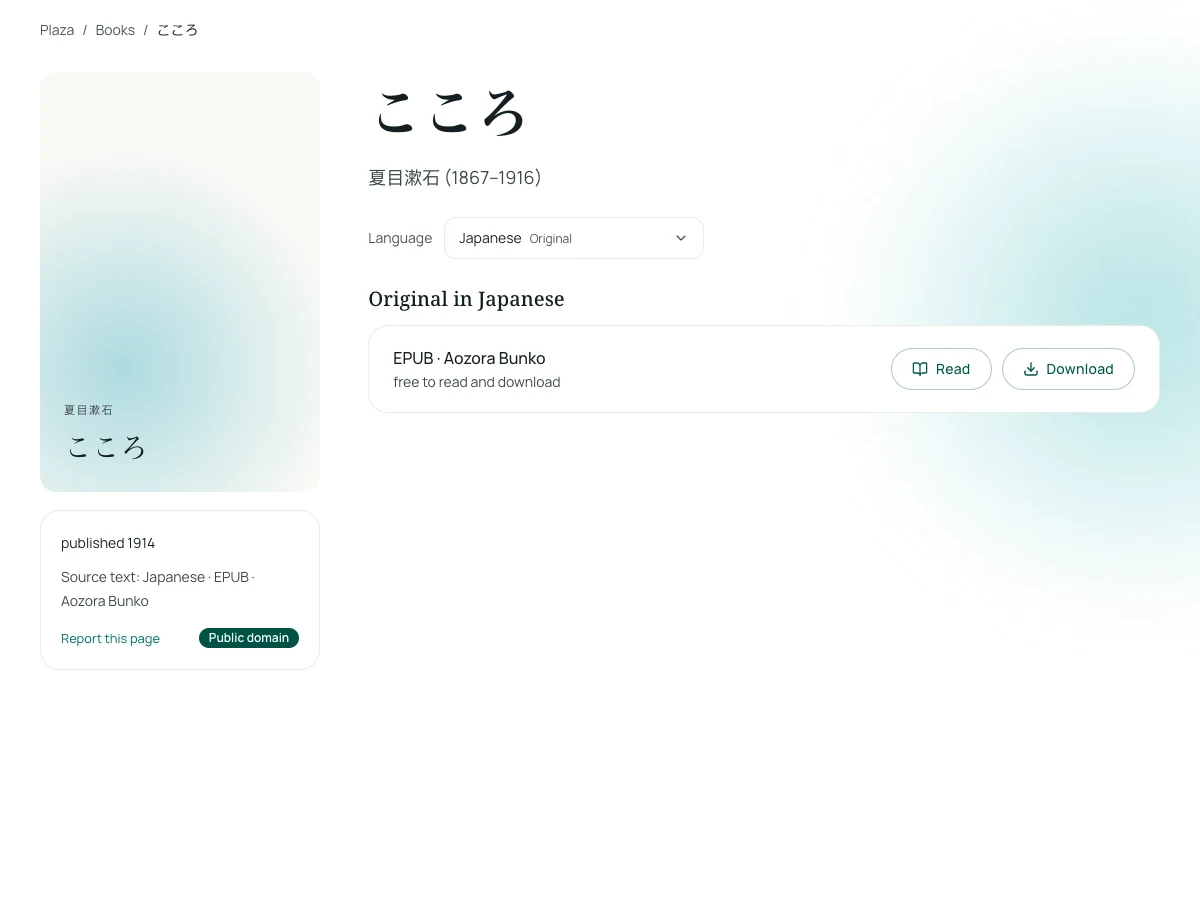
This separation is why curated public-domain repositories strip out commercial covers and track edition metadata explicitly. When catalogs such as Aozora Bunko, Wikisource, Standard Ebooks, or Equalang Plaza ingest a classic, they verify the author's death year against Wikidata and Open Library records, confirm the source edition's publication date, and strip modern copyrighted cover art before hosting the clean underlying EPUB or text.
4. A 60-Second Verification Checklist Before You Use or Share a Book
If you want to quote, translate, republish, or upload a book to an open repository, run through this checklist in order:
- Step 1: Verify the author's death year on Wikidata or national library authorities (Library of Congress Name Authority File, NDL Authorities in Japan, or BnF in France). If the book has co-authors or an illustrator whose drawings you plan to keep, check the death year of the last surviving contributor.
- Step 2: Check the country cutoff for 2026. Is the first US publication before January 1, 1931? In Life + 70 countries (EU, UK, post-1978 US), did the author die on or before December 31, 1955? In China (Life + 50), did the author die on or before December 31, 1975? In Japan, did the author die on or before December 31, 1967?
- Step 3: Check the translator's status (if you are not working from the original-language text). Apply the exact same publication-year or death-year rules to the translator.
- Step 4: Strip modern paratext. Remove any post-cutoff foreword, study guide, translator's note, or modern cover image, or source your base file directly from a repository that already isolates public-domain text.
If you want to skip manual edition-stripping and read or translate clean base files directly, you can pull verified editions from public-domain ebook repositories or search Equalang Plaza by title, author, or DOI. Because Plaza only accepts verified public-domain books (from sources such as Aozora Bunko, Wikisource, and Standard Ebooks) and permissively licensed open-access papers (CC BY, CC BY-SA, and CC0 from OpenAlex, PubMed Central, and arXiv—excluding NC or ND restrictions), signed-in readers can read and download the original file for 0 credits, preview the first 20% of any existing translation side by side with synchronized scrolling, or download a full translation in its original format for 1/10 of the standard translation credit cost (PDF purchases include both a layout-preserved translation PDF and an alternating-page bilingual PDF). If you translate an eligible public-domain book or CC BY / CC BY-SA / CC0 paper yourself, you can also submit it via "Share to Plaza" (up to 3 submissions per day, subject to copyright review) and earn back 1/10 of your translation credit cost each time another reader downloads it, up to your original spend.
Frequently Asked Questions
What books enter the US public domain in 2026?
On January 1, 2026, books and other creative works first published in the United States in 1930 entered the US public domain after completing their 95-year copyright term. Notable 1930 books include William Faulkner's As I Lay Dying, Dashiell Hammett's The Maltese Falcon, Evelyn Waugh's Vile Bodies, Agatha Christie's The Murder at the Vicarage, and the original 1930 text of Carolyn Keene's The Secret of the Old Clock.
Is a book automatically in the public domain 70 years after the author's death?
In the European Union, the United Kingdom, and for US works created in or after 1978, yes—copyright expires on January 1 following the 70th calendar year after the last surviving author's death (meaning authors who died in or before 1955 are in the public domain in 2026). However, for works published in the United States before 1978, US copyright is calculated by publication year and renewal status (95 years from publication), not the author's death date. That means a novel published in 1935 by an author who died in 1940 is already in the public domain in the UK and EU, but remains under copyright in the United States until January 1, 2031, provided its US registration was renewed.
If an old book is in the public domain, can I freely use any translation of it?
No. Only the original-language text and old translations whose own copyright terms have expired are in the public domain. A modern translation holds a separate copyright covering the translator's expression. Always check the translation's publication year and the translator's death year independently of the original author.
Sources
- Cornell University Library — Copyright Term and the Public Domain in the United States (updated annually for 2026 cutoffs): https://guides.library.cornell.edu/copyright/publicdomain
- Stanford Libraries — Copyright Renewal Database (US Class A book renewals for 1923–1963 publications): https://exhibits.stanford.edu/copyrightrenewals
- U.S. Copyright Office — Circular 22: How to Investigate the Copyright Status of a Work: https://www.copyright.gov/circs/circ22.pdf
- U.S. Copyright Office — Official Public Records System (1978–present): https://publicrecords.copyright.gov/
- Agency for Cultural Affairs, Government of Japan — Overview of the December 30, 2018 Copyright Term Extension (TPP11 Amendment): https://www.bunka.go.jp/seisaku/chosakuken/hokaisei/h30_hokaisei/
- Equalang Plaza — Public-Domain Books & Open-Access Papers Collection: https://equalang.com/plaza