
CS Best Paper Awards Guide: NeurIPS, ICLR, ICML & CVPR
In brief
Track 2016-2026 CS Best and Outstanding Papers across NeurIPS, ICLR, ICML, and CVPR, with a staged reading roadmap and bilingual open-access editions.
Keywords: computer science best paper awards neurips iclr icml cvpr; neurips best paper award list; cvpr best paper; iclr outstanding papers; how to track cs conference best papers
Why Conference Award Lists Beat Daily Preprint Scrolling
When NeurIPS and CVPR each accept between 2,500 and 4,000+ papers in a single year, scrolling through daily preprint feeds becomes an exhausting way to build a research foundation. Program committees spend months filtering thousands of peer-reviewed submissions down to a handful of Best Paper, Outstanding Paper, and Test-of-Time recognitions. Those winning papers form a high-signal curriculum across machine learning, computer vision, natural language processing, computer graphics, security, and systems.
The practical hurdle is rarely finding out which paper won—it is gathering the actual full texts and reading dense mathematical proofs or cross-disciplinary terminology without losing momentum. Community trackers such as Jeff Huang's CS Best Paper Awards page and official conference announcements list titles, yet the underlying PDFs sit scattered across OpenReview, the Computer Vision Foundation (CVF) Open Access archive, the ACL Anthology, the ACM Digital Library, and IEEE Xplore under varying license terms.
To make this canon actionable, we organized a four-stage reading progression spanning recent 2016–2026 winners and audited 56 CCF-A conferences on Equalang Plaza. Over 1,300 verified commercially open (CC BY, CC BY-SA, CC0) award-winning papers are indexed there newest-first (2026, 2025, 2024, 2023...), pairing official open-access originals with side-by-side translations.
Staged Reading Roadmap across Major CS Venues (2016–2026)
Rather than reading award winners in random chronological order, grouping them by technical objective helps you anticipate both the mathematical prerequisites and the dense prose conventions of each community.
Stage 1: Mastering Modern Machine Learning Derivations (NeurIPS, ICLR, ICML)
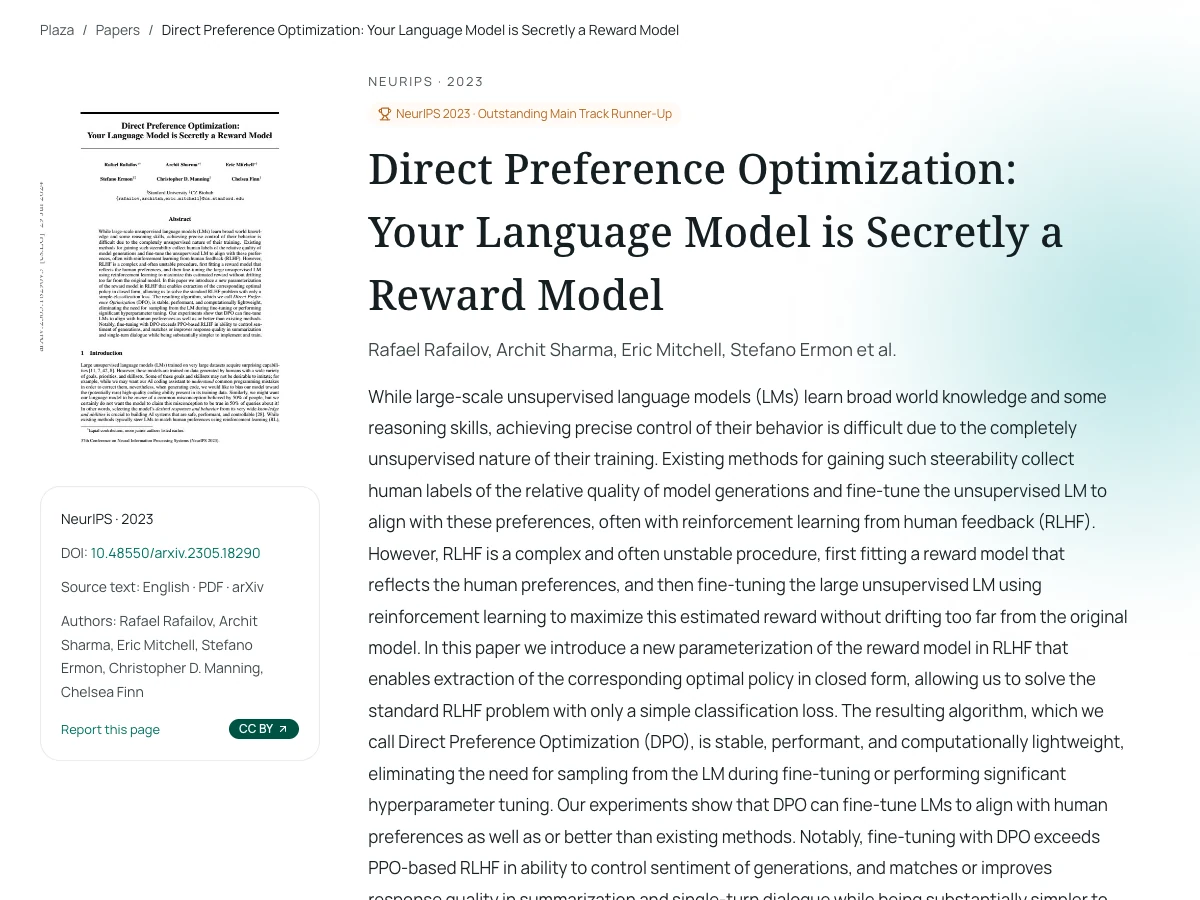
Papers recognized as Outstanding Main Track winners at NeurIPS, ICLR, and ICML frequently compress a major conceptual shift into a remarkably simple final equation—backed by ten pages of appendix proofs. Starting with Direct Preference Optimization (NeurIPS 2023 Outstanding Main Track Runner-Up) gives readers a direct bridge from probability theory to production LLM training.
When reading Stage 1 papers, the main obstacle for non-native English readers or researchers entering from another subfield is not the code; it is the transitional reasoning connecting lemmas to empirical design choices. Keeping the original English proof on the left while scanning the translated narrative on the right prevents misinterpreting subtle assumptions about partition functions or gradient variance.
Stage 2: Visual Computing and Real-Time Rendering (CVPR, SIGGRAPH)
Computer vision and graphics award winners combine heavy linear algebra with dense visual comparison grids. In 3D Gaussian Splatting for Real-Time Radiance Field Rendering (SIGGRAPH 2023 Best Paper), the authors move smoothly between camera calibration pipelines, adaptive density control heuristics, and custom tile-based GPU sorting routines.
Many readers skim the figures and miss the implementation constraints buried inside figure captions and footnotes. When you inspect these papers in a layout-preserving PDF translation, small figure callouts and multi-line ablation headers remain anchored next to the rendered scene comparisons so you do not lose track of which hyperparameter governs splat pruning.
Stage 3: Evaluation Benchmarks, NLP, and Societal Scale (NeurIPS, ACL)
Over the past decade, award committees at NeurIPS and ACL have elevated empirical analysis, dataset curation, and behavioral auditing alongside novel architectures. Works like Artificial Hivemind (NeurIPS, CC BY) require reading nuanced methodological arguments about diversity metrics, prompt sensitivity, and statistical validity. For a deeper dive into computational linguistics venues specifically, see our companion bilingual guide to ACL Anthology and CCF-A award papers.
Stage 4: Systems and Security Venues (OSDI, SOSP, CCS, S&P)
Machine learning practitioners increasingly read systems award winners to understand memory bottlenecks, kernel scheduling, and security threat models. While USENIX venues (such as OSDI, NSDI, and USENIX Security) make full proceedings freely accessible on their websites, licensing across ACM and IEEE systems conferences varies by author choice. Checking the license line at the bottom of page one tells you immediately whether a paper can be redistributed in open bilingual repositories.
Where to Track Award Lists vs. How to Read Full Texts Side by Side
If you want to monitor award announcements as soon as a conference concludes, combine three reliable public sources with an audited full-text shelf:
- Cross-Venue Trackers: Jeff Huang's Computer Science Best Paper Awards page aggregates historical winners across AAAI, ACL, CHI, CVPR, ICML, IJCAI, NIPS/NeurIPS, SOSP, and SIGGRAPH from 1996 onward. It is an effective starting checklist for longitudinal literature reviews.
- Primary Open-Access Archives:
- OpenReview: Hosts official camera-ready PDFs, reviewer discussions, and author rebuttals for ICLR, NeurIPS, and ICML.
- CVF Open Access: Provides direct PDF and supplement downloads for CVPR, ICCV, and WACV, including award lists on conference program pages.
- ACL Anthology: Archives all ACL, EMNLP, and NAACL best and outstanding papers under open licenses.
- Audited Bilingual Editions on Equalang Plaza:
- We audited 56 CCF-A conferences from 2016 through 2026 and curated 1,300+ award-winning papers that carry verified commercially open licenses (
CC BY,CC BY-SA, orCC0). - Newest award years (
2026,2025,2024,2023...) are prioritized first for translation, and every entry displays its conference badge and award tier so you can search by title, author, or DOI in any language.
- We audited 56 CCF-A conferences from 2016 through 2026 and curated 1,300+ award-winning papers that carry verified commercially open licenses (
Honest Boundaries and Credit Rules on Equalang Plaza
Before using Equalang Plaza for your weekly paper reading group, keep its operational rules and copyright boundaries in mind:
- Sign-in required: You must sign in to your account to read or download the original papers or preview translations.
- 0-credit originals and 20% side-by-side preview: Once signed in, you can read and download the original PDFs for free (0 credits) and sample the first 20% of any available translation side by side with synchronized scrolling. That 20% window typically covers the abstract, introduction, and problem formulation—enough to decide whether a paper deserves a deep read.
- 1/10-credit full bilingual downloads: Downloading the full translation costs 1/10 of the standard document translation credit rate, rounded up and displayed directly on the work page. For example, downloading the full Simplified Chinese AI translation of 3D Gaussian Splatting for Real-Time Radiance Field Rendering costs 24 credits. Every PDF translation purchase includes both the layout-preserved translated PDF and a page-by-page alternating bilingual PDF, with permanent online full-text access and unlimited re-downloads.
- Strict open-license scope: Plaza only hosts and accepts public-domain books and open-access papers licensed under
CC BY,CC BY-SA, orCC0. Papers carrying Non-Commercial (NC) or No-Derivatives (ND) restrictions—or traditional closed-access copyright in IEEE Xplore or the ACM Digital Library—cannot be hosted or shared on Plaza. - Requesting or sharing missing open works: If an eligible
CC BYaward paper on Plaza does not yet have a translation in your target language, you can click "Translate now" from the base file or click "Want this translation" to register demand (frequently requested works are prioritized). If you translate an unindexedCC BY,CC BY-SA, orCC0paper yourself in the workspace, you can submit it via "Share to Plaza" at the top of the workbench (up to 3 submissions per day, published after copyright verification); each time another reader downloads your shared edition, you receive 1/10 of your original translation cost back in credits until your initial cost is recouped.
Translating Restricted or Local Conference PDFs Yourself
When a CVPR, IEEE S&P, or ACM SIGGRAPH award paper is only available as a personal download without a CC BY redistribution license, you can still translate your local copy privately through Document Translation or our Zotero integration.
Uploading a two-column conference PDF preserves multi-column layouts, headers, footers, figure captions, cross-reference links, and inline or display math equations without turning symbols into garbled text. Sentences split across page breaks are reassembled before translation, and bold emphasis in the source maps onto the corresponding translated terms. Note that font sizing and line wraps adjust naturally to accommodate target-language length rather than remaining pixel-identical. The web uploader accepts files one at a time without a total quantity cap; up to 3 documents process concurrently per account while additional files queue automatically. You can read a full walkthrough in our guide on how to translate academic paper PDFs.
Frequently Asked Questions
Why are some NeurIPS or CVPR Best Papers missing from Equalang Plaza?
Equalang Plaza strictly verifies licensing before indexing any work. Only papers published under commercially permissive open licenses (CC BY, CC BY-SA, CC0) or in the public domain are eligible. If a conference paper was published under a custom non-commercial agreement, an NC/ND Creative Commons license, or a traditional publisher copyright transfer, it is excluded from the public Plaza shelf. You can still translate your own legally obtained PDF privately via Document Translation.
What files do I receive when I unlock a full PDF translation on Equalang Plaza?
A single PDF purchase on Equalang Plaza gives you two downloadable files plus full online side-by-side reading: a layout-preserved translated PDF that keeps the multi-column academic structure, tables, and equations intact, and an alternating-page bilingual PDF where each original page is followed immediately by its translated page for tablet annotation.
How can I check whether a paper I want to translate is already on Equalang Plaza?
You can search Equalang Plaza directly by title, author, or DOI before spending full translation credits. Additionally, when you upload a document to the translation workspace, the system checks whether an edition in your target language already exists on Plaza and prompts you to preview the first 20% for free or download it at 1/10 of the standard translation cost.
Sources
- Equalang Plaza — Open-Access Papers & CCF-A Award Shelf
- Jeff Huang — Best Paper Awards in Computer Science
- OpenReview — NeurIPS, ICLR, and ICML Conference Archives
- CVF Open Access — CVPR and ICCV Proceedings
- ACL Anthology — Computational Linguistics Archive
- OpenAlex — Open Catalog of Scholarly Papers and Licenses