
CC BY vs CC BY-NC vs CC BY-ND: Open-Access Licenses
In brief
Compare CC0, CC BY, CC BY-SA, CC BY-NC, and CC BY-ND open-access licenses in one table to check if you can translate, adapt, or share papers legally.
Keywords: cc by vs cc by nc vs cc by nd open access licenses; cc by vs cc by nc; can i translate a cc by nc nd paper; creative commons licenses explained table; cc0 vs cc by 4.0
Seeing an orange "Open Access" badge on a journal paper or textbook PDF means you can read and download it without hitting a paywall. It does not automatically mean you can translate that paper into another language and post the translated PDF on your lab website, newsletter, or shared digital library.
Under international copyright law and Creative Commons (CC) 4.0 legal code, a translation is legally a derivative work (officially termed Adapted Material). Whether you can publish, redistribute, or monetize a translated edition depends entirely on four two-letter building blocks attached to the license: BY, SA, NC, and ND.
Below is the complete permission matrix for all six Creative Commons licenses plus CC0, followed by the legal rules for translating academic papers and a ready-to-use attribution checklist.
The 4 Creative Commons Building Blocks Explained
Every standard Creative Commons license combines one or more of four core conditions:
BY(Attribution): You must credit the original creator, link to the license, and explicitly state whether you made changes (including translating the text).SA(ShareAlike): If you remix, transform, or translate the material, you must distribute your new contribution under the exact same license (or a formally designated compatible license).NC(NonCommercial): You may not use the work—or any translation of it—for purposes primarily intended for or directed toward commercial advantage or monetary compensation.ND(NoDerivatives): You may copy and redistribute the work in any medium or format only in unadapted, verbatim form. You cannot publicly share translations, abridged chapters, or remixed figures without separate permission from the copyright holder.
Beside these four conditions sits CC0 (Public Domain Dedication), where the creator waives all copyright and related rights worldwide to the fullest extent allowed by law, placing the work on the same legal footing as public-domain literature.
7-Row Permission Matrix: CC0 and All 6 CC Licenses Compared
Use this table to check what you can legally do with an open-access article, preprint, or textbook before you distribute it or publish a translation:
Why ND (NoDerivatives) Blocks Public Translations
The most common legal mistake among researchers and student translation groups is assuming that translating a paper is merely "changing the format" rather than altering the work.
Section 1(a) of the Creative Commons Attribution-NoDerivatives 4.0 International (CC BY-ND 4.0) and CC BY-NC-ND 4.0 legal code explicitly defines Adapted Material as:
"...material subject to Copyright and Similar Rights that is derived from or based upon the Licensed Material and in which the Licensed Material is translated, altered, arranged, transformed, or otherwise modified in a manner requiring permission under the Copyright and Similar Rights held by the Licensor."
Furthermore, Section 2(a)(1)(B) states that while you may technically produce Adapted Material for your own private study, you are only licensed to Share the Original Licensed Material, not the Adapted Material.
In practical terms:
- Private reading vs. public distribution: If you download a
CC BY-NC-NDpaper from an open-access repository and run it through a document translator for your own personal study or internal lab reading, you are not redistributing Adapted Material to the public. - Public posting requires permission: The moment you upload that translated PDF to a public GitHub repository, a blog, a WeChat channel, or a shared library, you are publicly distributing Adapted Material—which violates
CC BY-NDandCC BY-NC-NDunless you obtain explicit written permission from the author or publisher.
How NC (NonCommercial) Affects Shared Libraries and Platforms
Even when a paper permits derivatives—such as CC BY-NC or CC BY-NC-SA—the NonCommercial (NC) clause restricts where and how the translation can be hosted.
Creative Commons defines NonCommercial by the primary purpose of the use, not the tax status of the user. A university press, a non-profit organization, or an individual blogger can still violate an NC license if they distribute a translated paper behind a paid subscription, bundle it into a paid course packet, or upload it to a platform that charges credits for downloads or recovers translation costs through user fees.
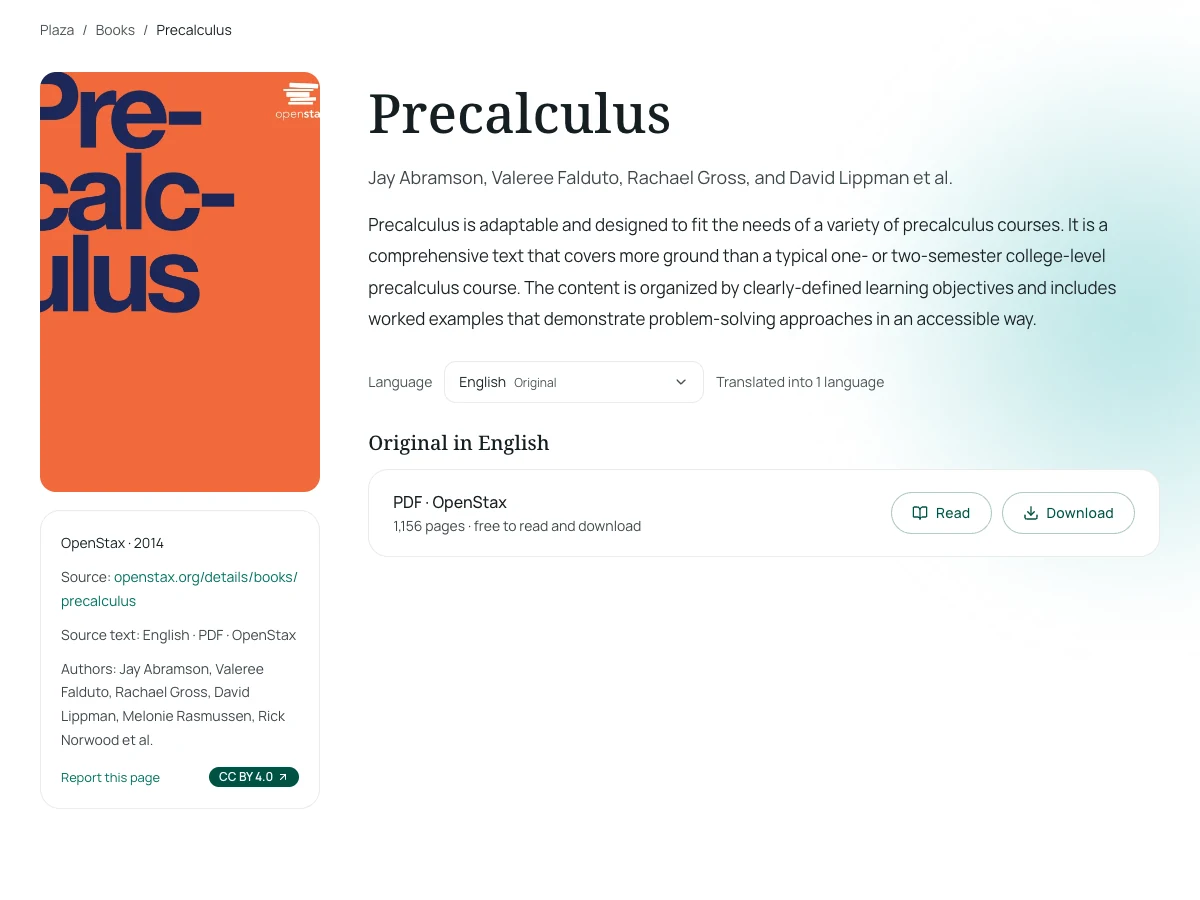
This exact legal boundary explains how open-knowledge repositories and bilingual document libraries enforce copyright compliance. For example, OpenStax publishes its core textbooks under CC BY 4.0, and shared bilingual repositories like Equalang Plaza strictly accept only public-domain books and CC0, CC BY, or CC BY-SA open-access papers (from sources such as OpenAlex, PubMed Central, and arXiv). Because signed-in readers on Equalang Plaza can read and download the original works for 0 credits, sample the first 20% of any translation side by side for free, and download full translated editions (including both a layout-preserved translated PDF and an alternating-page bilingual PDF) for 1/10 of standard translation credits—with contributors receiving a 1/10 credit refund per download up to their original translation cost—any paper carrying an NC or ND restriction is automatically rejected during copyright review.
Step-by-Step Compliance Checklist Before Publishing a Translation
If you plan to translate an open-access paper or textbook chapter and publish the translated edition on your website or an open repository, run through this 4-step verification checklist:
1. Verify the exact license version on the document and metadata
Do not rely solely on a green or orange "Open Access" icon on a search engine. Open the PDF and check the copyright footer on Page 1, or inspect the publisher's landing page (DOI link) for the exact license string:
- Green light for public translation & all platforms:
CC0 1.0,CC BY 4.0(or3.0/2.0),CC BY-SA 4.0. - Yellow light (strictly free, non-commercial channels only):
CC BY-NC 4.0,CC BY-NC-SA 4.0. - Red light (no public translation without written permission):
CC BY-ND 4.0,CC BY-NC-ND 4.0, or "All Rights Reserved / Bronze Open Access" (free to read on the publisher's site, but carries no open license at all).
2. Audit third-party figures and embedded tables
Section 2(a)(2) of the CC 4.0 legal code warns that a paper's overarching CC BY license only covers material owned by the licensor. Academic authors frequently reprint a figure or photograph from an older subscription journal "with permission from Elsevier/Springer." Look carefully at every figure caption: if a caption says "Adapted with permission from [Journal], Copyright 2021, All Rights Reserved", that specific figure is exempt from the paper's CC BY license and must be omitted or replaced in your public translation.
3. Include the mandatory TASL + Modification attribution block
To satisfy the BY condition under CC 4.0 Section 3(a), your translated PDF or webpage must visibly display:
- T — Title: The original title of the paper or book.
- A — Author(s): Full credit to the original authors (and the original publisher/institution if requested).
- S — Source: A direct hyperlink or URI (preferably the canonical
https://doi.org/...link) to the original unmodified work. - L — License: The exact Creative Commons license name linked directly to its official deed URL (e.g.,
https://creativecommons.org/licenses/by/4.0/). - M — Modification notice: An explicit statement that your version is a translation of the original work, plus disclaimer language confirming the original authors do not endorse your translation.
Copy-paste attribution template for a CC BY 4.0 translation:
This work is a [Target Language] translation of "[Original Title]" by [Original Authors], originally published in [Journal/Source] ([DOI URL]) under the Creative Commons Attribution 4.0 International License (https://creativecommons.org/licenses/by/4.0/). Translated by [Your Name/Tool]. The original authors and publisher have not reviewed or endorsed this translation.
4. Apply the required downstream license (for SA works)
If the source paper or textbook chapter uses CC BY-SA 4.0 or CC BY-NC-SA 4.0, you cannot lock your translated text behind an "All Rights Reserved" copyright notice. You must license your translated text under the exact same ShareAlike license (CC BY-SA 4.0 or CC BY-NC-SA 4.0) so future readers enjoy the same freedoms.
Frequently Asked Questions
Can I translate a CC BY-NC-ND paper for my own research or lab meeting?
You may translate a CC BY-NC-ND paper for private, individual study where the translated file is not distributed outside your personal reading environment. Under CC 4.0 Section 2(a)(1)(B), the ND restriction specifically prohibits sharing (publicly distributing, posting online, or circulating outside private use) Adapted Material. If you want to post the translated PDF online or share it in a public repository, you must email the corresponding author or publisher (depending on who holds the copyright) for written translation permission.
What is the difference between CC0 and CC BY 4.0?
CC0 1.0 waives all copyright restrictions worldwide, placing the work into the public domain so anyone can translate, adapt, and republish it without any legal requirement for attribution (though academic norms still require citing your sources to avoid plagiarism). CC BY 4.0 retains copyright and grants you permission to translate, adapt, and commercially reuse the work only on the condition that you provide proper attribution, link to the CC BY 4.0 license, and indicate what changes or translations were made.
Why do some "Open Access" papers have no Creative Commons license at all?
Publishers refer to free-to-read articles without an open license as Bronze Open Access. On these papers, the publisher removes the paywall so anyone can read the PDF on the journal's website, but retains a standard "All Rights Reserved" copyright transfer agreement. Without a CC BY or similar license, Bronze OA papers cannot be redistributed, mirrored, or publicly translated without formal copyright clearance.
Sources
- Creative Commons — About CC Licenses and the 4 License Elements: https://creativecommons.org/share-your-work/cclicenses/
- Creative Commons Attribution 4.0 International (
CC BY 4.0) Legal Code: https://creativecommons.org/licenses/by/4.0/legalcode.en - Creative Commons Attribution-NonCommercial-NoDerivatives 4.0 International (
CC BY-NC-ND 4.0) Legal Code (Section 1(a) Adapted Material & Section 2(a)(1)(B)): https://creativecommons.org/licenses/by-nc-nd/4.0/legalcode.en - Creative Commons FAQ — Is a translation considered an adaptation under CC licenses?: https://creativecommons.org/faq/#how-do-cc-licenses-operate-on-translations
- Creative Commons Best Practices for Attribution (TASL): https://wiki.creativecommons.org/wiki/Recommended_practices_for_attribution
- Equalang Plaza Open-Access & Public-Domain Bilingual Library: https://equalang.com/plaza