
bioRxiv vs medRxiv vs Europe PMC: Preprints & OA Guide
In brief
Compare bioRxiv, medRxiv, and Europe PMC on peer review, clinical screening, XML/PDF access, and CC BY licensing, plus how to read papers bilingually.
Keywords: biorxiv vs medrxiv vs europe pmc; biorxiv vs medrxiv; europe pmc vs pubmed central; read biology preprints open access; medical open access papers
bioRxiv and medRxiv are dedicated preprint servers for unreviewed manuscripts—bioRxiv covers basic life sciences, while medRxiv covers clinical medicine and epidemiology under stricter ethics and trial-registration screening. Europe PMC is a comprehensive life-science discovery database operated by EMBL-EBI that indexes over 40 million records, combining peer-reviewed journal articles from PubMed and PubMed Central with preprints from bioRxiv, medRxiv, and other servers. If you want to post or catch a manuscript the day it leaves the lab, go to bioRxiv or medRxiv; if you want to search peer-reviewed papers alongside preprints, track whether a preprint later passed peer review, or filter specifically for CC BY open-access full text, start with Europe PMC.
Once you find a dense biomedical paper or clinical study, discovery is only half the job. For permissive open-access papers (CC BY, CC BY-SA, CC0) indexed in Europe PMC and PubMed Central, Equalang Plaza lets signed-in readers download the original PDF for 0 credits, preview the first 20% side by side with synchronized scrolling for free, and download full layout-preserved and alternating-page bilingual PDFs for 1/10 of standard translation credits.
Side-by-Side Comparison: bioRxiv vs. medRxiv vs. Europe PMC
bioRxiv vs. medRxiv: Why Cold Spring Harbor Split Biology and Medicine
Researchers new to preprints often wonder why Cold Spring Harbor Laboratory runs two separate servers instead of putting all biomedical manuscripts in one place. The split comes down to patient safety and clinical verification.
bioRxiv: Built for Basic and Computational Life Sciences
Launched in 2013 by Cold Spring Harbor Laboratory, bioRxiv is the primary preprint server for experimental and computational biology. When a genomics lab finishes a single-cell atlas or a structural biology team benchmarks a new protein-folding workflow, posting to bioRxiv puts the findings in front of the community months before traditional journal peer review concludes.
- Subject categories: Covers 27+ basic biology disciplines, including bioinformatics, biochemistry, cancer biology, cell biology, evolutionary biology, genetics, genomics, microbiology, neuroscience, and synthetic biology.
- What bioRxiv excludes: Manuscripts reporting clinical trials, clinical decision-making tools, or direct medical interventions on human patients are redirected away from bioRxiv during screening.
- Direct journal transfer (B2J): Authors can submit a manuscript to bioRxiv and push it directly to hundreds of partner journals (such as PLOS, eLife, EMBO Press, and Nature family titles) without re-uploading files.
medRxiv: Built for Clinical Medicine with Stricter Safeguards
Co-founded in 2019 by Cold Spring Harbor Laboratory, Yale University, and BMJ, medRxiv applies the speed of preprints to health sciences while adding safeguards needed for medical literature. Because an unreviewed clinical claim can be misread by the general public or misapplied in patient care, medRxiv enforces a steeper pre-posting checklist:
- Mandatory ethics and trial declarations: Every submission involving human participants must include an explicit statement of Institutional Review Board (IRB) or ethics committee approval, informed consent confirmation, and—for interventional trials—a verified registration ID from a recognized registry such as ClinicalTrials.gov or ISRCTN.
- No identifiable patient data: Screeners check that case descriptions, imaging, and pedigrees strip out identifying patient details.
- Prominent clinical disclaimer: Every medRxiv page and PDF carries an explicit warning that the manuscript has not been certified by peer review and must not be used to guide clinical practice.
Where Europe PMC Fits In (and How It Links Preprints to Journal Articles)
While bioRxiv and medRxiv are publishing servers where authors deposit unreviewed drafts, Europe PMC is an aggregator, archive, and discovery engine hosted by the European Bioinformatics Institute (EMBL-EBI). If you have already compared broader discovery tools in our guide to OpenAlex vs. Semantic Scholar vs. PubMed Central, think of Europe PMC as the European partner in the PMC International network—with several distinct advantages for preprint readers:
- Unified search across peer-reviewed journals and preprints: Unlike standard PubMed searches that primarily emphasize published journal citations (plus a subset of NIH-funded preprints), Europe PMC indexes over 40 million records, combining all of PubMed and PubMed Central with preprints from bioRxiv, medRxiv, Research Square, SSRN, SciELO Preprints, and more.
- Automatic Preprint-to-Published version linking: One of the biggest headaches with preprints is citing a 2024 bioRxiv draft without realizing the authors published a revised, peer-reviewed version in Nature Methods or The Lancet six months later. Europe PMC displays a banner at the top of a preprint record linking directly to the peer-reviewed journal article once published—and vice versa—while also surfacing peer-review reports from services like Review Commons and eLife.
- Granular license filtering (
LICENSE:"cc by"): Not every "free to read" paper is legally open for text mining or translation. Europe PMC lets you filter specifically forOPEN_ACCESS:yandLICENSE:"cc by", making it straightforward to isolate papers that allow derivative works. - Text-mined biological annotations (SciLite): Europe PMC automatically highlights genes/proteins, diseases, organisms, GO terms, and accession numbers (such as PDB, UniProt, or ENA IDs) directly inside the full-text reader.
The Licensing Trap: Why "Free to Read" on bioRxiv or medRxiv Does Not Always Mean CC BY
When you download a PDF from bioRxiv or medRxiv, you do not hit a paywall. However, copyright and reuse terms vary paper by paper because authors choose their own license during upload:
- Permissive licenses (
CC0,CC BY): Anyone may redistribute, text-mine, adapt, and translate the paper, provided attribution is kept forCC BY. - Restrictive Creative Commons licenses (
CC BY-NC,CC BY-ND,CC BY-NC-ND):NCprohibits commercial reuse, whileND(No Derivatives) legally prohibits distributing modified or translated versions of the manuscript. - All rights reserved (No reuse allowed): Many authors leave the default restrictive copyright option selected on bioRxiv or medRxiv, meaning the PDF can be read online individually but cannot be reposted or shared as a translated edition.
If you are building a bilingual reading library for your lab or sharing translated papers with colleagues, checking the license line on the bioRxiv/medRxiv abstract page—or filtering by CC BY in Europe PMC—is essential.
Reading Permissive Biology and Medical Papers Bilingually on Equalang Plaza
Finding the right paper on Europe PMC, bioRxiv, or medRxiv gets you the English PDF. When you need to read a 25-page clinical cohort study or a dense structural biology benchmark in your native language without losing track of the original English equations, gene symbols, and figures, Equalang Plaza bridges discovery and side-by-side reading.
What You Can Do on Equalang Plaza
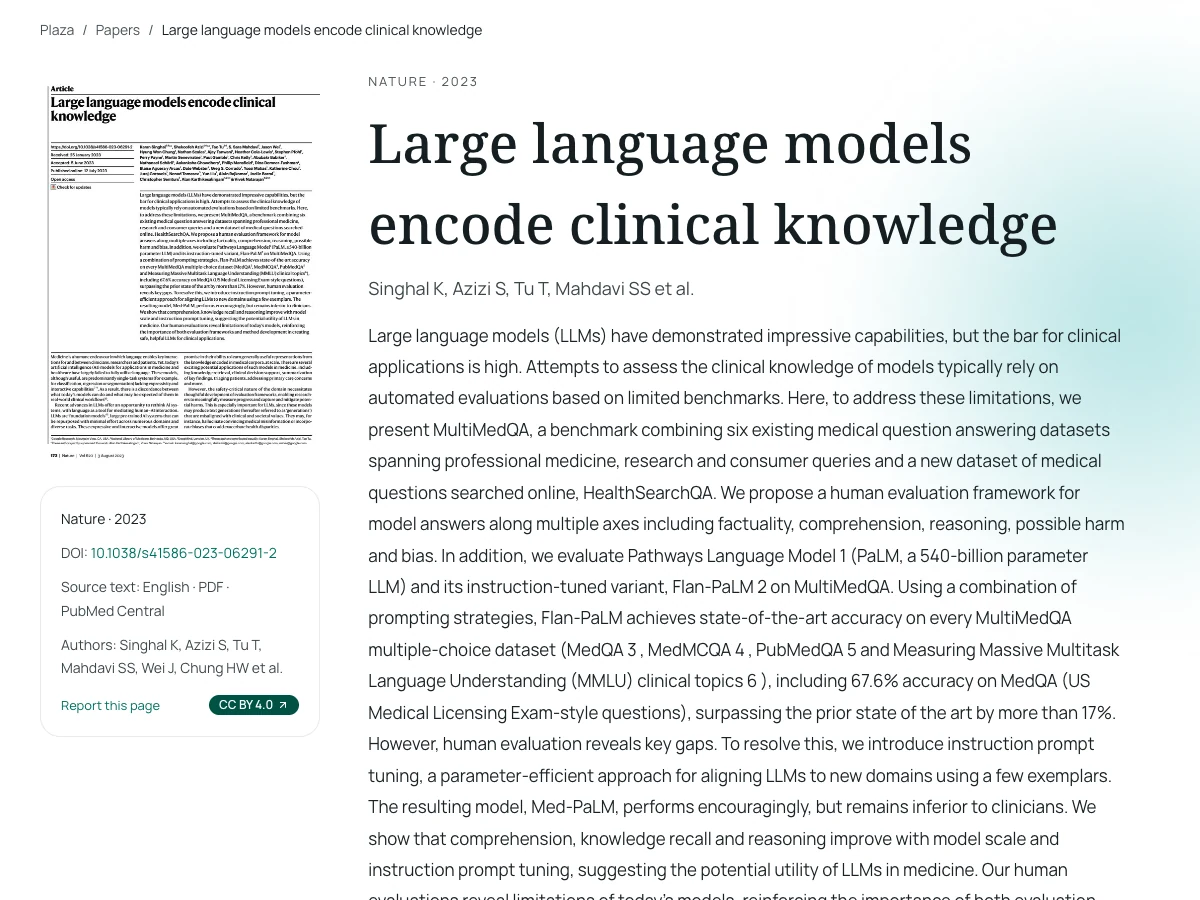
Equalang Plaza collects public-domain books and permissively licensed open-access papers (CC BY, CC BY-SA, CC0) sourced from Europe PMC, PubMed Central, OpenAlex, and arXiv. You can search in any language by title, author, or DOI—for instance, looking up the Nature clinical AI paper Large language models encode clinical knowledge (10.1038/s41586-023-06291-2, CC BY 4.0) or the Nucleic Acids Research paper AlphaFold Protein Structure Database in 2024 (10.1093/nar/gkad1011, CC BY 4.0).
Once you sign in to your Equalang account, the workflow is straightforward:
- 0-credit original reading and download: Read or download the original English PDF on Plaza for free (0 credits).
- Free 20% side-by-side preview: Open any available translation and sample the first 20% of the paper for free, with the original and translation displayed side by side and synchronized scrolling so you can cross-check methods and terminology.
- 1/10-credit full bilingual download: Download the complete translated edition for 1/10 of the standard translation credit cost (rounded up and displayed on the page). Every PDF purchase includes two downloadable files: a layout-preserved translated PDF (keeping multi-column structure, figures, tables, and captions intact) and a page-by-page alternating bilingual PDF for side-by-side tablet or print review.
- Request or translate missing languages: If a Plaza paper does not yet have a translation in your target language, click Want this translation to register demand (high-demand works are prioritized), or click Translate now directly from the Plaza source file.
- Share eligible
CC BYpapers back to the Plaza: If you translate an unindexedCC BY,CC BY-SA, orCC0paper from Europe PMC or bioRxiv/medRxiv in our Document Translator, you can click Share to the plaza at the top of the workspace (up to 3 submissions per day, published after copyright verification). Each time another reader downloads your shared translation, you receive back 1/10 of the credits you spent on that translation, up to the full amount you originally paid.
Honest Boundaries: When to Use Private Document Translation Instead
Because Equalang Plaza strictly verifies open licenses, it enforces clear boundaries you should know before uploading:
- No
NC,ND, or paywalled papers on Plaza: If a bioRxiv or medRxiv preprint carries aCC BY-NC,CC BY-ND,CC BY-NC-ND, or all-rights-reserved license—or if a final journal article is closed-access—it cannot be listed or shared on Equalang Plaza. - Sign-in is required: You must sign in before downloading 0-credit originals or opening the 20% side-by-side preview.
- Private workflow for restricted papers: For preprints with
NC/NDrestrictions or institutional PDFs that you are only reading personally, translate them privately in Equalang Document Translation or connect your local reference library via the Equalang Zotero Plugin. If you upload a PDF that already has a translation on Plaza, the workspace will notify you automatically so you can grab the 1/10-credit Plaza edition instead of paying for a duplicate translation.
Frequently Asked Questions
Can I submit a clinical trial manuscript to bioRxiv?
No. bioRxiv screens out clinical trials and papers that inform direct clinical decision-making. Any manuscript reporting human interventional trials, clinical epidemiology, or public health outcomes should be submitted to medRxiv, where screeners verify ethics committee approval, informed consent statements, and clinical trial registration IDs.
How do I check if a bioRxiv or medRxiv preprint was later peer-reviewed and published?
Search the preprint's title or DOI on Europe PMC (https://europepmc.org/). When a bioRxiv or medRxiv preprint is subsequently published in a peer-reviewed journal indexed by PubMed or Europe PMC, Europe PMC automatically links both records and shows a notification banner pointing to the final journal version.
Can all bioRxiv and medRxiv preprints be shared on Equalang Plaza?
No. Only preprints and open-access articles released under permissive licenses that allow derivatives and redistribution—specifically CC BY, CC BY-SA, or CC0—can be hosted or shared on Equalang Plaza. Preprints where the author selected CC BY-NC, CC BY-ND, or all-rights-reserved can still be translated privately for personal reference in Equalang Document Translation, but they cannot be published to the public Plaza.
Sources
- bioRxiv Frequently Asked Questions & License Terms: https://www.biorxiv.org/about/FAQ
- medRxiv Submission Guidelines & Clinical Screening Requirements: https://www.medrxiv.org/submit-a-manuscript
- Europe PMC Preprints Documentation & Version Linking: https://europepmc.org/Preprints
- Europe PMC Open Access Subset & License Filtering Guide: https://europepmc.org/downloads/openaccess
- Nature Open-Access Article (Large language models encode clinical knowledge,
CC BY 4.0): https://doi.org/10.1038/s41586-023-06291-2 - Nucleic Acids Research Open-Access Article (AlphaFold Protein Structure Database in 2024,
CC BY 4.0): https://doi.org/10.1093/nar/gkad1011 - Equalang Plaza Official Rules & Open-Access Catalog: https://equalang.com/plaza