How to Get Real-Time Bilingual Subtitles on TRT Haber Live News
 Equalang
In brief
A step-by-step guide to TRT Haber’s 24-hour live news: Learn how to use the Equalang browser extension to translate Turkish news broadcasts into real-time bilingual subtitles.
Keywords: TRT Haber; Turkish live stream; real-time translation; bilingual subtitles; Equalang
As the flagship 24-hour national news channel under the Turkish Radio and Television Corporation (TRT), TRT Haber (trthaber.com) is a vital primary source for tracking geopolitical developments across the Black Sea, Mediterranean, and Middle East, diplomatic and economic updates from Ankara and Istanbul, and regional breaking news. Whether for international relations researchers, foreign trade professionals, or analysts monitoring breaking global events, TRT Haber's live web broadcast offers immense real-time value.
However, viewers watching TRT Haber live often face a formidable language barrier: the platform's web stream is broadcast entirely in Turkish, and the player itself provides no subtitle options. Turkish is a classic agglutinative language characterized by rapid speech, rich morphological suffixation, and a predominantly verb-final sentence structure. For non-native speakers, relying solely on listening is extremely challenging, while standard webpage translation tools are completely powerless when it comes to streaming video.
This article explains how to use the Equalang browser extension on TRT Haber's web live stream to enable real-time speech translation and display bilingual Turkish-to-Chinese subtitles side-by-side.
Objective Comparison of Existing Solutions and Their Use Cases
When dealing with national news broadcasts in less widely taught languages like TRT Haber, existing audiovisual aids each have distinct limitations:
- TRT Haber Native Web Player: Built on a broadcast-grade streaming architecture, it delivers smooth streaming and reliable video quality. However, the web stream offers no subtitle options or cross-lingual transcription, relying entirely on the viewer's own Turkish listening comprehension.
- Standard Webpage Translation Extensions: These can easily translate TRT Haber's text articles, column analyses, and navigation menus into Chinese, but under the hood, they only manipulate static text in the DOM tree. When facing audio and video streams delivered over HLS protocols, webpage translation extensions cannot access audio streams and remain completely ineffective inside the video player.
- Local Offline Transcription Models (e.g., self-hosted Whisper): These allow users to import recorded news audio files into a local environment for offline transcription and translation, making them well-suited for detailed post-broadcast reviews of long-form programs. However, running high-parameter transcription models locally demands significant hardware resources, and the offline slicing and transcription process introduces processing delays, making it impractical for breaking live news.
- Equalang Browser Extension: Tailored specifically for web playback environments, it enables real-time speech translation directly on the stream page and overlays bilingual subtitles on the video player without requiring video downloads or relying on native subtitle tracks.
Step-by-Step Guide to Enabling Live Bilingual Subtitles
The official TRT Haber live stream uses a customized player based on Video.js, streaming media segments over the public HLS protocol.
To enable bilingual subtitles, follow these steps:
- Open a desktop browser such as Chrome and navigate to the official TRT Haber live streaming page (trthaber.com/canli-yayin-izle.html).
- Click the Equalang extension icon in the browser toolbar or embedded within the playback area to open the control panel.
- Set the source language to "Turkish" and the target language to "Simplified Chinese", then turn on "Real-time Live Translation". Bilingual subtitles will immediately appear across the player interface.
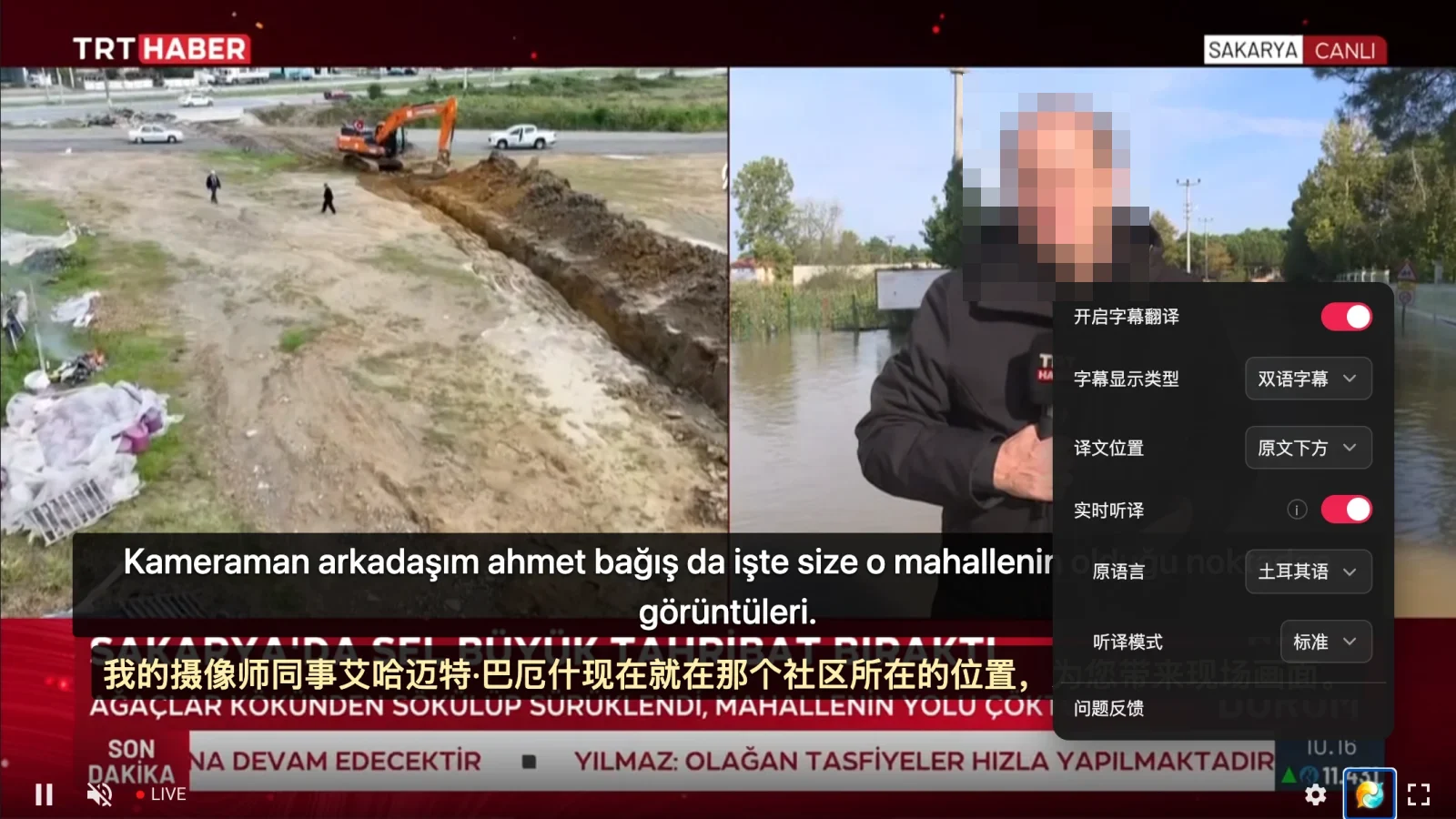
Once subtitles are enabled in the player, the original text and translation appear in a two-line bilingual layout. Given the linguistic characteristics of Turkish and the fast cadence of news broadcasting, keep the following considerations in mind:
- Waiting for complete sense units in agglutinative, verb-final sentences: Turkish builds meaning by attaching extensive suffixes for tense, person, voice, and case to root words, predominantly following a Subject-Object-Verb (SOV) sentence structure where the critical verb appears at the very end of the sentence. Streaming speech translation systems must receive the complete sense unit—including the sentence-ending verb—before generating a coherent, naturally aligned translation. Consequently, there is a natural pause while the semantic unit closes before the full translated line emerges, reflecting standard linguistic structural patterns.
- Locking the source language to Turkish: International news broadcasts frequently intersperse foreign personal names, places, and abbreviations (such as Turkish acronyms like BM for the UN, AB for the EU, or TCG for naval ship designations). Explicitly setting the source language to "Turkish" in the panel prevents automatic language detection from drifting due to foreign loanwords or abbreviations.
- Choosing your subtitle layout: Equalang allows toggling between "Bilingual Subtitles" and "Translation Only", as well as placing the translation either above or below the original text, letting viewers customize the display according to their reading preferences.
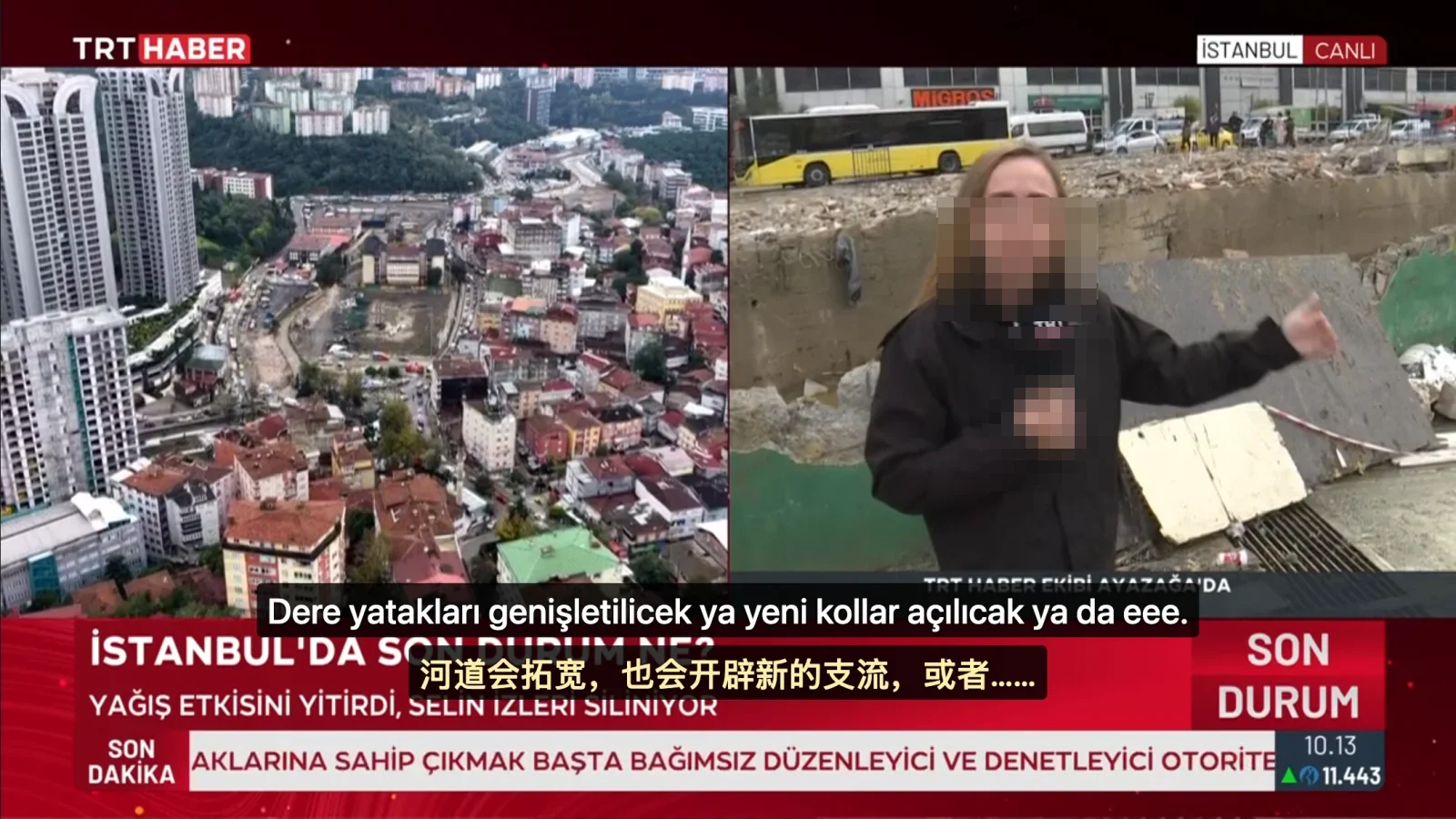
As shown in our live testing, when the Turkish reporter was reporting on the riverbed widening project, the system generated the corresponding translation in real time. Because breaking field reports often involve colloquial pronunciations (for example, the recognized words genişletilicek and açılıcak represent colloquial phonetic spellings), minor discrepancies may appear in transcription or transliteration; viewers can interpret these in context alongside on-screen visuals.
Objective Technical Boundaries and Usage Considerations
When using real-time speech translation in practice, several inherent physical and technical constraints should be noted:
- Complex Ambient Noise and Multi-Speaker Overlap: In stable environments such as studio anchor broadcasts or press conferences with single speakers, acoustic characteristics are clean, allowing transcription and translation to maintain high stability. However, during breaking outdoor reports, disaster relief scenes, or intense multi-guest debates with overlapping speech, background sirens, wind noise, ambient commotion, and overlapping voices can significantly disrupt spectral feature extraction. This may cause speech segments to miss words or misrecognize phrases, which is a common limitation across current acoustic signal processing technology.
- Digital Rights Management (DRM) vs. Public Streams: As an open public news stream, TRT Haber's current live broadcast is unencrypted. However, on commercial on-demand platforms protected by hardware-level Digital Rights Management (DRM) such as Widevine, decrypted audio/video streams are routed directly into hardware-protected media pipelines. Constrained by modern browser security standards and sandbox architectures, standard browser extensions cannot capture this decrypted audio for speech translation.
- Network Delivery and Cloud Processing: Watching international live streams involves pushing video from Turkish broadcast studios, caching and segmenting it via CDN nodes, and routing it to viewers' browsers worldwide—all subject to network latency and routing conditions. Furthermore, Equalang relies on cloud services, making a stable internet connection an essential prerequisite for smooth real-time simultaneous translation.
Sources
- TRT Haber Official Online Live Stream: https://www.trthaber.com/
- Equalang Browser Extension Official Homepage: https://equalang.com/extension
- Video.js Open Source HTML5 Player Project: https://videojs.com/