Struggling with Foreign Medical Reports? How to Accurately Translate Complex Lab Tables Without Data Shifts
 Equalang
In brief
A practical guide to translating overseas health checkups and medical records, showing how in-place table alignment preserves biochemical parameters and prevents misaligned lab values.
Keywords: foreign medical report translation, medical records translation, lab test table alignment, blood test reference intervals, cross-border healthcare documents

In recent years, an increasing number of patients and travelers have been going abroad for comprehensive medical checkups—such as precision cancer screenings in Japan—or seeking specialized treatment and second opinions across Europe, North America, and Asia.
Yet whether you receive a health assessment from an overseas diagnostic center or outpatient test panels from a foreign hospital, the result is often dozens of pages filled with unfamiliar medical terminology. These reports are densely packed with biochemical abbreviations (such as ALT, AST, HbA1c, and CRP), numerical ranges, and reference intervals. When language barriers get in the way, snapping a quick smartphone photo or pasting text into a generic translator often leads to a disorienting problem: row misalignment. A line for fasting blood glucose might shift under lipid markers, or a normal minor variance might be paired with the wrong baseline, making it appear critically abnormal. For patients and their families, these formatting errors can trigger immediate, unnecessary anxiety.
When translating clinical lab reports, the priority is not rhetorical flair—it is structural alignment. Parameter names, measured values, units, reference intervals, and diagnostic flags must stay strictly aligned in their respective rows and columns. Below, we break down why tabular medical documents frequently break in standard translation tools and examine practical workflows using a team-crafted medical report sample.
1. Why Standard Translation Tools Struggle with Medical Lab Panels
Compared to regular continuous text, medical lab sheets follow an exacting structural logic:
- Tight Grid Dependency: Every row forms a rigid five-part data structure:
[Test Parameter, Measured Value, Flag (+/- or H/L), Measurement Unit, Reference Interval]. If a translation engine cannot reconstruct table geometry, these cells get flattened into a single stream of disconnected text, severing values from their corresponding parameters. - Critical Diagnostic Symbols Get Dropped: Essential clinical markers (such as
+,-,±,Hfor high, andLfor low) are often stripped out during generic text cleanup as formatting noise, making it difficult to tell at a glance whether an index falls outside normal boundaries. - Compound Medical Terminology Requires Semantic Stability: Biochemical indicators, tumor markers, and cytology diagnoses require specialized medical vocabulary. General-purpose consumer models can produce literal translations that obscure the clinical meaning.
2. In-Place Table Preservation: Illustrative Translation of a Medical Report
When working with dense clinical grids, an effective document translation tool needs to parse the table structure cell by cell, translate the medical terms accurately, and write the layout back into the original document format. Below, we examine a team-crafted sample of a foreign health screening report translated using Equalang Document and Photo Translation.
1. Examining the Original Report Structure
Here is a typical team-crafted sample of a foreign medical checkup requisition and lab panel featuring multiple biochemical test items, units of measurement, reference ranges, and A/B determinations:
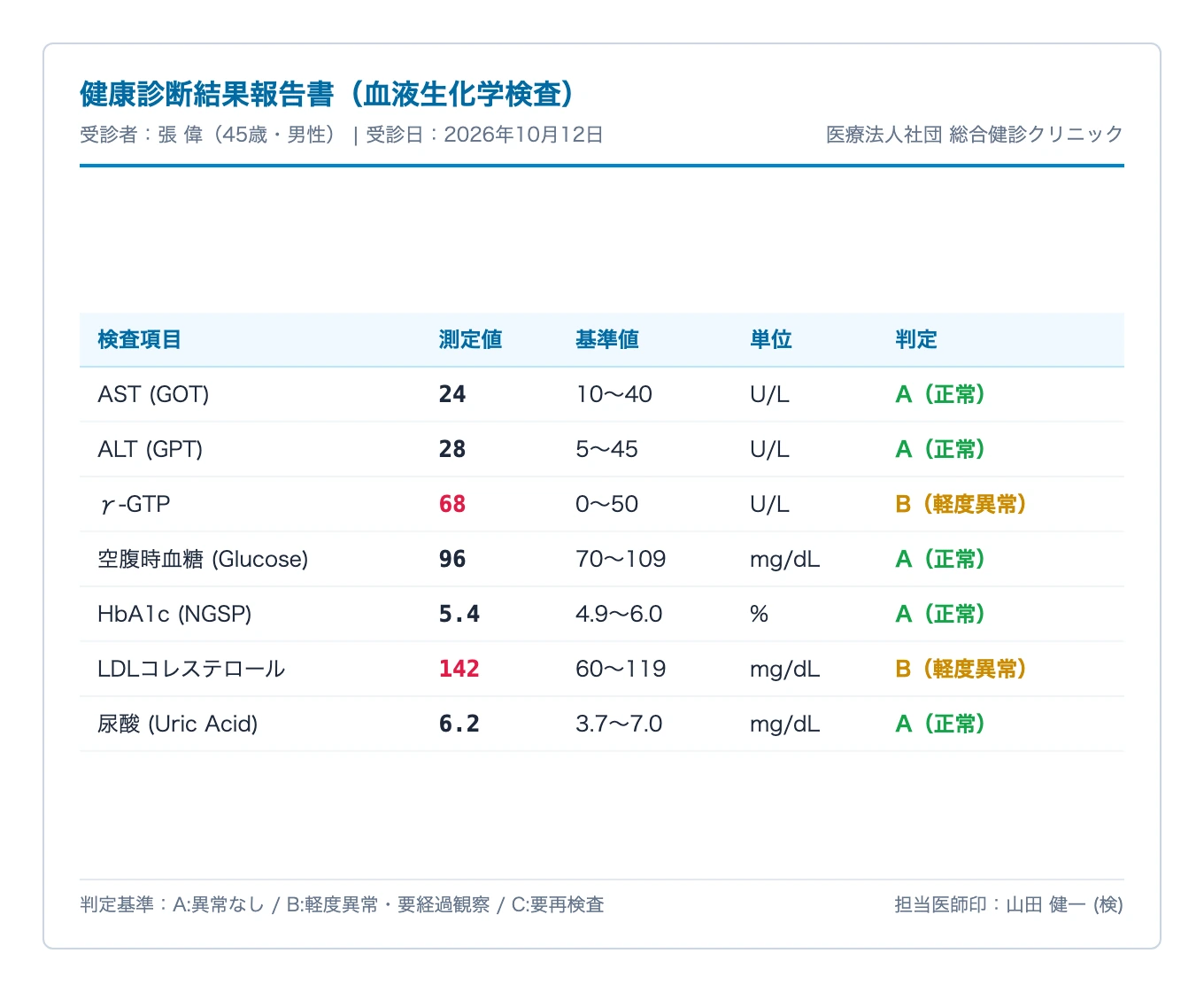
The sample organizes biochemical markers by physiological system, paired directly with numerical reference intervals and A/B determinations on the right.
2. Illustrative Equalang Translation
The image below illustrates the effect of layout-preserving document translation:
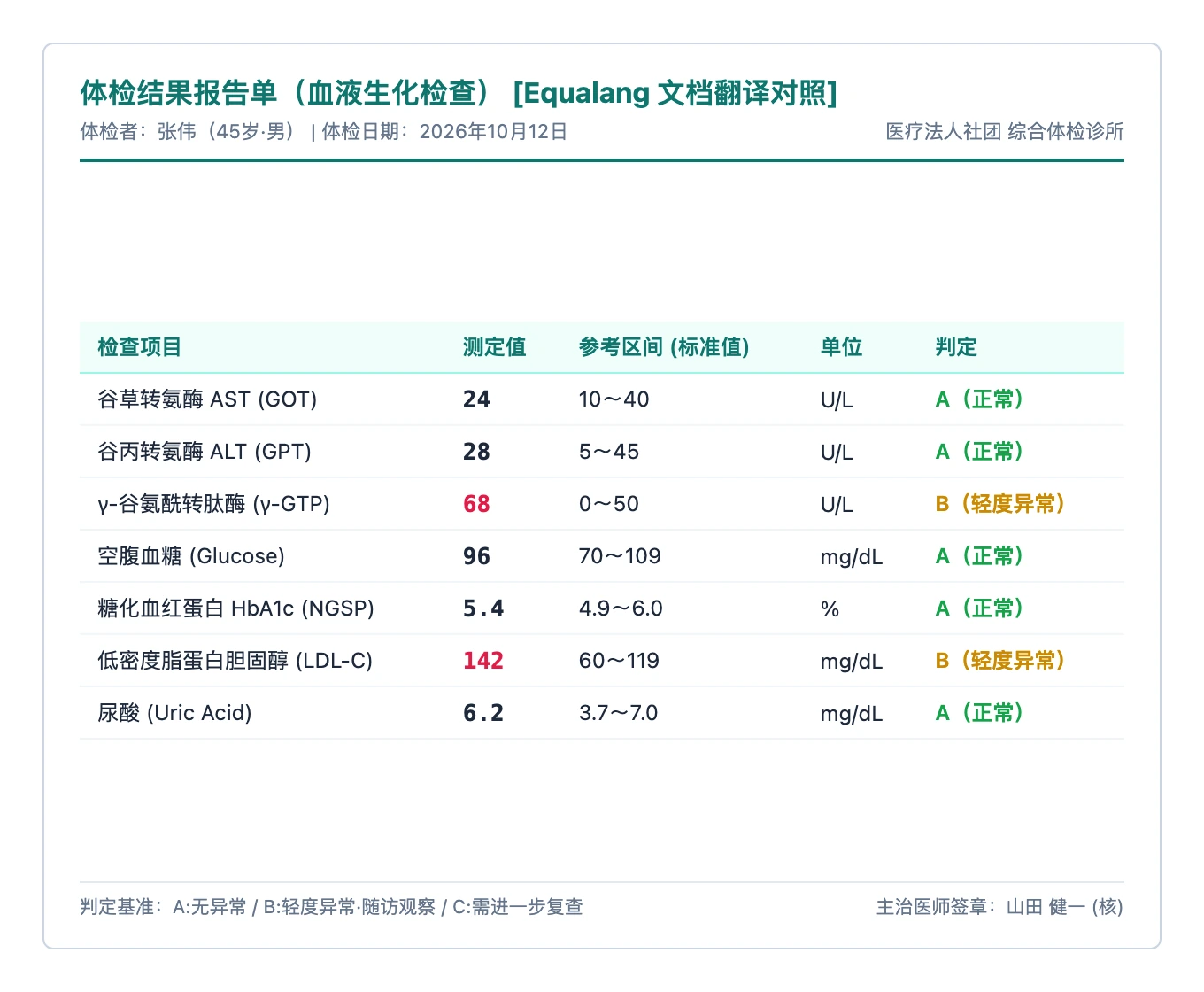
In the comparison illustration, three key points can be seen:
- Borders and Grid Layout Preserved In-Place: Each test parameter name, measurement, and reference interval remains locked inside its original cell, eliminating row shifts and vertical drift.
- Numbers and Units Left Intact: Numerical test values (such as concentrations, ratios, and percentages) and standard units (such as mg/dL, mmol/L, and U/L) are retained without distortion, preserving the objective clinical data.
- Determination Indicator Layout Kept Intact: A/B determination flags align cleanly with their corresponding rows, making diagnostic conclusions straightforward to read.
3. Comparing Translation Methods for Cross-Border Medical Records
4. Best Practices for Reviewing Overseas Medical Reports
When organizing and reading foreign medical reports, keeping the following steps in mind can help you navigate the information systematically:
- Review the Summary First, Then Check Flagged Items: Comprehensive health screening packages typically provide an "Overall Evaluation" or "Lifestyle Recommendations" section on the first few pages. Reviewing this summary gives you an overall picture of your health status before you inspect individual flagged parameters in the detailed lab tables.
- Account for Institutional Variations in Reference Ranges: Diagnostic equipment, reagent batches, and measurement units (such as blood glucose measured in
mmol/Lversusmg/dL) vary across countries and laboratories. Always interpret your values against the reference intervals printed on that specific report, rather than relying on baselines from your home country. - Always Consult the Attending Physician for Medical Decisions: Machine-translated documents help patients and families understand physiological parameters and bridge communication gaps. When it comes to formal diagnoses, prescription changes, or surgical plans, always submit the original foreign reports to a qualified clinician for professional medical guidance.
Sources
- Equalang Document and Photo Translation: https://equalang.com/documents
- National Library of Medicine Medical Subject Headings (MeSH): https://www.nlm.nih.gov/mesh/meshhome.html
- World Health Organization International Classification of Diseases (ICD-11): https://icd.who.int/en
- Ministry of Health, Labour and Welfare of Japan – Medical Guide for Foreigners: https://www.mhlw.go.jp/