How to Translate Cross-Border Contracts and NDAs Without Breaking Legal Layouts
 Equalang
In brief
A practical guide to translating cross-border commercial contracts, NDAs, and procurement agreements while preserving multi-tiered clause numbering, liability tables, and in-place table alignment.
Keywords: international contract translation, cross-border NDA translation, procurement agreement formatting, legal document layout preservation, bilingual contract alignment

In cross-border partnerships, global software procurement, and international supply chain operations, executing non-disclosure agreements (NDAs), supply confirmation orders, and master service agreements is essential to defining commercial terms.
Yet legal counsel and commercial teams frequently face a tough dilemma when reviewing foreign agreements: manual, line-by-line translation of a dense, multi-page legal agreement can take days. Conversely, running a Word or PDF file through generic machine translation tools almost always dismantles the document layout. Multi-tiered clause hierarchies collapse, liquidated damage formulas drift out of tables, and worst of all, the signature block at the end misaligns—making it easy to conflate party obligations and introducing serious compliance and performance risks.
The integrity of a legal contract depends not only on precise phrasing and qualifiers, but also on keeping clause hierarchies and liability tables strictly in place. Drawing on common structures found in cross-border agreements, this guide outlines how to translate commercial contracts efficiently while preserving their formatting and legal hierarchy.
1. Three Hidden Pitfalls in Cross-Border Contract Translation
Unlike standard business correspondence, commercial contracts carry strict legal consequences and rely heavily on document structure. During translation, three vulnerabilities emerge most frequently:
- Scrambled clause hierarchies: Commercial agreements typically rely on nested numbering structures, such as
Section 1.1 -> (a) -> (i). When a translation engine loses indentation or numbering levels, dependent conditions can easily be mistaken for standalone obligations, shifting the legal balance of responsibilities. - Misaligned itemized tables and specifications: Procurement agreements and order confirmations feature item names, technical specifications, quantities, unit prices, and tax-inclusive totals. If a table collapses into unstructured plain text, figures detach from their line items, quickly sparking reconciliation and payment disputes.
- Displaced signature and authorization blocks: Representative names, titles, corporate seal areas, and signing dates usually sit in parallel, side-by-side columns at the end of an agreement. When formatting breaks down, confirming authorization and managing legal archiving becomes unnecessarily fraught.
2. Layout-Preserving Translation in Practice: A Cross-Border Supply Agreement
Balancing translation speed with structural fidelity requires a tool built with precise document layout parsing. Below, we demonstrate how Equalang handles a sample international supply confirmation agreement in DOCX format.
1. Structure of the Original Agreement
Our test sample is a standard international supply confirmation agreement. It covers contracting parties, an itemized product list, delivery schedules, inspection standards, payment terms, and a closing sign-off:
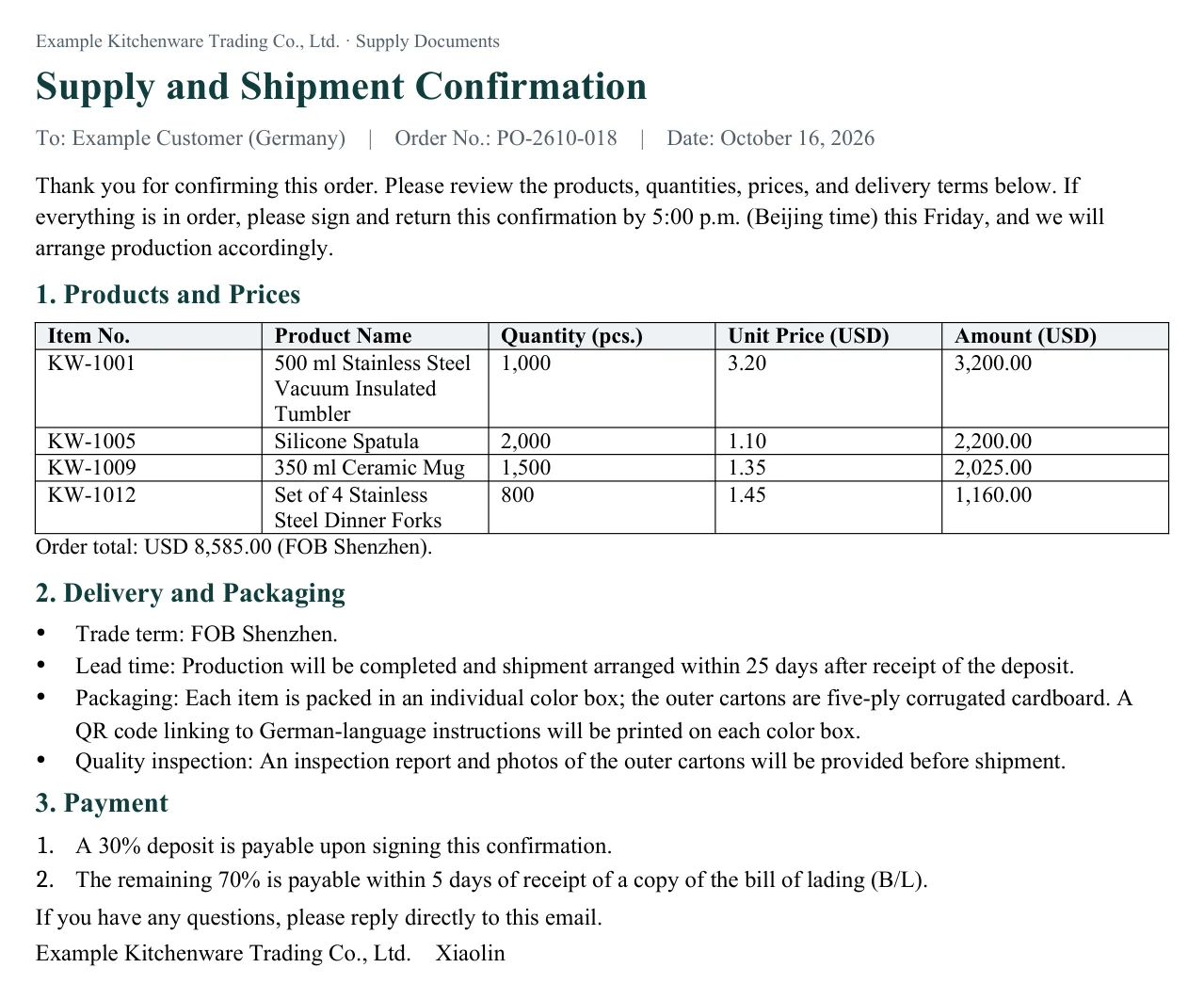
The original file combines narrative legal stipulations with a detailed four-row product table and a single-line closing sign-off at the end.
2. Translated Document Output via Equalang
After uploading the document to Equalang and selecting the source and target languages, the translated English agreement is generated within seconds:
Examining the translated output highlights key formatting and legal details:
- Table structure preserved: The table grid remains intact. Product models, quantities, unit prices, and total amounts still line up cleanly, but in the English translation, the item names for KW-1001 and KW-1012 wrap across three and two lines respectively, noticeably increasing row heights, and the Latin font is changed to Times New Roman.
- Clear clause structure and list numbering: Delivery schedules, inspection standards, and payment terms preserve their original paragraph spacing and bold emphasis.
- Closing sign-off preserved: The closing line "示例厨具贸易有限公司 小林 / Xiaolin" retains its original layout.
3. Comparison of Contract Review and Translation Approaches
4. Checklist for Reviewing International Commercial Agreements
Even with automated layout preservation, legal and commercial teams should conduct thorough due diligence before formal signing:
- Scrutinize legal qualifiers and operational terms:
Shall(mandatory obligation) vs.May(discretionary right).Indemnification: Verify the covered scope, triggers, and liability caps.Governing Law & Dispute Resolution: Confirm official legal naming conventions for jurisdictions, arbitration institutions, and venue clauses.
- Double-check currency symbols and decimal notation: Ensure currency notations (such as USD, EUR, or RMB) and numerical values align with regional conventions—especially when working with European formatting where commas often serve as decimal separators.
- Verify data privacy and confidentiality safeguards: When handling sensitive contracts and NDAs, confirm that the translation platform employs industry-standard transport encryption to safeguard confidential commercial data.
Sources
- Equalang Documents Translation: https://equalang.com/documents
- International Chamber of Commerce (ICC) Model Commercial Contracts: https://iccwbo.org/
- United Nations Convention on Contracts for the International Sale of Goods (CISG): https://uncitral.un.org/en/texts/salegoods/conventions/sale_of_goods/cisg
- International Bar Association (IBA) Cross-Border Transactions Guides: https://www.ibanet.org/