How to Read Official Letters in Germany: Bürgeramt, Tax Office, Health Insurance, and 25 Essential Terms
 Equalang
In brief
A practical guide for international professionals and students on decoding official German paper mail, managing four critical post-arrival letters, and understanding key bureaucratic terms.
Keywords: German official letters; Germany mail translation; Anmeldung Germany; Rundfunkbeitrag; Behördendeutsch guide
A few days after moving into an apartment in Berlin or Munich and taping your name to the mailbox (Briefkasten), you open it to find a stack of grey, white, or yellow window envelopes. Inside, there are no pleasantries—just dense paragraphs packed with compound German nouns twenty to thirty letters long: Beitragsservice, Steueridentifikationsnummer, Mitwirkungspflicht, Rechtsbehelfsbelehrung.
For newcomers in Germany, everyday conversational German is rarely the main source of stress. The real anxiety comes from not knowing whether the letter in your hand is merely an informational confirmation to file away, or a strict 14-day demand to submit missing documents or transfer money—where missing the deadline triggers late fees (Mahngebühr) or even jeopardizes your residence status.
Even as administrative digitization progresses across Germany, legally binding decisions (Bescheide), tax identifiers, and broadcasting fee demands still arrive almost exclusively as physical paper mail. The system assumes that every resident can read and understand administrative German (Behördendeutsch).
This guide breaks down the standardized layout of official German mail, maps out the four essential letters you are guaranteed to receive during your first few months, provides a glossary of 25 high-frequency bureaucratic terms, and outlines a clear three-step workflow from opening the envelope to attending in-person appointments.

1. Don't Reach for the Dictionary First: 5 Key Anchors on Official German Letters
Letters from the German Tax Office (Finanzamt), Citizen's Registration Office (Bürgeramt), Immigration Office (Ausländerbehörde), and statutory health insurers strictly follow the DIN 5008 standard business layout. Once you open the envelope, look for these five specific zones in order:
- Top-Right Information Block (Sender & Case Number):
Contains the case worker's name, phone extension, room number, and most importantly, the case or reference number (
Aktenzeichen, abbreviatedAz.). Whenever you call, reply, or wire money, officials need this reference number to locate your file. - Bold Subject Line (
Betreff: Nature of the Letter): Located just below your address and above the formal salutation. If you seeBestätigung(confirmation), you can usually verify the details and file it away. If you seeAnhörung(formal hearing before an adverse decision),Aufforderung(request to provide documents), orMahnung(payment reminder), you must respond within the stated timeframe. - Deadlines in the Body Text (
Frist: Due Date): Look forbis zum [Date](by [date]),innerhalb von 2 Wochen(within two weeks), orunverzüglich(without undue delay / immediately). In German administrative law, deadlines are calculated based on when the agency receives your submission, not the postmark date you sent it. - Amounts and Payment Details (
Zahlung: Payment or Refund): Phrases likeBitte überweisen Sie...(Please transfer...) orNachzahlung(additional payment/arrears) mean you must transfer funds before the deadline. Phrases likeGuthaben(credit balance) orErstattung(refund) indicate money returned to you. When sending a bank transfer, you must copy theVerwendungszweck(payment reference) into your online banking transfer memo exactly as printed. - Instructions on Legal Remedies (
Rechtsbehelfsbelehrung: Right to Appeal): A block of dense, small text at the end of the letter (typically stating that you can lodge an objection—Widerspruch—within one month) indicates that this letter is a formal administrative act (Bescheid). If you do not lodge a formal objection within that window, the decision becomes legally binding and final.
2. Four Letters You Will Definitely Receive in Your First Three Months
Once you complete your address registration (Anmeldung) at the Bürgeramt, automated inter-agency data sharing triggers the following four key letters:
3. 25 Essential German Bureaucratic Terms to Know
When reviewing official mail or filling out forms, these 25 administrative terms appear constantly. Keep this reference table handy:
4. Facing Lengthy German Mail or In-Person Appointments? A 3-Step Workflow
Staring at pages of bureaucratic German or sitting across from a formal counter clerk can feel daunting, but sharing uncensored photos in online expat groups poses serious privacy risks (leaking your address, IBAN, and tax ID). Instead, follow this structured three-step approach:
Step 1: Use Photo Translation on Paper Mail to Quickly Grasp Intent and Deadlines
When official letters arrive, typing long German words into a dictionary is slow and prone to errors—especially if you miss umlauts (ä, ö, ü, ß). In practice, the fastest workflow is photo translation: lay the letter flat and capture a clear image. An in-place layout translation overlays the translated text directly onto the corresponding sections of the original document, allowing you to instantly locate the sender, core demand, and payment deadlines.
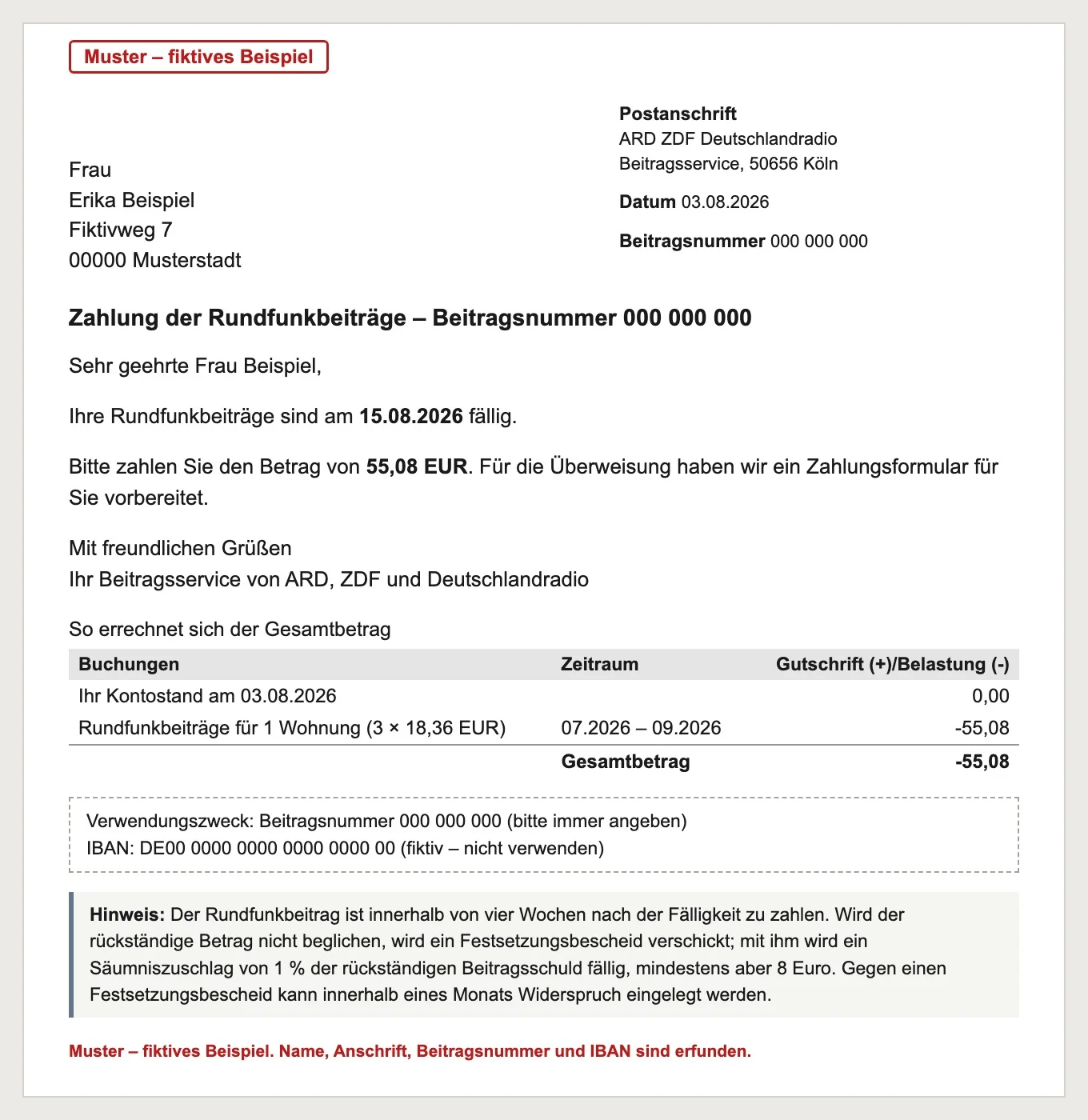
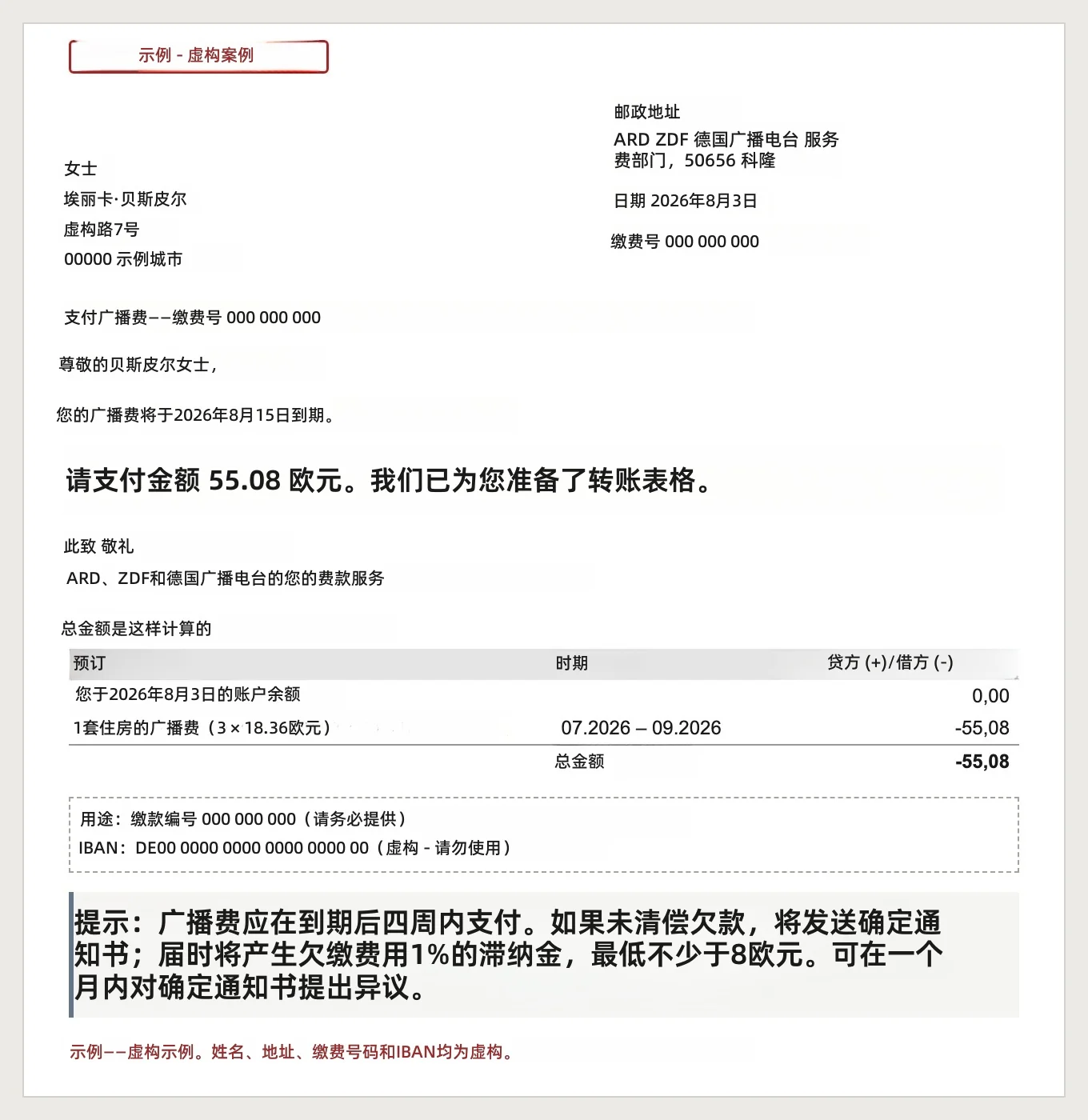
Take the most common letter received by newcomers—the payment demand from the German public broadcasting fee service (ARD ZDF Deutschlandradio Beitragsservice)—as an example, showing a comparison between a fictional sample created in the official format and the actual result of Equalang photo translation:
| Fictional Sample Created in the Official Format | Actual Result of Equalang Photo Translation |
|---|---|
 |  |
Comparing the fictional sample with the translation reveals several essential checkpoints:
- Top-right reference grid: Instantly spot the 9-digit fee account number (
Beitragsnummer: 000 000 000) and the due date (15.08.2026), preventing unnecessary penalty fees. - Itemized balance and bank transfer details: Clearly see the three-month quarterly charge of
€55.08(€18.36/month), locate the recipient IBAN at the bottom, and note the mandatory payment reference (Verwendungszweck: 000 000 000) required for automated clearing. - Notice (
Hinweis): Clarifies that the broadcasting fee must be paid within four weeks of the due date; if unpaid, an assessment notice (Festsetzungsbescheid) will be issued along with a late surcharge of 1% of the arrears (minimum €8), against which an objection can be lodged within one month.
[!TIP] Photo translation is designed to give you quick situational awareness. When handling bank accounts (IBANs), exact monetary sums, or 11-digit tax numbers, always cross-reference the original document digit by digit rather than copying numbers blindly from translated text.
Step 2: Reviewing Lengthy Digital PDFs (Leases, Insurance Terms)? Maintain Document Layout for Side-by-Side Comparison
Landlords, universities, and public utilities frequently send lengthy .pdf attachments via email—such as apartment handover protocols (Übergabeprotokoll), electricity contracts, or annual utility reconciliations. Copying and pasting text out of these documents destroys multi-column formatting and tables. Using document translation that preserves layout allows you to review the original German and the generated Chinese translation side by side, focusing closely on liability clauses, itemized charges, and notice periods.
Step 3: Visiting the Bürgeramt or Bank? Use Real-Time Split-Screen Conversation Tools
When registering an address at the Bürgeramt, recording fingerprints at the immigration office, or opening a bank account, German administrative law establishes German as the official language (Amtssprache ist Deutsch). Case workers are generally not obliged—and often hesitant—to switch to English. When unfamiliar vocabulary or complex queries arise, face-to-face split-screen translation tools bridge the gap.
Taking address registration (Anmeldung) at a Berlin Bürgeramt counter as an example, an illustrative split-screen dialogue is shown below:
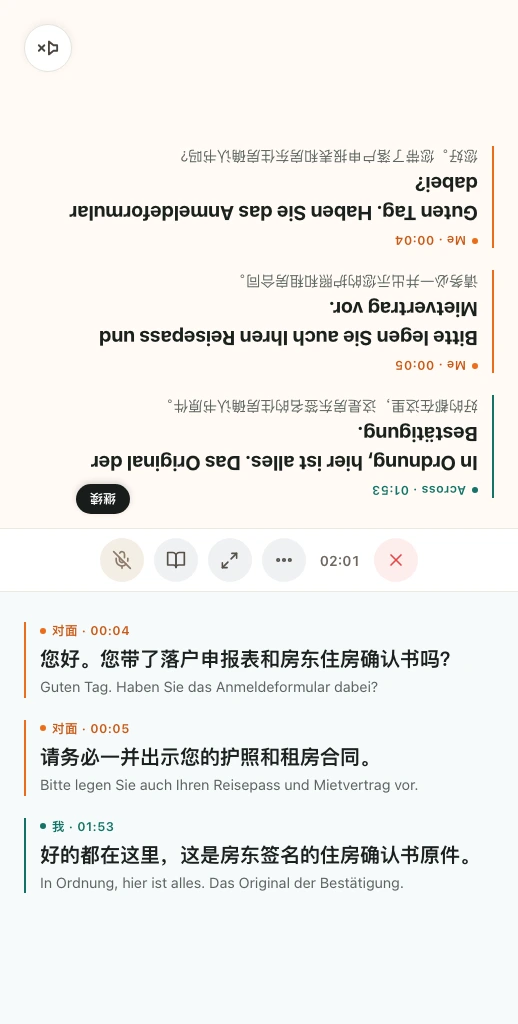
With the phone laid flat on the counter, each person speaks in their native language while bilingual text updates in real time. At quiet administrative desks, you can mute audio playback and read directly from the screen to avoid disrupting the room, leaving a clean written transcript to reference later.
Navigating German bureaucracy becomes manageable once you establish a reliable routine: open mail the day it arrives → identify the issuing body and notice type → extract the statutory deadline and reference number → wire payment or reply in writing within the window. Bookmark this guide and the 25 key terms for quick reference whenever a new envelope lands in your mailbox.
The translation screenshots in this guide were generated using Equalang.
Sources
- Make it in Germany (Official Portal of the Federal Government): Important steps after arrival / Registration (Anmeldung)
- Federal Central Tax Office (BZSt): Information on the Tax Identification Number (Steuer-ID)
- Der Rundfunkbeitrag: Multilingual information and exemption guidelines for shared flats